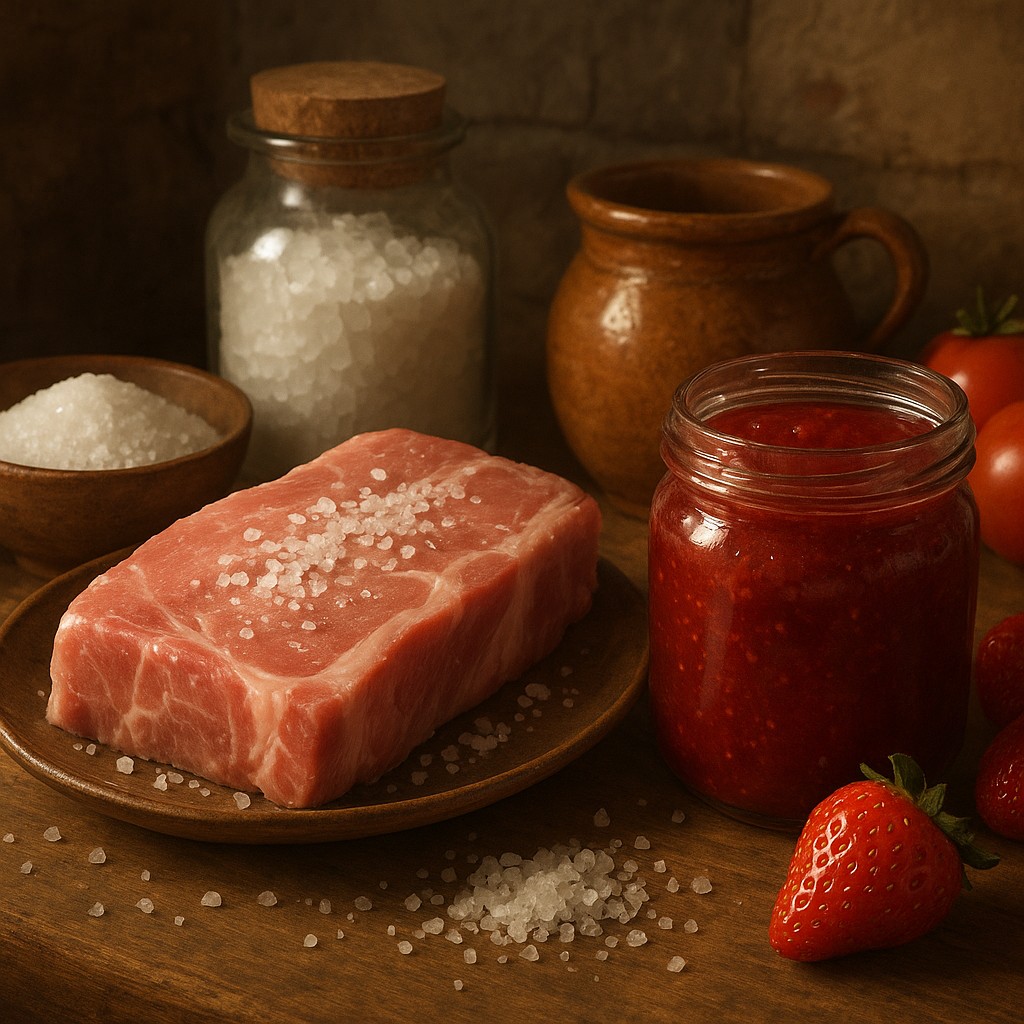
Imagine standing in a colonial-era pantry or a medieval cellar in the heat of summer. Long before the hum of the refrigerator or the invention of modern chemical preservatives, our ancestors kept meat, fruit, and vegetables edible for months. They did not have sterile labs or vacuum-sealed plastics, but they did have a deep, intuitive grasp of a microscopic battlefield. By rubbing a slab of pork with salt or boiling berries into a thick sugar syrup, they were fighting an invisible war, using the laws of physics as their primary weapon.
The "magic" here is not chemical toxicity in the usual sense. While we think of salt and sugar as flavor enhancers, in the world of microbiology, they act more like powerful vacuum cleaners. They work by controlling the movement of water, the most essential ingredient for life. By mastering the art of the "solute" (substances dissolved in a liquid), humans learned to create environments so harsh that even the toughest bacteria are physically paralyzed. To understand why a jar of strawberry jam stays fresh on the shelf while a fresh strawberry rots in days, we have to look at the microscopic tug-of-war known as osmosis.
The Microscopic Tug of War
At the heart of food preservation is a process called osmosis. It sounds like a dry topic from a high school biology book, but it is actually a relentless physical force. Osmosis is the movement of water through a semi-permeable membrane (a thin skin that lets some things pass but captures others). Water naturally moves from an area with a lot of "free" water to an area where there is less. Every living cell, whether it is a human muscle cell or a tiny bacterium landing on your lunch, is essentially a small bag of salty, sugary water wrapped in a thin membrane. This skin allows water to flow through but keeps vital proteins and DNA inside.
When you coat food in a high concentration of salt or sugar, you create what scientists call a "hypertonic" environment. Imagine a bacterial cell sitting on a piece of salted ham. Inside the bacteria, water and minerals are balanced. Outside, there is a mountain of salt. Because nature seeks a balance, the water inside the bacterial cell feels an overwhelming "urge" to leave the cell and dilute the salt on the outside. This is not a choice the bacteria makes; it is a physical certainty. The water rushes out of the microbe’s body, causing its internal pressure to collapse.
The Anatomy of Microbial Deflation
When a microbe loses its internal water, it undergoes a process called plasmolysis. Think of it like a balloon with a tiny, invisible leak. As the air (or in this case, water) leaves, the balloon becomes limp and wrinkled, eventually losing its shape entirely. For a bacterium, this is fatal. Water is the medium where all its internal chemistry happens. Without enough water, the enzymes that help the bacteria eat and grow stop working, and the cell’s internal machinery grinds to a halt. It becomes a shriveled, dormant husk, unable to multiply or release the toxins that cause food poisoning.
It is important to distinguish between "total water" and "water activity." You might look at a jar of honey and think it is "wet" because it is a liquid. However, honey has very low "water activity" because almost every water molecule in that jar is "busy" clinging to a sugar molecule. To a microbe, honey is a desert. There is no "free" water available for the microbe to drink or use for its biological functions. This is why archaeologists have found pots of honey in ancient Egyptian tombs that are thousands of years old and still technically edible. The sugar has effectively locked up the water, making it unreachable for the organisms that cause spoilage.
Comparing the Two Great Preservatives
While salt and sugar both draw water out of cells, they do so with different levels of strength and for different culinary reasons. Salt is easily the more powerful of the two. Because salt molecules (sodium chloride) are much smaller than sugar molecules (sucrose), a gram of salt contains many more individual particles than a gram of sugar. Since osmotic pressure depends on the number of particles in a solution rather than their size, salt packs a much harder punch. This is why you only need a small amount of salt to preserve meat, but you need a massive amount of sugar to preserve fruit.
| Feature |
Salt (Sodium Chloride) |
Sugar (Sucrose) |
| Efficiency |
Highly efficient; small molecules create high pressure. |
Less efficient; requires high concentrations. |
| Mechanism |
Pulls water out and can also damage enzymes. |
Pulls water out and creates a physical barrier. |
| Common Uses |
Curing meats, pickling vegetables, preserving fish. |
Jams, jellies, candied fruits, honey. |
| Impact on Flavor |
Intense saltiness; usually requires rinsing. |
Intense sweetness; becomes part of the dessert. |
| Target |
Effective against a wide range of bacteria. |
Works on bacteria; less effective against some molds. |
Beyond just pulling water out, salt has a second trick. The chloride ions in salt can be toxic to certain microbes by interfering with their enzymes. Sugar, on the other hand, does not usually kill microbes through toxicity; it simply creates such a high-pressure environment that they cannot function. This is why you might see mold growing on the surface of old jam but rarely see it on a salty piece of beef jerky. Some molds and yeasts are "osmophilic," meaning they are slightly better at surviving sugary, high-pressure environments than common bacteria are.
The Strategy of the Invisible Shield
The beauty of using osmotic pressure as a preservative is that it creates a product that can sit on a shelf without needing to kill every single microbe with heat. While canning uses high temperatures to sterilize food, curing and sugaring use what experts call "hurdle technology." This is the idea that if you create enough obstacles for a microbe, it simply cannot survive. The lack of water is the biggest hurdle. When you combine high osmotic pressure with other factors, like the acid in pickles or the cool temperature of a cellar, you create a multi-layered defense system that keeps food safe for a long time.
However, we must be careful not to confuse "inactive" with "dead." Osmosis is primarily a growth inhibitor. It puts microbes into a state of suspended animation. If you took a piece of salt-cured meat and soaked it in a large bucket of fresh water, you would dilute the salt and "rehydrate" the environment. If any hardy spores were still on the meat, they might wake up and start reproducing again. This is why food safety is a continuous process. Methods like salting and sugaring buy us time and safety by flipping the "off" switch on microbial life, but the environment must remain stable for the magic to last.
The Enduring Legacy of the Solute
Understanding the physics of the pantry changes how we look at our meals. The humble salt shaker and sugar bowl are not just for taste; they are some of the oldest biotechnologies in human history. They allow us to capture a harvest and stretch it through a lean winter, proving that sometimes the best way to fight a biological enemy is not with complex chemicals, but with the simple, elegant application of physical laws. By controlling the concentration of solutes, we turned the tiny world of bacteria into a desert, ensuring our own survival through the ages.
Next time you spread marmalade on your toast or enjoy a slice of savory prosciutto, take a moment to appreciate the silent, osmotic battle on your plate. You are participating in a tradition thousands of years old, using a sophisticated understanding of biology that existed long before the microscope. Science isn't just found in labs; it is found in the syrupy glisten of a candied cherry and the dry texture of a well-cured salami. Using these principles reminds us that we come from a long line of clever innovators who learned to work with the forces of nature to feed their communities.