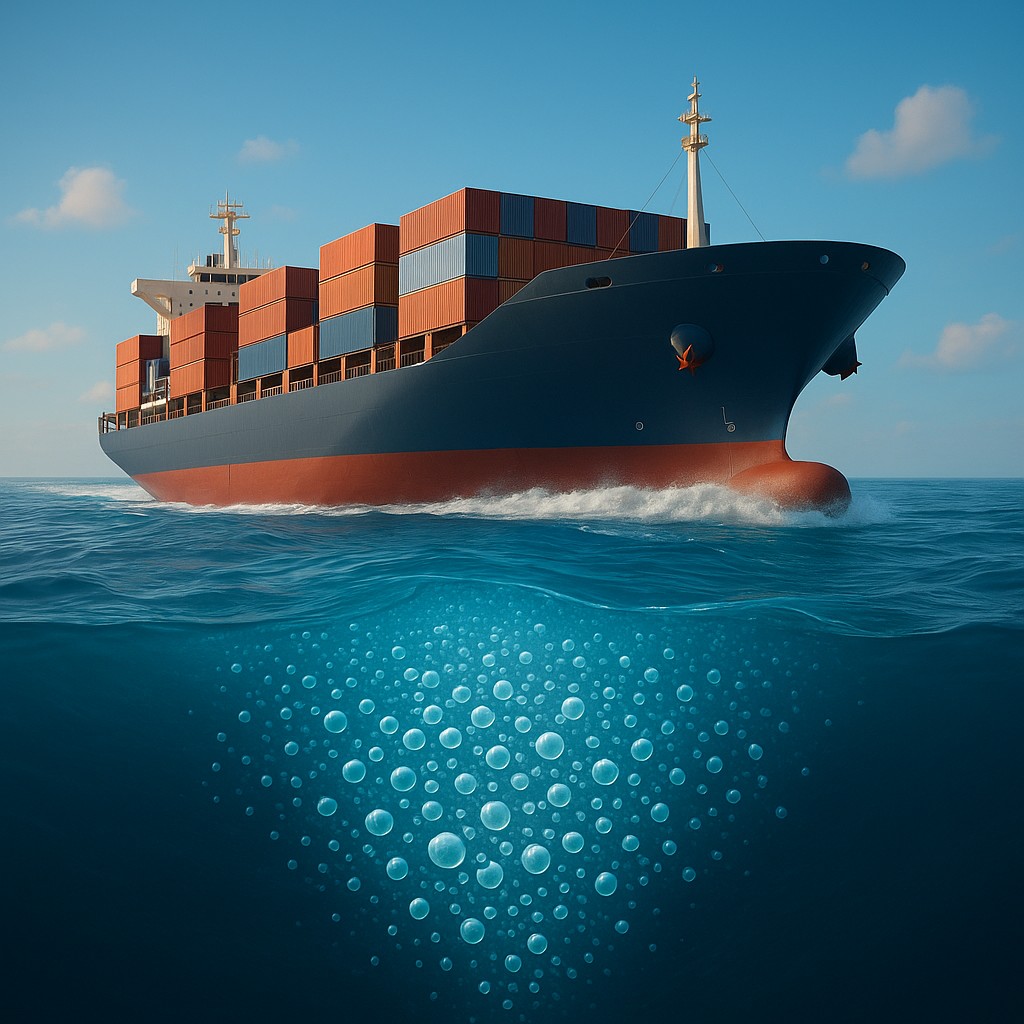
Imagine standing on the deck of a massive cargo ship. It is a steel giant weighing hundreds of thousands of tons, carrying everything from your morning coffee beans to the smartphone in your pocket. As this behemoth plows through the ocean, it feels like an unstoppable force, yet it is locked in a constant, invisible wrestling match with the water. We often imagine the ocean as a fluid that parts easily for a sharp bow, but at the scale of a 300-meter vessel, water acts less like a liquid and more like a thick, syrupy glue. This "stickiness" is the main reason international shipping consumes millions of barrels of fuel every day, as engines work overtime just to peel the hull away from the water’s stubborn grip.
For decades, ship designers focused on making hulls pointier or engines more powerful, but the real revolution is happening right where the steel meets the sea. Engineers have realized that if you cannot change the nature of the ocean, you can change how the ship touches it. By spreading a constant, shimmering carpet of microscopic air bubbles under the flat bottom of the vessel, shipping companies are essentially teaching these giants how to skate. This technology, known as air lubrication, turns the hull from a high-friction surface into a slippery air cushion. It allows massive ships to glide with a fraction of the effort they used to need. It is a simple solution to a multi-billion dollar problem, turning a blunt tool of trade into a precision-engineered hover-vessel.
The Invisible Anchor of Sticky Drag
To understand why bubbles are so revolutionary, we first have to look at the physics holding the ship back. When a ship moves, it faces two main types of resistance: wave-making resistance and viscous drag. Wave-making resistance is exactly what it sounds like, the energy spent pushing water out of the way to create those white crests at the front. However, for large, slower vessels like oil tankers and bulk carriers, the real culprit is viscous drag. This is caused by the "no-slip condition," a rule in fluid physics where the layer of water touching the hull actually sticks to the steel, moving at the exact same speed as the ship.
This sticky layer of water pulls on the next layer, and so on, creating a thick "boundary layer" of swirling liquid that the ship has to drag along. It is like trying to run through a pool while wearing a suit made of heavy, wet wool. Water molecules bond to the tiny imperfections in the ship’s paint, creating a constant backwards tug. Because air is roughly 800 times lighter than water and much less "sticky," adding it to this boundary layer changes everything. By replacing some of that heavy water with a thin film of air, the ship’s surface contact with the water decreases, and friction drops significantly.
Engineering the Perfect Micro-Bubble Carpet
You might think that simply pumping air under a boat would do the trick, but if the bubbles are too large or poorly spread, they just float up the sides and disappear. The secret to a successful air lubrication system lies in "micro-bubbles." These bubbles are usually about 0.5 to 3 millimeters wide, small enough to stay trapped under the hull for as long as possible. The system uses a series of air release units, which are specialized nozzles or wing-like structures tucked into the forward section of the ship's flat bottom. These units blow a steady stream of compressed air that fans out to cover the entire underside of the vessel.
The goal is to move from "bubble lubrication" to a state called "air layer lubrication." In a perfect world, the air would form a solid, continuous sheet, like a layer of ice for the ship to slide on. In the chaotic open ocean, however, the system creates a dense, frothy mixture. This foam acts as a buffer, preventing turbulent swirls in the water from ever touching the steel plates. For the system to stay efficient, the air pressure must be exact. If the pressure is too low, the weight of the ocean will crush the air vents; if it is too high, the system wastes more energy running the air compressors than it saves in fuel.
The Delicate Dance of Water and Air
One of the greatest challenges in using this technology is making sure the air carpet stays where it belongs. Ships are rarely stable; they tilt and roll in the waves, and they travel at different speeds. If the air bubbles escape from under the hull and reach the ship’s propellers, it can cause a problem called cavitation. Propellers are designed to bite into dense, heavy water. If they suddenly start spinning through a mix of water and air, they lose their "grip," causing the engine to spin too fast and creating vibrations that can damage the ship's machinery.
To prevent this, engineers use computer models to place the air vents in "sweet spots." They also design the hull with small ridges or "fences" that act like side-skirts on a race car, corralling the bubbles and keeping them centered under the ship. The flow of water itself helps hold the bubbles in place, as the ship's speed creates pressure that keeps the air trapped against the hull. The table below shows how different ship types benefit from this technology based on their design and speed.
| Ship Type |
Suitability |
Main Benefit |
Operational Challenge |
| Bulk Carriers |
High |
Large flat bottoms allow for a stable, wide air carpet. |
Keeping the bubble layer stable at different weights. |
| LNG Tankers |
High |
Consistent speeds and flat hulls maximize friction reduction. |
Fitting the system around complex cooling equipment. |
| Cruise Ships |
Moderate |
Less vibration and noise improves comfort for passengers. |
Complex hull shapes can let air "leak" out the sides. |
| Container Ships |
Moderate |
Big fuel savings on long routes across the Pacific or Atlantic. |
High speeds can "wash away" the air layer too quickly. |
The Reality of Efficiency Gains
While a 10 percent reduction in fuel might sound small, in global shipping, it is a total game-changer. A single large container ship can burn over 200 tons of heavy fuel oil per day. Cutting that by 10 percent means saving 20 tons of fuel every 24 hours. Over a 20-day voyage across the Pacific, that is 400 tons of fuel saved on just one leg of the trip. When you multiply that by the thousands of large ships traveling the globe, the environmental and financial impact is massive. This isn't just about saving money; it is about meeting strict international carbon emission standards.
The beauty of air lubrication is that it is a highly efficient trade-off. While it takes power to run the compressors, that power use is usually less than a quarter of the total energy saved by reducing drag. It is one of the few technologies where "spending" a little energy creates a massive gain for the whole system. Additionally, the air carpet has an unexpected bonus: it acts as a silencer. Modern ships are incredibly loud, and that noise can disrupt whales and other marine life. The carpet of bubbles helps scatter sound waves from the engine and hull, making the ship quieter and friendlier to the ocean's inhabitants.
Navigating the Future of Maritime Travel
The move toward air lubrication represents a shift in how we think about industrial efficiency. We are moving away from brute force and toward the clever use of physics. We are no longer satisfied with just building bigger engines; we are now looking at the microscopic space where man-made materials meet the natural world. This technology is often added to existing ships, proving that even the oldest vessels in the fleet can be upgraded. As sensors become more sensitive and AI begins to control the air flow in real-time, these systems will become even more effective, adjusting the "bubble density" second-by-second to match the waves.
The next time you see a freighter on the horizon, remember that it might not be pushing through the water as much as it is floating on a cloud. This transition to "skating" across the ocean is a testament to human ingenuity. By simply putting a few million bubbles in the right place at the right time, we are making the world’s supply chains faster, cleaner, and quieter. It is a reminder that sometimes, the best way to move forward isn't to push harder, but to find a way to let go of the friction holding us back.