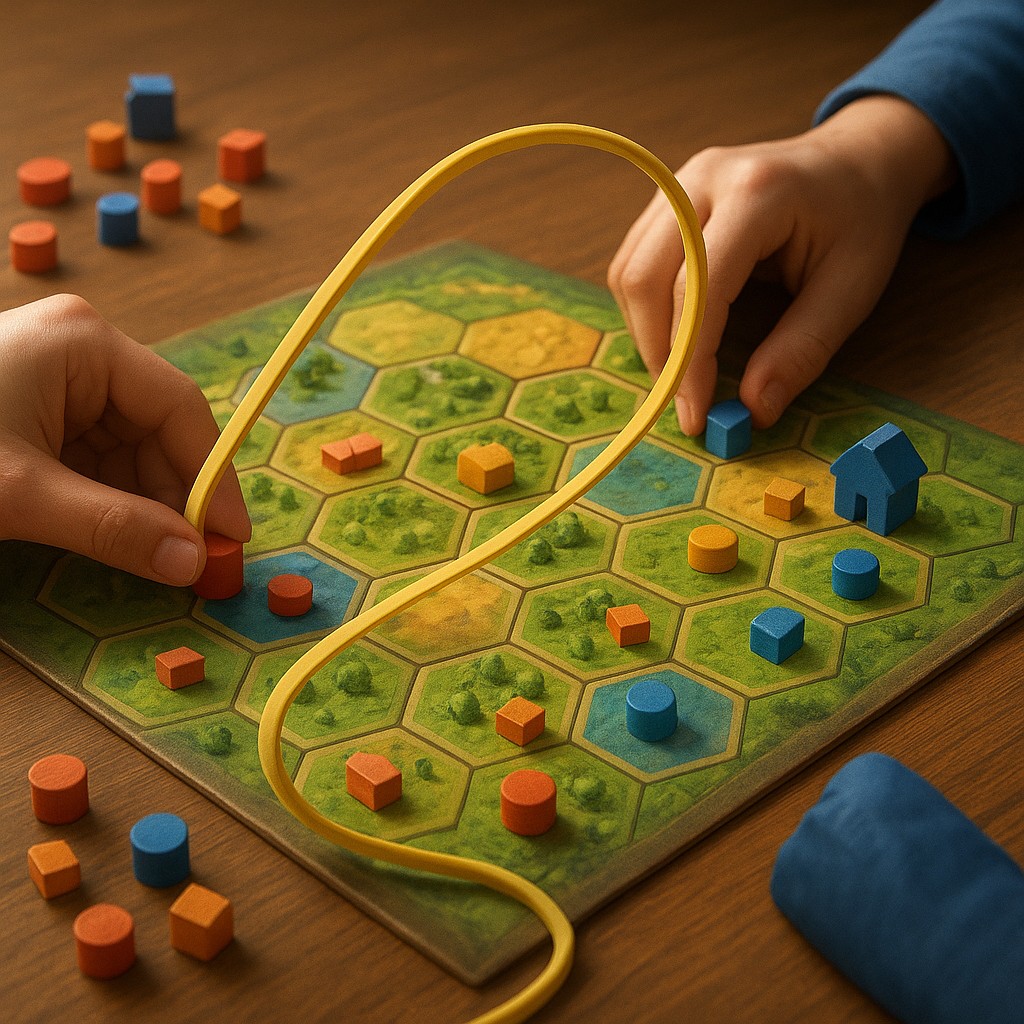
Imagine sitting down for a marathon session of a complex strategy game, the kind with thick cardboard tiles and hundreds of wooden tokens. You spend the first thirty minutes meticulously planning your economy, only to have a single unlucky roll or a clever move by your opponent send you spiraling into debt. By the one-hour mark, your friend is an unstoppable force, amassing wealth and power at an incredible rate. Meanwhile, you are effectively a spectator, trapped in a "death spiral" where you have no hope of winning but are socially obligated to keep playing for another two hours. This is the dreaded "runaway leader" problem, a design flaw that can turn a fun evening into a slow-motion lesson in hopelessness.
To solve this, game designers look to the physics of tension and elasticity. They implement systems known as "rubber banding," named after the way a stretched band pulls two distant points back toward one another. In the world of board games, rubber banding acts as a corrective force that helps the person in last place or places heavy anchors on the leader. It is the invisible hand that ensures the final turn of the game is just as tense as the first, keeping every player engaged and believing that victory is still within reach.
The Architecture of the Negative Feedback Loop
In the language of systems engineering, rubber banding is a "negative feedback loop." While the term "negative" sounds pessimistic, it actually refers to a stabilizing force that counters change. In a positive feedback loop, success breeds more success: you win a battle, get more gold, buy more soldiers, and win even more easily next time. This is the "snowball effect." A negative feedback loop does the opposite; it pushes back against momentum. If you are doing too well, the system finds a way to slow you down. If you are struggling, the system provides a boost to help you regain your footing.
This structure is essential because humans are biologically wired to enjoy "flow," a state of perfect challenge where a task is neither too easy nor too hard. When a game becomes a blowout, the leader gets bored because the challenge has vanished, and the loser gets frustrated because the goal has become impossible. By narrowing the gap between the first and last player, designers maintain the "tension of uncertainty." This uncertainty is what fuels engagement. If we already know who is going to win forty minutes before the game ends, finishing the match becomes a chore rather than entertainment.
Tools for Lifting the Underdog
There are several ways a designer can give the person at the back of the pack a helping hand without making it feel like obvious charity. One of the most common methods is "turn order advantage." In many modern strategy games, the player currently in last place on the victory track gets the first pick of resources or actions in the following round. This gives them the "best of the best" before the leader can touch it. It turns a deficit into a strategic asset, allowing the trailing player to grab the exact tool they need to stage a comeback.
Another subtle method is the "scaling cost of victory." In these systems, expanding your empire or gaining points becomes much more expensive the further ahead you are. Perhaps the first three cities you build cost five gold each, but the tenth city costs fifty. Meanwhile, the player with only one city might receive a "pioneer bonus" from the bank. This ensures that the leader’s economy is constantly strained by the weight of their own success, while the trailing player enjoys a lean, efficient path toward growth. This creates a natural rhythm where the leader eventually hits a ceiling, allowing others to catch up.
Balancing the Elasticity of Competition
The following table illustrates the most common ways designers implement these "pull factors" and how they look in the game experience. Each method has a specific goal: to turn a player's disadvantage into a different kind of operational advantage.
| Mechanic Type |
How It Works |
Psychological Impact |
| Resource Subsidies |
Players at the back receive "pity" resources or extra actions per turn. |
Reduces frustration by giving the player more options despite losing. |
| Catch-up Tracks |
A secondary board provides rewards only to those behind a certain point threshold. |
Creates a mini-game where staying slightly behind triggers powerful bonuses. |
| Targeted AI |
Computer-controlled enemies focus their aggression primarily on the leader. |
Relieves pressure on the underdog while challenging the frontrunner. |
| Hidden Scoring |
Large chunks of points are kept secret or awarded at the very end for specific feats. |
Maintains hope by keeping the true standing of every player a mystery. |
The Danger of Making Skill Irrelevant
While rubber banding is a vital tool for keeping a group engaged, it is a double-edged sword that requires careful tuning. If the mechanism is too strong, it can lead to "blue shell syndrome," a term from the Mario Kart video game series. In that game, the person in last place often receives a guided missile that automatically hits the person in first place. If this happens too frequently or right at the finish line, the leader might feel that their superior skill was completely erased by a random gift given to an opponent.
In board games, over-tuned rubber banding can lead to a strategy called "sandbagging." This happens when players realize that being in first place during the middle of the game is actually a disadvantage. If the rewards for being in last place are too generous, smart players will intentionally play poorly or hold back their best moves until the final moments to avoid being targeted by the game's corrective systems. When the best way to play a game is to pretend you are losing, the logic of the competition breaks down. A well-designed game must reward skill above all else, using rubber banding only as a safety net to prevent a player from becoming irrelevant, not as a springboard that leaps over the leader effortlessly.
The Social Contract and Kingmaking
Beyond the math of the game, rubber banding serves a deep social purpose. Board games are, at their core, a way for people to connect. They are excuses to sit around a table and interact. When one person is getting crushed, the mood in the room shifts. This often leads to the "kingmaking" problem. Kingmaking occurs when a player who has no chance of winning becomes the one who decides who does win. If a player feels they have been treated unfairly by the game, they might use their final turns to spitefully ruin the leader's chances, choosing a winner based on a whim rather than the rules.
Effective rubber banding minimizes kingmaking by keeping everyone's "win condition" alive. If a player believes they have even a five percent chance of winning through a clever comeback, they will continue to play their best. This keeps the game honest. By providing a boost to the trailing player, the designer is essentially buying that player’s continued interest in the outcome. It turns a potential "spoiler" back into a legitimate competitor, preserving the integrity of the game and the mood of the party.
Timing is the Ultimate Strategy
The most sophisticated form of rubber banding doesn't just give out free resources; it shifts the focus of the game from simple efficiency to "timing the surge." In these games, the winner isn't the person who leads the most laps, but the person who crosses the finish line first. This distinction is subtle but profound. It requires players to manage their position relative to the rest of the group. You might deliberately stay in second or third place, harvesting underdog bonuses and staying out of the spotlight, only to unleash a massive burst of energy in the final two rounds.
This adds a layer of psychological depth to the experience. You are no longer just playing against the board; you are playing against the "elasticity" of the game itself. You are asking, "When is the right moment to snap the rubber band?" If you surge too early, the game will pull you back. If you surge too late, you won't have enough time to overtake the leader. This pacing turns a standard strategy game into a tense thriller where the leaderboard is a fluid landscape rather than a fixed hierarchy.
Understanding the invisible physics of rubber banding changes how you look at every competition. It reveals that games are not just sets of rules, but carefully balanced ecosystems designed to manage human emotion and attention. The next time you find yourself in last place and receive a sudden windfall, or the next time the cost of your victory rises as you approach the finish line, take a moment to appreciate the design at work. It is the designer’s way of ensuring the journey remains challenging for the winner and hopeful for the loser. It keeps the heartbeat of the game alive until the very last card is played. Embrace the pull, manage your surge, and remember that in a well-designed world, it is never truly over until it’s over.