If you have ever stood by a campfire or watched a gas stove click to life, you have seen how humans have used fire for thousands of years. This process is called deflagration, and it is a relatively polite way for fuel to burn. The flame moves through the air at speeds slower than sound, leisurely eating up the energy in front of it. For over a century, our most advanced rockets have worked this way. We pump fuel into a chamber, light it, and let the expanding gases push the rocket toward the stars. It is a reliable method, but from a physics perspective, it is surprisingly slow and somewhat wasteful.
Now, imagine a process so violent and rapid that it does not just burn; it shatters the air around it. This is the world of detonation. Here, a combustion wave moves faster than the speed of sound, creating a high-pressure shockwave that squeezes every possible drop of energy out of the fuel. For decades, engineers saw detonation as an enemy, a destructive force that would rip an engine apart. Today, however, a new generation of aerospace startups and agencies like NASA are trying to tame this explosion. By trapping a supersonic shockwave inside a circular track, they are creating the Rotating Detonation Engine (RDE). This device could finally break the efficiency limits of modern rocketry and change how we reach deep space.
The Physical Limits of Modern Rocketry
To understand why the Rotating Detonation Engine is such a big deal, we first have to look at the engines we use today. Current rocket engines run on what engineers call a "Constant Pressure" cycle. In these systems, fuel and oxygen are mixed and burned at a steady pressure inside a large chamber. While these engines are masterpieces of engineering, they have reached a point where we can no longer make them much better. We have spent sixty years squeezing every bit of performance out of them, and we are now hitting a wall built by the laws of physics.
The main problem is that in a standard burn, the pressure stays roughly the same throughout the process. This limits the "work" the gas can do as it shoots out of the nozzle. Imagine pushing a car with a steady, gentle hand. You can move it, but you are limited by the force you can consistently apply. Now imagine hitting that car with a massive, high-speed sledgehammer. The instant pressure is much higher, and the potential to move the object is vastly increased. Standard engines are the gentle hand; detonation is the sledgehammer.
By switching from a steady burn to a detonation, we use a different physical process called the Humphrey cycle. Because detonation involves "Constant Volume" combustion, it creates much higher pressure and temperature almost instantly. This allows an engine to produce more thrust while using significantly less fuel. In space travel, every extra pound of fuel means one less pound for scientific tools or food. A 10 to 15 percent jump in efficiency is not just an improvement; it is a revolution.
Surfing the Supersonic Circle
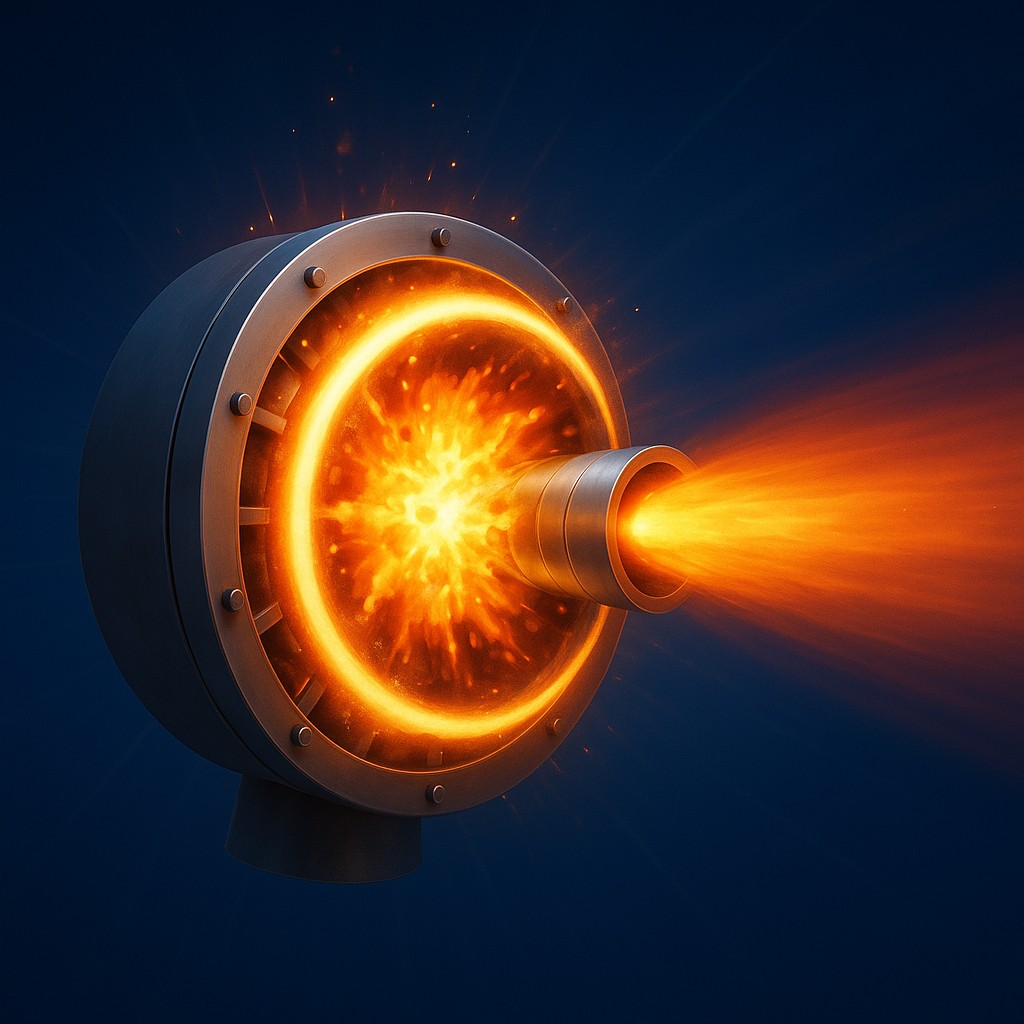
How do you keep a supersonic explosion going without blowing up the entire machine? The secret is in the shape of the engine. Unlike a traditional hollow chamber, a Rotating Detonation Engine uses an "annulus," which is just a fancy word for a ring-shaped channel. Fuel and oxygen are injected into this thin, circular gap. When the engine starts, a shockwave begins to race around the ring. This wave is not just a flame; it is a wall of pressure moving at several times the speed of sound.
As this wave circles the channel, it consumes the fresh fuel being pumped in just ahead of it. The magic happens because the wave sustains itself. The high pressure of the shockwave actually crushes the incoming fuel before lighting it, doing the work of a heavy compressor without needing any moving parts. After the wave passes a point, a new mixture of fuel is sprayed in, ready for the wave to hit it again on its next lap. This happens thousands of times every second, creating a continuous, high-pressure blast.
This process is essentially a controlled, nonstop explosion that "surfs" around the engine. It creates a distinct, high-pitched scream, a sound completely different from the low roar of a standard rocket. Because the burning happens so fast and at such high pressure, the engine can be much smaller and lighter than a traditional one while producing the same amount of power. Saving weight on the engine while also saving fuel creates a snowball effect that makes the entire spacecraft far more capable.
Comparing the Old Guard and the New Wave
When we compare these two ways of traveling through the stars, the differences show up in more than just looks. They handle the physics of energy release in completely different ways.
| Feature |
Traditional Rocket Engine (Deflagration) |
Rotating Detonation Engine (Detonation) |
| Flame Speed |
Subsonic (slower than sound) |
Supersonic (faster than sound) |
| Physics Cycle |
Brayton Cycle (Constant Pressure) |
Humphrey Cycle (Constant Volume) |
| Efficiency Potential |
High, but near its physical limit |
Extremely high (10-25% better) |
| Complexity |
High (needs heavy pumps and turbines) |
Moderate (fewer parts, but harder to stabilize) |
| Pressure Build-up |
Steady and controlled |
Rapid and explosive |
| Main Engineering Hurdles |
Heat management and weight |
Vibration and structural strength |
Taming the Mechanical Earthquake
If Rotating Detonation Engines are so much better, why haven't we used them since the moon landings? The answer is the sheer violence of the process. In a traditional engine, the gas flows relatively smoothly. In an RDE, you have a supersonic shockwave slamming into the walls of the engine thousands of times per second. This creates intense vibrations that can literally shake a metal engine into dust or cause it to "unzip" along its seams.
Engineers call these "unsteady loads." Imagine a person jumping up and down on a bridge at exactly the right speed to make the whole structure wobble. Now imagine that person is a supersonic shockwave and the bridge is a red-hot rocket nozzle. If the timing of the waves isn't perfect, or if the metal cannot handle the rapid pulsing of pressure, the engine will fail. Controlling these vibrations requires incredibly fast sensors and computer models that can predict how the gas will behave in millionths of a second.
Then there is the heat. Because the detonation wave is so intense, the heat stress on the engine walls is much higher than in a steady burn. We are seeing breakthroughs here thanks to 3D printing and advanced materials. New metals and "regenerative cooling" (where cold rocket fuel is pumped through the engine walls to cool them before being burned) are helping keep the engine from melting. Recent tests by NASA have successfully fired these engines for hundreds of seconds, proving that we are finally learning how to hold the tiger by the tail.
The Path to Deep Space and Beyond
Perfecting this technology does more than just make rockets a bit cheaper. Because RDEs are smaller and more efficient, they could be the key to "single stage" vehicles that reach orbit more easily or powerful engines for trips to Mars. When traveling such long distances, every gram of fuel saved is a gram you can use for oxygen, water, or to bring samples back to Earth. The Rotating Detonation Engine makes every other technology we send into space more effective.
Beyond rockets, the industry is looking at this technology for jet engines and power plants on the ground. A more efficient jet engine could drastically cut the carbon footprint of flying, while detonation-based power plants could generate electricity with much less waste. We are standing at the edge of the first major leap in engine physics in nearly a century. We are moving away from the "slow burn" of the industrial age and into the "high-speed shock" of the future.
As we improve the sensors and materials needed to keep these engines together, the dream of easier space travel becomes a mathematical certainty. The roar of the next generation of rockets won't just be the sound of fire; it will be the sound of a supersonic wave circling a track, pushing humanity further into the dark than ever before. It is a reminder that in science, even the most "destructive" forces can provide the energy we need to move forward. We are finally learning to ride the explosion, and the view from the top is going to be spectacular.