Imagine a massive steel fortress, longer than three football fields and weighing hundreds of thousands of tons, trying to sprint through a thick pool of molasses. That is essentially what every container ship, oil tanker, and cruise liner faces every day on the open ocean. Water might feel soft when you dive into a pool, but at the scale of a commercial vessel, it becomes a viscous, clinging wall. This resistance, known as skin friction, is the primary reason the shipping industry burns nearly 300 million tons of fuel annually. It takes incredible brute force to push a metal hull through such a dense medium, and for decades, the only solution was to build bigger engines or burn more oil.
Fortunately, we are witnessing a quiet revolution beneath the waves, one that uses nothing more complex than the air we breathe to solve this age-old physics problem. By creating a literal "carpet" of bubbles between the steel hull and the water, maritime engineers have found a way to trick physics, letting ships glide rather than grind. This technology, known as air lubrication, is no longer just a laboratory dream or a small-scale experiment. It is currently being deployed in international trials across the globe, proving that we can make the giants of the sea more efficient, more profitable, and significantly kinder to the planet.
Breaking the Grip of Viscous Resistance
To understand why bubbles are so revolutionary, we first have to understand the enemy: drag. When a ship moves, the water molecules directly touching the hull try to stick to the steel. This creates a thin layer of turbulent water that moves along with the ship, pulling against the rest of the ocean. This "viscous resistance" can account for up to 80 percent of the total drag a cargo ship encounters. It is like trying to slide a heavy wooden box across a sandpaper floor. No matter how hard you push, the textures of the two surfaces fight one another, generating heat and wasting energy.
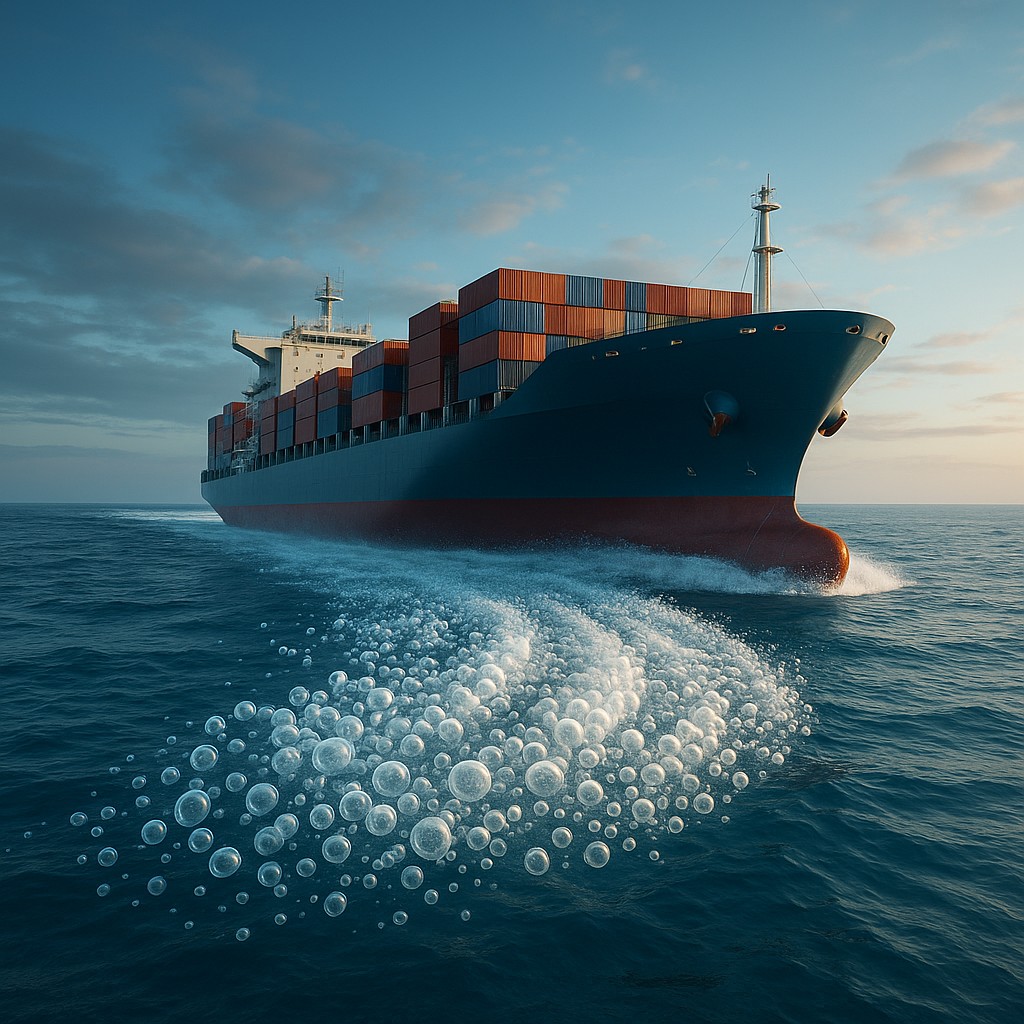
Air lubrication systems (ALS) change the texture of that surface entirely. By injecting a steady stream of air through specialized release units at the bottom of the hull, the system creates a mixture of air and water. Since air is about 830 times less dense than water, this mixture is much thinner and easier to move through. The sandpaper floor is effectively replaced with a layer of ball bearings. As the ship moves forward, it no longer fights the heavy grip of the water; instead, it "slides" over a pressurized cushion of air. This simple change in fluid dynamics at the boundary layer - the area where water meets the hull - can reduce overall resistance by a staggering margin, allowing the ship to maintain speed with much less effort from the engine.
The Engineering Magic of the Air Release Unit
While blowing bubbles sounds simple enough for a bathtub, doing it at the scale of a 400-meter ship in the middle of the North Atlantic is a feat of precision engineering. The system consists of three main parts: high-efficiency air compressors, a network of piping, and the "secret sauce" known as Air Release Units (ARUs). These ARUs are not just holes in the bottom of the boat; they are carefully designed nozzles or "wing" structures that ensure the air is dispersed into millions of uniform, microscopic bubbles. If the bubbles are too large, they simply float up the sides of the ship and escape too quickly. If they are the right size, they stay trapped beneath the flat bottom of the hull for as long as possible.
The magic happens when these bubbles create a "stable air carpet." The goal is to keep the air layer attached to the hull throughout the entire length of the vessel. Modern systems use automated sensors to monitor the ship's speed, the roughness of the sea, and how deep the vessel sits in the water. The onboard computers then adjust the output of the compressors in real time. If the ship hits a heavy swell, the system pumps more air to maintain the carpet; if the ship slows down, it eases back to save energy. This automation makes the technology viable for commercial use, ensuring that the energy spent running the compressors never outweighs the energy saved by reducing friction.
Comparing Traditional Hulls with Air Lubricated Vessels
It is helpful to see how these systems stack up against traditional methods of improving efficiency, such as specialized hull coatings or streamlined bow designs. While every measure helps, air lubrication offers a unique "active" advantage that physical shapes cannot match on their own.
| Feature |
Standard Steel Hull |
Optimized Hydrodynamic Hull |
Air Lubrication System (ALS) |
| Primary Resistance |
High skin friction and drag |
Improved flow, moderate friction |
Significantly reduced viscous drag |
| Operational Flexibility |
Static performance |
Fixed to specific speed ranges |
Adjustable via compressor control |
| Environmental Impact |
High fuel burn and emissions |
Moderate reduction |
Net fuel savings of 5% to 10% |
| Maintenance Needs |
Frequent cleaning of marine growth |
Special anti-fouling coatings |
Bubbles may reduce barnacle growth |
| Retrofit Potential |
N/A |
Difficult and expensive |
High (can be added to existing ships) |
Balancing the Energy Equation
One common misconception about air lubrication is that it provides a "free lunch" in terms of energy. In reality, it takes a significant amount of electricity to power the massive compressors that shove air down to the bottom of a ship. Remember, the deeper the ship sits in the water, the higher the water pressure. The compressors have to work against that pressure to get the air out of the nozzles. Therefore, the real measure of success for a maritime air lubrication system is the "net saving." If the system reduces the main engine's fuel consumption by 12 percent but requires 4 percent of the ship's total energy to run the compressors, the net saving is 8 percent.
While 8 percent might seem modest, in the world of global shipping, it is a monumental victory. A single large container ship can spend tens of thousands of dollars on fuel every single day. An 8 percent reduction translates to millions of dollars in savings over a year. Furthermore, as international regulations on carbon emissions become stricter, these percentage points are the difference between a ship being legally allowed to operate or being forced into early retirement. The "bubble carpet" also has an accidental side benefit: it acts as a sound dampener, reducing the underwater noise pollution that disturbs whales and other marine life.
From Microbubbles to Ocean Giants
The types of vessels currently trialing air lubrication are diverse, proving that the technology is not just for one specific niche. We see it on massive "bulkers" that carry iron ore and grain, where the flat, wide bottoms of the ships provide the perfect surface for a long-lasting air carpet. We also see it on liquid natural gas (LNG) carriers and even luxury cruise ships. In fact, some of the most successful trials have occurred on cruise liners, where the desire for a smooth, quiet ride for passengers aligns perfectly with the vibration-reducing qualities of the air layer.
There is also a fascinating "synergy" when air lubrication is combined with other green technologies. For example, some ships are being fitted with giant mechanical sails or rotors to harness wind power. When you combine wind propulsion with an air-lubricated hull, the efficiency gains start to stack up. The less friction the hull has, the more effective the "free" energy from the wind becomes. We are moving toward a future where a ship is no longer just a metal box with a motor, but an intelligent system that manages air, water, and wind to move goods with surgical precision.
Debunking the Myths of the Bubbly Hull
Whenever a "miracle" technology emerges in a traditional industry, skepticism follows. One common myth is that the bubbles will interfere with the propeller’s ability to "grip" the water, leading to a loss of power. While it is true that air hitting a propeller can cause cavitation - the formation of vapor bubbles that can erode metal - engineers have solved this by carefully placing the air release units. The air is typically released far enough forward that the bubbles dissipate or move outward before they reach the propeller at the rear. Furthermore, modern sensors ensure that the air flow is cut or redirected if the ship’s maneuvers put the propeller at risk of "breathing" too much air.
Another misconception is that the bubbles will wear away the hull's paint or encourage rust. In reality, the system uses standard atmospheric air, and it only touches the hull for a short time as the bubbles sweep from front to back. Some studies even suggest that the constant movement of air and water across the hull makes it harder for marine organisms like barnacles and algae to catch a ride, potentially keeping the hull cleaner for longer. This "self-cleaning" effect further reduces drag, as a hull covered in shellfish is a nightmare for fuel efficiency.
The Future of the Frictionless Sea
As we look toward the 2030s and 2040s, the maritime industry is under immense pressure to cut carbon emissions. Air lubrication is standing out as one of the most practical "ready now" solutions because it does not require a total redesign of how we build ships. It can be retrofitted onto existing vessels during their scheduled maintenance, allowing the current global fleet to become greener without waiting 25 years for a new generation of ships. The automation of these systems is the final piece of the puzzle, removing the need for crew members to constantly adjust valves and allowing the ship to optimize its own efficiency.
The sight of a massive vessel leaving a trail of shimmering white bubbles in its wake is becoming a symbol of a smarter approach to global trade. Our lives are supported by the goods carried on these ships, and seeing them adapt to 21st-century challenges is both comforting and exciting. By mastering the microscopic world of bubbles and the physics of the boundary layer, we are proving that even the heaviest objects on Earth can be taught to dance across the water.
This journey into air lubrication reminds us that sometimes the most profound solutions are hidden in the simplest places. We did not need an exotic fuel or a sci-fi engine to make ships 10 percent more efficient; we just needed to look at the space between steel and water and realize that a little bit of air could change everything. As you think about the vast oceans, imagine thousands of ships currently gliding on carpets of air, silently saving fuel and protecting the environment, one bubble at a time. The next time you see a ship on the horizon, remember that its secret to success might just be the invisible cushion beneath its feet, turning the heavy resistance of the sea into a graceful glide toward the future.