For decades, the war against malaria has been a grueling game of biological whack-a-mole. We spray insecticides, only for mosquitoes to evolve resistance. We hand out bed nets, only for the insects to start biting earlier in the evening while people are still active. We develop drugs, only for the Plasmodium parasite to find a way to survive the treatment. Despite our best efforts, malaria remains one of history’s most prolific killers, claiming hundreds of thousands of lives every year - mostly children in sub-Saharan Africa. The problem is not just the disease itself, but the delivery system: the Anopheles mosquito, a creature that has spent millions of years perfecting the art of survival.
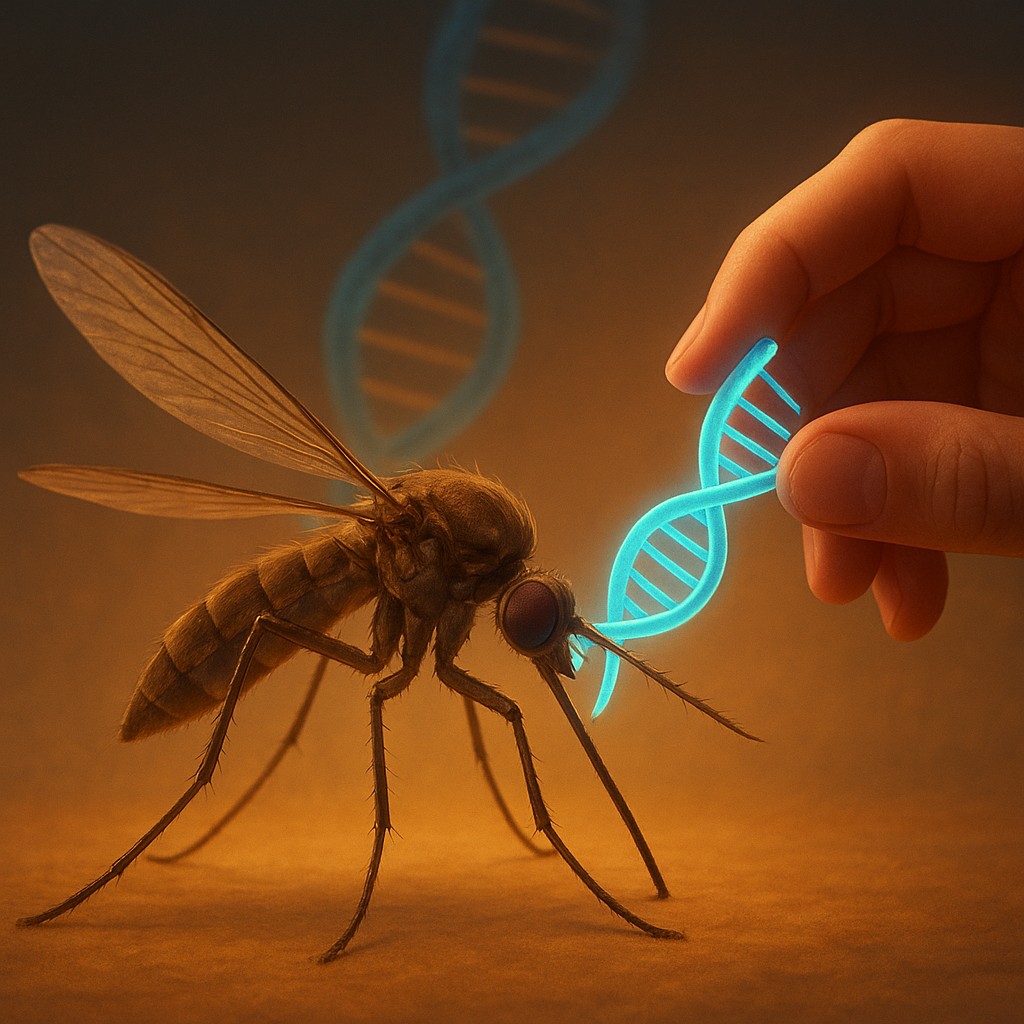
But what if we could change the rules of biology from the inside out? Scientists are no longer just looking for ways to kill individual mosquitoes or treat patients. Instead, they are treating the genetic code of entire species as a programmable interface. By using a technology called a "gene drive," public health agencies are exploring ways to push specific traits through a wild population at a speed that ignores the usual laws of inheritance. This is not just a better pesticide; it is a fundamental shift in how humans interact with nature, moving from managing the environment to editing it. It is a bold and scientifically brilliant attempt to solve a global health crisis by rewriting the future of a species.
The Mathematical Cheat Code of Genetics
To understand why a gene drive is such a radical departure from nature, we first have to look at how traits are usually passed down. In the standard model of genetics, known as Mendelian inheritance, every offspring is a coin toss. You get 50 percent of your DNA from your mother and 50 percent from your father. If a scientist modifies a single mosquito in a lab to be resistant to malaria and that mosquito mates with a wild partner, only half of their offspring will carry that new trait. In the wild, that 50 percent chance usually means the lab-grown trait will eventually disappear, especially if the change makes the mosquito slightly less "fit" or likely to survive than its wild cousins.
A gene drive acts like a "search and replace" function that works in real time inside the organism’s own cells. It does more than just wait to be passed on; it actively copies itself. Instead of a 50 percent chance of passing on a trait, a gene drive ensures nearly a 100 percent chance. It does this by carrying the instructions for CRISPR-Cas9 - a molecular "scissors" tool used for gene editing - directly inside the mosquito's DNA. When a gene drive mosquito mates with a wild one, the CRISPR machinery in the resulting embryo finds the "normal" chromosome from the wild parent, cuts it, and uses the engineered chromosome as a template to repair the gap. The result is an insect with two copies of the modified gene, ensuring that every single one of its own future offspring will also carry the drive.
This creates a massive explosion of a specific trait through a population. In a normal scenario, a new trait might stay at a frequency of 1 percent for generations. With a gene drive, that 1 percent can become 100 percent in just a few dozen generations. For an insect like a mosquito, which reproduces every few weeks, an entire local population could be fundamentally changed in a single season. We are effectively overriding "survival of the fittest" and replacing it with "survival of the engineered."
From Malaria Resistance to Population Collapse
Scientists intend to use this "inheritance engine" to fight disease in two primary ways. The first is often called "population replacement." In this scenario, the gene drive carries a payload that makes the mosquito's gut a hostile environment for the malaria parasite. The mosquito still lives and bites people, but it can no longer act as a biological shuttle for the disease. If the gene drive spreads successfully, the entire species remains in the ecosystem, but they are no longer a threat to human health. This is seen as a "gentle" approach because it keeps the food chain intact.
The second, more aggressive strategy is "population suppression." This involves using the gene drive to spread a trait that makes it harder for the species to reproduce. One common target is female fertility. Imagine a gene drive that makes female mosquitoes sterile but allows males to carry and spread the drive without any issues. As the drive spreads, more and more females are born sterile, causing the population to crash. Eventually, there are not enough fertile females left to sustain the next generation, and the local population collapses.
| Feature |
Standard Inheritance |
Gene Drive Inheritance |
| Inheritance Probability |
50% chance per offspring |
Nearly 100% chance per offspring |
| Spread Speed |
Slow; often disappears if the trait is a burden |
Rapid; spreads even if the trait is a burden |
| Mechanism |
Natural sexual reproduction |
CRISPR-based "copy and paste" |
| Ultimate Goal |
Stability and genetic variety |
A fixed trait across the entire population |
| Human Control |
Selective breeding |
Active genetic reprogramming |
Each of these strategies comes with its own technical hurdles. In population replacement, the challenge is making sure the parasite doesn't evolve a way around the new "gut barrier." In population suppression, the challenge is preventing the mosquito itself from evolving "resistance" to the gene drive. If a random mutation occurs at the spot where CRISPR is supposed to cut, the drive will fail to copy itself. That resistant mosquito would then have a massive evolutionary advantage, quickly out-competing the gene drive mosquitoes and causing the population to bounce back.
Borderless Biology and Global Diplomacy
The technical brilliance of gene drives is matched only by the complex ethical and political questions they raise. Unlike a vaccine or a drug given to an individual who can give consent, a gene drive is a community-wide intervention. Once those mosquitoes are released, they do not respect national borders. A project started in Burkina Faso to eliminate malaria could easily result in modified mosquitoes migrating into neighboring Mali or Ivory Coast. This creates a difficult challenge for international law: how do you regulate a technology that is designed to be uncontrollable once it starts?
There is also the risk of accidental release. Laboratory research is strictly regulated, but accidents happen. If a few gene drive mosquitoes escaped a high-security lab in London or Seattle, they could potentially wipe out a target species across an entire continent before anyone realized it. This has led to calls for "reversal drives" or "brakes" - secondary gene drives designed to chase the first one and overwrite it back to the original wild DNA. However, these "antidotes" are still mostly theoretical and add more complexity to a delicate biological balancing act.
In recent years, we have seen the first real-world steps toward this future. Projects like Target Malaria have worked extensively in Africa, focusing on community outreach and small-scale releases of "sterile male" mosquitoes - which do not use gene drives - to build trust and gather data. Progress is rarely a straight line; political shifts and regulatory pauses, such as the recent suspension of activities in Burkina Faso, highlight the friction between cutting-edge science and local government. Meanwhile, lab results in places like Tanzania have shown that gene-drive mosquitoes can indeed stop malaria transmission in controlled environments, proving the concept works even if the social foundations aren't quite ready for it.
Ecological Risks and the "Niche Vacuum"
Ecologists often ask, "What happens next?" If we successfully move from treating malaria to deleting the mosquito, what happens to the birds, bats, and fish that eat them? This is where the specific biology of malaria-carrying mosquitoes is important. There are over 3,500 species of mosquitoes on Earth, but only a handful - mostly in the Anopheles genus - are responsible for most malaria cases. Supporters argue that we aren't talking about killing all mosquitoes, but rather targeting a few specific species that have evolved to live as human parasites.
The "niche vacuum" theory suggests that if you remove one species, another will simply move in to take its place. If we eliminate Anopheles gambiae, will a different, perhaps worse, pest take over? Current research suggests this is unlikely to happen overnight, and the ecological impact of losing a few specific mosquito species might be minor compared to the massive benefit to human life. Nonetheless, the uncertainty of editing an ecosystem is what keeps many scientists awake at night. We are essentially running a giant computer simulation on the environment, but we don’t have a "reset" button if the program crashes.
Common misunderstandings about gene drives often involve the idea that they will mutate wildly and jump to other species, like bees or butterflies. Biologically, this is highly unlikely. Gene drives require sexual reproduction to spread, and they are designed to target DNA sequences unique to a specific mosquito. A gene drive designed for a mosquito is as useless to a honeybee as a Mac application is to a Windows computer. The risk isn't that the drive will jump species; the risk is that the drive will work exactly as intended, but we will realize too late that we didn't fully understand the role that specific mosquito played in its environment.
The Mental Weight of Waiting
When we discuss the risks of gene drives, we often forget to weigh them against the risks of doing nothing. Every day we wait to use new technology is a day where hundreds of people die from preventable diseases. For a mother in a malaria-prone region, the theoretical risk of an "ecological shift" feels very different than it does to an ethics expert in a comfortable office in Europe. The moral calculation involves balancing the very real, current tragedy of global disease against the potential future risks of a new technology.
The use of gene drives marks the moment humanity graduated from being a tenant of the Earth to being an active architect of its biological systems. It is an awesome power that inspires both wonder and a healthy amount of fear. We are moving toward a world where "extinction" is no longer something that just happens to a species, but something that can be chosen as part of public policy. As we refine these tools and navigate international regulations, we are participating in one of the most significant biological experiments in history.
The story of the gene drive is more than just a tale of labs and insects; it is a story of human ambition and the desire to stop suffering. It reminds us that our greatest tools are those that allow us to understand the fundamental code of life. Whether or not we ever see a continent-wide release of these mosquitoes, the research has already changed our understanding of genetics. It has forced us to ask how much we are willing to change the planet to save ourselves, and it has made us look closer at the tiny, buzzing creatures that have been our deadliest rivals for thousands of years.
As we stand at this turning point, we should feel a sense of profound responsibility. We are learning to speak the language of life itself, and with that language, we have the chance to write a final chapter for diseases that have plagued us since the dawn of time. Imagine a world where the buzz of a mosquito is just a nuisance, not a death sentence. That world is no longer a fantasy; it is a draft currently being written in genetic labs across the globe, waiting for the moment we are brave enough - and wise enough - to hit "save.