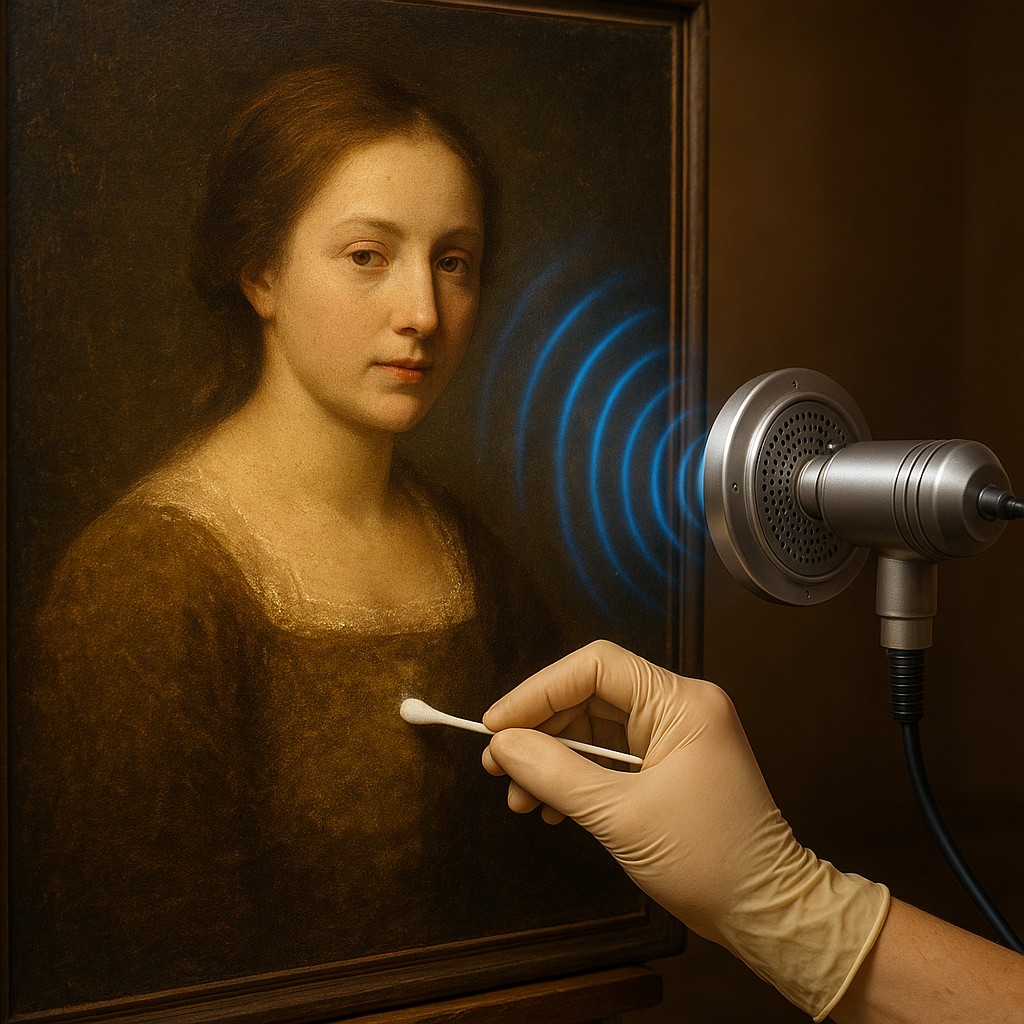
Imagine standing before a Rembrandt or a Da Vinci, where centuries of history are layered onto a single piece of woven flax. In the hundreds of years since the artist’s final brushstroke, that masterpiece has survived wars, humidity, candle soot, and the steady breath of millions of admirers. However, a hidden enemy eventually claims almost every historic painting: the very varnish meant to protect it. Over time, natural resins oxidize and turn a murky, tea-colored yellow, obscuring the vibrant blues and delicate skin tones underneath. For generations, the only way to rescue the image was a nerve-wracking combination of harsh solvents and physical scrubbing. A restorer would dip a cotton swab in chemicals and rub, hoping the friction would not take the history of the art along with the dirt.
Today, the art world is experiencing a quiet revolution that replaces the friction of the swab with the precision of sound. Restorers are increasingly turning to high-frequency ultrasonic waves to achieve what was once thought impossible: removing microscopic grime without a single hair or fiber ever touching the canvas. By using the physics of fluid dynamics, experts can now "shake" the dirt away at a molecular level. This technique represents a massive shift in conservation philosophy, moving away from aggressive chemical baths toward a more surgical, mechanical approach. It allows us to see the past with a clarity that hasn't been possible since the day the paint first dried, all while treating the fragile artwork with the reverence it deserves.
The Microscopic Violence of a Tiny Bubble
To understand how sound can clean a painting, we have to look at a phenomenon called cavitation. While the word might sound like something you would hear at a dentist’s office, in physics, it refers to the rapid formation and collapse of vapor bubbles in a liquid. When high-frequency sound waves, usually well above the range of human hearing, travel through a cleaning solution applied to the painting's surface, they create alternating cycles of high and low pressure. During the low-pressure phase, the liquid is literally pulled apart, creating millions of microscopic vacuum bubbles. These are not like the soap bubbles in your kitchen sink; they are tiny pockets of empty space that exist for only a fraction of a second before the surrounding pressure forces them to implode.
When these bubbles collapse, they do not go out quietly. The implosion releases a concentrated burst of energy in the form of a micro-jet of fluid. These jets act like tiny pressure washers, striking the surface of the painting with surgical focus. Because the waves are so frequent and the bubbles so small, this mechanical action targets the "weak" bonds of surface contaminants. If a layer of sticky soot or brittle, yellowed varnish is sitting on top of a stable paint film, the cavitation energy vibrates those unwanted particles until they lose their grip on the underlying art. It is a process of detachment rather than dissolution, meaning we can lift the dirt away without melting the varnish into a messy sludge that might sink deeper into the canvas fibers.
Balancing Frequency and Fragility
Not all sound waves are created equal when it comes to saving a masterpiece. In industrial settings, like cleaning engine parts or jewelry, low-frequency ultrasound is used because it creates larger bubbles that pack a heavy punch. However, using those same frequencies on a 17th-century oil painting would be a disaster, as the energy could be strong enough to vibrate the paint right off the canvas. Fine art restoration requires "megasonic" or high-frequency ranges, where the bubbles are much smaller and the energy is distributed more evenly. This creates a gentle scrubbing action that handles the pigment layers with extreme care.
One of the most fascinating aspects of this technology is how it changes the role of the liquid involved. In traditional cleaning, the liquid is a solvent, a chemical designed to eat away at the grime. In ultrasonic cleaning, the liquid is primarily a medium, a highway for the sound waves to travel through. This allows restorers to use much milder solutions, or even just distilled water, because the physics of the sound wave is doing the heavy lifting rather than the caustic nature of the chemical. By reducing the "dwell time," or the time liquids sit on the painting, restorers minimize the risk of the canvas warping or the wooden frames expanding due to moisture.
When Sound is the Best Tool for the Job
While the idea of ultrasonic cleaning is mesmerizing, it is not a magic wand that works on every object in a museum. Conservation is a deeply analytical field where the first rule is to do no harm. Restorers must evaluate the chemical composition of the binders, the "glue" that holds the pigment together, before deciding if sound is the right approach. For works using stable oil binders, the ultrasonic method is a dream. For others, it might be a risk. To see how this technology compares to traditional methods, we can look at the specific strengths and limitations of the ultrasonic approach.
| Feature |
Traditional Swab Cleaning |
Ultrasonic Cavitation |
| Physical Contact |
High (Mechanical friction) |
Zero (Non-contact) |
| Chemical Intensity |
High (Strong solvents) |
Low (Mild water-based solutions) |
| Precision |
Limited by tool size |
Molecular (Microscopic bubbles) |
| Risk of Abrasion |
Present (Fibers can scratch) |
Negligible |
| Suitable For |
Most stable surfaces |
Stable binders; non-flaking surfaces |
| Complexity |
Low to Moderate |
High (Requires specific calibration) |
This comparison highlights that while ultrasonic cleaning is better at preventing scratches, it requires more technical expertise to set up. A restorer must calibrate the frequency, the distance of the tool from the painting, and the specific chemistry of the solution to ensure the energy stays on the surface. If the painting is already flaking or if the paint layers are separating from the canvas, the vibration of the bubbles could accidentally widen those cracks. This is why the method is currently a specialized tool for sturdy masterpieces rather than a universal fix for every decaying relic.
The Challenge of Water Sensitivity and Flaking
The magic of ultrasound works best when there is a clear distinction between the "bad" dirt and the "good" paint. However, art history is full of experimental techniques that make this distinction blurry. For example, tempera paintings, which often use egg yolk as a binder, or works on paper are notoriously sensitive to water. Since ultrasonic cleaning usually requires a liquid medium to carry the sound waves, applying it to a water-sensitive work could cause the pigment to swell or bleed. Similarly, if a painting is "cupping," where the paint edges curl upward like dried mud, the energy from the bubbles might get underneath those edges and pop them off entirely.
Because of these risks, the introduction of ultrasound into the studio involves a lot of preparation. Restorers often use fluorescence imaging or specialized light scans to map out exactly what is on the surface before they begin. They are looking for "acoustic impedance," which is a term for how different materials reflect or absorb sound energy. By understanding the density of the varnish versus the density of the paint, they can tune the ultrasound to a "sweet spot" where it shakes the varnish but leaves the paint undisturbed. It is a high-tech version of the classic tablecloth trick, pulling the grime out from under the masterpiece so fast that the artwork barely notices it’s gone.
Precision Engineering for Aesthetic Preservation
One of the most exciting developments in this field is the move away from large ultrasonic baths toward handheld "pens" or specific delivery systems. In the past, ultrasonic cleaning usually meant submerging an object in a tank. While this works for a Greek bronze statue or a piece of ancient jewelry, you cannot exactly dunk a six-foot-tall canvas into a bathtub without causing catastrophic damage. Modern restorers use specialized probes that create a "meniscus," a tiny bridge of liquid, between the tip of the tool and the painting. The ultrasound travels through this tiny droplet, allowing the restorer to clean the painting square millimeter by square millimeter.
This localized approach offers a level of control that previous generations of conservators could only dream of. It allows them to vary the intensity based on the colors used in different parts of the painting. Since different pigments have different mineral weights, some might be more or less resistant to vibration. Lead white, for instance, is very heavy and stable, while certain organic reds are much lighter. By adjusting the frequency as they move across the canvas, restorers can customize the cleaning process for every individual pigment on the artist’s palette. This ensures that the cleaning is not just effective, but theoretically perfect, leaving the "skin" of the painting exactly as the artist intended.
A New Window into the Past
As we refine these sonic techniques, we are beginning to realize that much of what we thought we knew about art history was filtered through a layer of brown sludge. When the yellowed varnish is removed with such extreme precision, we often discover that artists were much bolder than we gave them credit for. Sky blues that looked like muddy grays suddenly pop with Mediterranean intensity. Shimmering highlights on silk gowns that had been muted for two centuries reappear with their original metallic luster. This isn't just about making things look pretty; it is about restoring the original intent and the visual language of the creator.
The transition from "scrubbing" art to "sounding" art marks a point where high-energy physics meets the delicate touch of the humanities. It reminds us that the preservation of our cultural heritage is a moving target, constantly improving as our understanding of the physical world deepens. As you walk through a museum in the coming years, notice the clarity of the oldest works. You might just be looking through a window that was cleaned by the invisible power of sound, a testament to our desire to keep the past from fading away. There is something deeply poetic about using cutting-edge science to protect the oldest spirits of our history, ensuring that the strokes of a brush from five hundred years ago remain as vibrant and defiant as the day they were born.