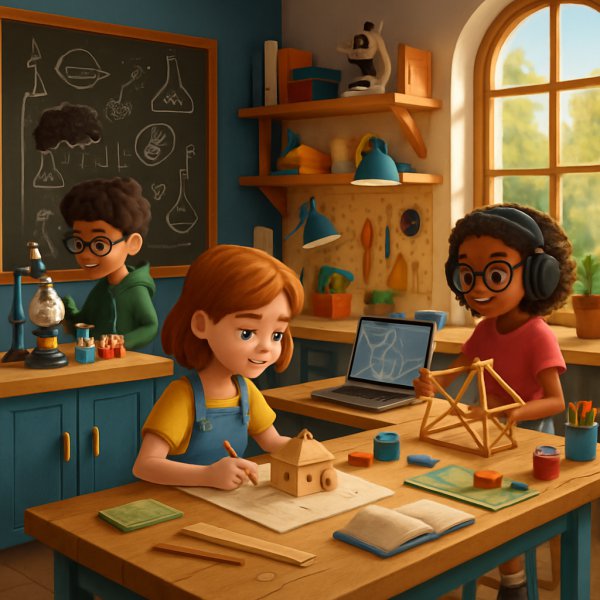
<h2>Imagine walking into a school that feels like a curious laboratory, a studio, and a cozy workshop all at once</h2>
Picture a place where the bell does not dictate learning, where tests are moments of reflection rather than fear, and where students leave each day with a project they are proud of and a question they want to chase tomorrow. Consider this surprising fact: many adults remember vivid moments from school - the time a science demo fizzed over, a teacher’s offhand comment that changed their mind, or a project that became an obsession - yet most of those memories were not created in a lecture hall. They were created in moments of curiosity and doing. What if school was built around creating those moments on purpose?
This article is a guided tour of what the best way to learn could look like, and how I would reinvent school to make learning more effective, joyful, and durable. You will find research-backed strategies, clear design principles, practical schedules, real-world examples, and small challenges you can try immediately. By the end you should feel energized, equipped, and ready to imagine - or build - a school that makes learners smarter and more curious.
<h2>Why the traditional model often misses the mark</h2>
Traditional schooling grew in an age of factories and mass administration. Students were grouped by age, moved in lockstep through a curriculum, and judged primarily by standardized tests. That system produces some measurable skills, but it systematically undervalues curiosity, deep understanding, and transfer - the ability to use knowledge in new situations. Research shows that passive study and repeated exposure are poor long-term strategies; techniques like retrieval practice, spacing, and varied practice produce far stronger learning (Dunlosky et al., 2013). Yet many classrooms still rely on lectures and cram-style assessment.
Beyond cognitive science, there is an emotional cost. When teaching emphasizes compliance over autonomy, students often lose intrinsic motivation. They learn to play the school game instead of learning to think. Real-world problems do not arrive packaged by topic or grade level the way textbooks do. The result is curious young people who do not learn how to learn, and adults who spend time re-learning before they can be useful in new contexts.
<h2>Foundational principles for a reinvented school that actually works</h2>
A redesigned school should rest on a small number of powerful, evidence-based principles that shape everything from the timetable to the seating, from assessment to teacher roles. Below are the core principles I would use, with short explanations and practical implications.
- Spark curiosity with meaningful problems: Start learning with questions students care about, problems that are concrete and relevant, and projects that invite exploration. Motivation changes everything.
- Use cognitive science to structure practice: Make retrieval practice, spacing, interleaving, elaboration, and dual coding the default learning strategies.
- Build mastery, not seat-time: Students progress when they demonstrate competence, not after a fixed number of days in class.
- Blend guided instruction and guided discovery: Offer clear, concise explanations when needed, and provide scaffolded opportunities to explore and struggle productively.
- Make learning social and collaborative: Real learning happens when ideas are argued, defended, and co-created.
- Ground learning in the real world: Internships, community projects, and apprenticeships connect abstract learning to authentic contexts.
- Measure learning with meaningful assessment: Use portfolios, exhibitions, and formative feedback instead of just standardized tests.
Each of these principles has practical consequences for daily routines, teacher work, use of technology, and assessment. The rest of the article explains how those consequences look in practice.
<h3>Sparking curiosity with projects that matter</h3>
Curiosity is the engine of learning. The trick is to harness it with projects that have clear constraints and real stakes. A biology unit can center on designing a pollinator-friendly garden for the neighborhood. A math unit can focus on budgeting and building a functioning small business. Science class becomes citizen science when students measure local water quality and present findings to the community.
Concrete example: A middle school class learns statistics by running a local survey on sleep habits, analyzing the data with spreadsheets, and presenting recommendations to the school. Students gain statistical tools because they need them to answer a real question about their lives, not because they were assigned practice problems in a workbook.
Small challenge: Think of one local problem in your area - a park that needs cleaning, a bus route that confuses people, a small business that could benefit from digital marketing. How could a class use that problem to learn math, writing, and science at the same time?
<h3>Use cognitive science - make learning stick</h3>
Cognitive science offers a toolkit for turning short-term exposure into long-term knowledge. Here are the techniques to bake into every curriculum:
- Retrieval practice: Practicing recalling information strengthens memory more than re-reading. Weekly low-stakes quizzes that ask students to retrieve prior lessons produce real gains.
- Spacing: Spreading study over time beats cramming. Return to core ideas across weeks and months.
- Interleaving: Mixing different types of problems helps learners learn when to apply which strategy.
- Elaboration: Asking learners to explain ideas in their own words promotes deeper understanding.
- Dual coding: Combining words and visuals makes complex ideas easier to remember.
Practical implementation: Structure each week so that 15-20 minutes are devoted to retrieval practice of past content, not new content. Use mixed-problem sets for homework, and require students to write brief explanations showing how and why they solved problems, not just the final answer.
Quote that captures the idea:
"Memory is the residue of thought." - Daniel Willingham
Reflective question: When was the last time you genuinely forgot something and then could recall it after explaining it to someone else? What did the act of explaining do to your memory?
<h3>Mastery-based progression - competency over time served</h3>
Mastery-based education flips the default from "everyone moves on together" to "students move on when they are ready." This requires clear learning targets, frequent formative assessment, and flexible grouping. Mastery does not mean perfection; it means reaching a leveled, agreed definition of proficiency.
Example structure: Students work on skill modules - for example, "clear argumentative writing," "solving linear equations," "experimental design." Each module has rubrics and exemplars. Students receive targeted coaching until they meet the rubric. Time becomes a variable students use differently - some accelerate, others get more practice.
This approach is supported by meta-analyses that show mastery learning techniques reduce achievement gaps and improve overall outcomes (Bloom originally proposed the idea, and many modern implementations show positive results). It also reduces the shame of failure because failure becomes feedback in a growth-oriented system.
<h3>Mentorship and apprenticeships - learning from real people</h3>
School should be a bridge to the world of work and civic life. Mentors and apprenticeships create that bridge. Pair students with professionals for projects, and treat mentorship as an essential credential for teachers. Not every project needs external partners, but regular contact with adults doing real work grounds learning.
Case study: High Tech High in San Diego emphasizes project-based learning and community partnerships. Their graduates report strong preparedness for college and careers, and academic studies show positive outcomes in critical thinking and persistence.
Practical idea: Build a "mentor hour" each week where students meet with a mentor online or locally to get feedback on projects. Document progress in a portfolio that mentors can review.
<h2>Designing the school day - a sample weekly rhythm that works</h2>
Schools need structure that supports these principles. Below is a sample weekly rhythm that balances concentrated instruction, practice, projects, and mentorship.
<table>
<tr><th>Day</th><th>Morning</th><th>Midday</th><th>Afternoon</th></tr>
<tr><td>Monday</td><td>Brief retrieval practice, focused mini-lesson, group work</td><td>Project studio - brainstorming and prototyping</td><td>Elective or skill labs (coding, art, writing)</td></tr>
<tr><td>Tuesday</td><td>Interleaved problem sets, coaching rotations</td><td>Mentor hour and community research</td><td>Practice sessions and peer review</td></tr>
<tr><td>Wednesday</td><td>Deep work block - extended focus time for projects</td><td>Guest speakers or site visits (real-world learning)</td><td>Formative assessment and feedback conferences</td></tr>
<tr><td>Thursday</td><td>Skills clinics - targeted small groups</td><td>Project development and testing</td><td>Reflection and journaling - elaboration tasks</td></tr>
<tr><td>Friday</td><td>Showcase and exhibitions - present progress</td><td>Portfolio time - compile evidence of mastery</td><td>Community action/planning for next week</td></tr>
</table>
This schedule emphasizes long blocks for deep work, regular opportunities for feedback, and a weekly demonstration of progress to build accountability and pride. Flexible spaces - studios, labs, outdoor zones - support varied modes of learning.
<h2>Assessment that helps learners grow, not just sort them</h2>
Assessment should be a window into learning, not a gate. Formative assessment - low-stakes checks for understanding - helps teachers adjust and students reflect. Portfolios show growth over time and enable authentic judgments. Public exhibitions make assessment transparent and meaningful: students must explain decisions, show process, and defend conclusions.
Checklist for effective assessment:
- Use clear rubrics with exemplars.
- Combine frequent low-stakes checks with occasional high-quality performances.
- Emphasize reflection: students annotate their portfolio entries with what improved and what still needs work.
- Include peer and mentor feedback to broaden perspectives.
Evidence supports the power of feedback. John Hattie's synthesis shows that timely, specific feedback has a large effect on achievement. Design assessments so the feedback is useful and actionable.
<h2>Teachers as designers, coaches, and learners</h2>
In a reinvented school, teachers do less monologue and more design and coaching. They craft compelling projects, diagnose misconceptions, model strategies, and orchestrate peer learning. That role requires professional development that focuses on student thinking, curriculum design, and coaching skills.
Professional development should be ongoing and collaborative. Teachers learn best when they observe one another, co-design units, and analyze student work together. Create teacher time for reflection and iteration - treat curriculum as an evolving experiment. When teachers feel supported, students feel supported too.
Quote: "The teacher is not the sage on the stage, nor the guide on the side, but the gardener who cultivates a field of inquiry."
<h2>Case studies - proof that reinvention pays off</h2>
Finland: Not magic, but design. Finnish schools emphasize teacher autonomy, less standardized testing, and equity. Student well-being and consistent teacher training correlate with strong outcomes on international assessments. The Finnish approach shows that supporting teachers and focusing on equity improves performance and well-being.
Montessori: A century of practice demonstrates that child-centered, mixed-age, hands-on learning produces gains in independence, executive function, and creative problem solving. Controlled studies and longitudinal research indicate benefits in academic and social outcomes.
High Tech High: Project-based learning with real audiences has produced graduates who are more likely to pursue further study, show higher engagement, and perform well on measures of critical thinking.
These are not identical models, but they share common features: respect for learners, emphasis on real work, strong teacher preparation, and systems that value mastery and equity.
<h2>Common objections and sensible answers</h2>
Objection: How do we ensure standards and accountability? Answer: Use clear competencies, external audits of portfolios, and standardized sampling rather than universal high-stakes tests. Accountability should measure growth and transfer, not just short-term recall.
Objection: Is this equitable? Won't wealthy kids get mentors more easily? Answer: Design partnerships so the school brokers mentorships for all students. Public investment in teacher training and community partnerships levels the playing field. Equity is a design constraint, not an afterthought.
Objection: Is it expensive? Answer: Some redesign costs time and training, not necessarily more money. Flexible scheduling and shared community resources can reduce costs. Long-term returns - lower remediation, higher graduation, better workforce readiness - offset initial investments.
<h2>Try it tomorrow - a simple starter pack for teachers, parents, or learners</h2>
- Pick one authentic problem in your community and design a one-week mini-project around it. Include one deliverable and a short public presentation.
- Replace one nightly worksheet with 10 minutes of retrieval practice - ask three questions that force recall and one question that asks for an explanation in students’ own words.
- Add a "student showcase" 15 minutes each Friday where one group shares work and receives peer feedback with a specific rubric.
- Create a small portfolio folder - digital or physical - where students save one piece of work per week with a 50-word reflection.
These small moves begin to change culture. They are low-cost, high-impact, and scalable.
<h2>Final thought - toward a culture of lifelong learners</h2>
Reinventing school is not about escaping standards or letting students do whatever they want. It is about creating an ecology where curiosity, cognitive science, quality feedback, and real-world work combine to make learning faster, deeper, and more joyful. Imagine graduating people who know how to learn, how to apply knowledge, and how to collaborate to solve messy problems. That is the future of education worth redesigning.
"If we teach today’s students the way we taught yesterday’s, we rob them of tomorrow." Keep that as a friendly provocation. Start small, test, iterate, and focus on the moments that make learning unforgettable.