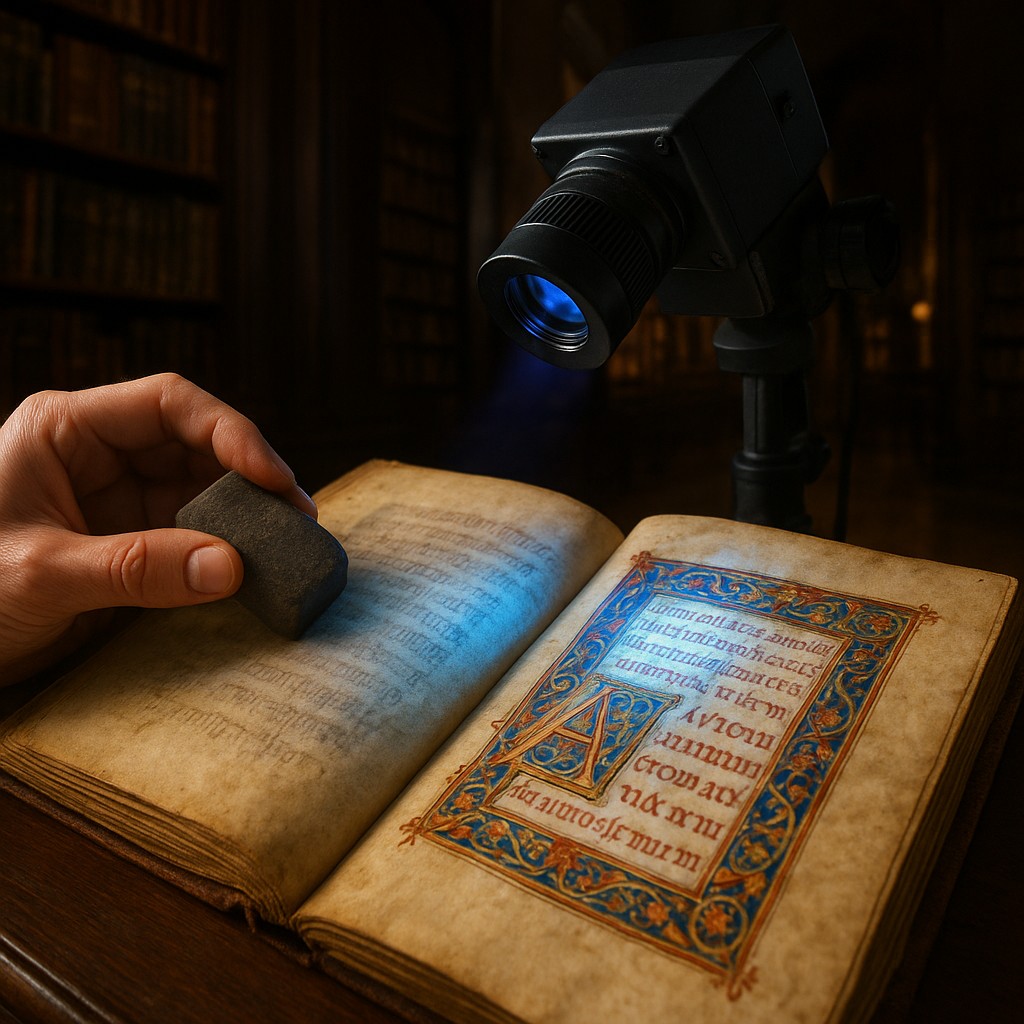
Imagine walking into a prestigious library a thousand years ago. You are a scribe tasked with recording a collection of religious hymns, but you have run out of parchment. In the medieval world, parchment was not a cheap office supply; it was a luxury item made from meticulously prepared animal skins. Faced with a shortage, you do what any resourceful professional would do. You reach for an old, dusty manuscript containing some outdated Greek mathematics that no one in your monastery seems to care about anymore. You take a pumice stone, scrape away the old ink until the pages look clean, and begin your new work. For centuries, the world sees only your hymns, while the foundational thoughts of a genius lay buried, quite literally, between the fibers of the page.
This is the birth of a palimpsest, a word from the Greek for "scraped again." For a long time, these hidden layers of history were considered lost forever. The original ink was physically removed, leaving behind nothing but a faint, yellowish blur that the human eye cannot decode. However, we have recently discovered that "gone" is a relative term in the world of chemistry. When a scribe scraped that parchment, they removed the bulk of the ink, but they could not erase the molecular footprint left by the minerals and metallic compounds in the fluid. Today, history is being rewritten not by a pen, but by high-tech cameras that can see parts of the light spectrum invisible to us.
The Chemistry of a Ghost Story
To understand how we "resurrect" these lost texts, we first have to understand how ancient ink worked. Most ancient and medieval scribes used iron-gall ink, a mixture of tannins (often from oak galls, which are growths on trees) and iron salts. When this ink was applied to parchment, it did not just sit on the surface like a modern sticker. It triggered a chemical reaction with the collagen fibers of the animal skin, biting into the surface and leaving behind metallic residues. Even after a scribe spent hours scrubbing the page with an abrasive stone, tiny traces of iron and other minerals remained trapped deep within the microscopic valleys of the parchment. These residues are the "ghosts" that modern experts are hunting.
The challenge is that these ghosts are invisible under normal, white light. White light is a mixture of all colors, and when it hits a palimpsest, the bright, fresh ink of the top text and the reflective surface of the parchment drown out the faint traces underneath. To solve this, scientists use multispectral imaging (MSI). Instead of taking one photo with a normal camera, they take dozens of photos, one for each specific wavelength of light. They start at the long, warm waves of infrared, move through the visible rainbow, and end at the short, energetic waves of ultraviolet. Each wavelength interacts with the ink and the parchment in a unique way, allowing us to peel back the layers of time digitally.
Dancing in the Ultraviolet
The most dramatic breakthroughs often happen at the ends of the light spectrum. When exposed to ultraviolet (UV) light, parchment has a natural property called fluorescence. It absorbs the high-energy UV light and spits it back out as a visible glow. However, the tiny metallic residues of the original iron-gall ink do not glow. Instead, they act like tiny sponges that soak up the light. When a scientist looks at a palimpsest under UV light, the parchment glows brightly while the "hidden" text appears as dark, crisp letters standing out against the background. It is a bit like looking at a star that is only visible after sunset; by changing the lighting, we make the faint signals readable.
On the other end of the spectrum, infrared light behaves differently. It has a talent for "seeing through" certain substances. Modern inks or stains that might cover an ancient text often become transparent under infrared light. This allows researchers to ignore the 10th-century hymns written on top and focus exclusively on the 4th-century philosophy hidden beneath. By combining these different views, mathematicians and computer scientists can create a composite image where the top text is filtered out and the hidden text is digitally sharpened. It is a process of subtraction that leads to a massive addition to our historical knowledge.
Comparing the Tools of the Trade
Standard photography captures what we see, but multispectral imaging captures what we know exists but cannot witness with the naked eye. While both have their place in a museum, the jump in depth is like moving from a magnifying glass to an MRI machine. The following table highlights the fundamental differences in how these approaches treat a historical document.
| Feature |
Standard Photography |
Multispectral Imaging (MSI) |
| Light Source |
Broad white light |
Specific LEDs (UV to Infrared) |
| Goal |
Visual appearance and beauty |
Chemical residues and "ghost" signatures |
| Resulting Data |
A single color image (RGB) |
A stack of 15 to 50+ light-specific images |
| Effect on Artifact |
High (if flash is used frequently) |
Minimal (controlled, low-heat LEDs) |
| Primary Use |
Cataloging and public display |
Forensic recovery of lost information |
| Complexity |
Point-and-shoot |
Requires heavy digital processing |
The Digital Scriptorium and Data Processing
Capturing the images is only half the battle. Once a manuscript has been "mapped" across thirty or forty different wavelengths, the resulting data is enormous. A single page might yield several gigabytes of information. This is where the magic of "Principal Component Analysis" comes in. This is a statistical technique used by scientists to find patterns in confusing data. By comparing how every single pixel behaves across all the different light wavelengths, a computer can identify which pixels belong to the parchment, which belong to the top layer of ink, and which belong to the hidden text beneath.
The computer then assigns false colors to these layers. It might turn the parchment blue, the top text bright red, and the hidden text a sharp, high-contrast black. This results in a map that a scholar can actually read. It is important to remember that these scientists are not "restoring" the ink. They are not painting over the letters or physically changing the page. They are simply detecting the chemical shadow left behind and using math to make that shadow visible. This ensures that the original artifact remains untouched, while the data it holds is set free.
From Archimedes to Lost Gospels
The real-world impact of this technology is staggering. Perhaps the most famous success story is the Archimedes Palimpsest. In the late 1990s, a prayer book was sold at auction that turned out to be a "reused" version of a much older manuscript. Hidden beneath the prayers were seven essays by the Greek mathematician Archimedes, including the only known copy of "The Method of Mechanical Theorems." This single discovery changed our understanding of the history of calculus, proving that Archimedes was using concepts of infinity nearly 2,000 years before Newton and Leibniz.
Beyond mathematics, multispectral imaging is currently being used at Saint Catherine’s Monastery in the Sinai Desert. This is the oldest continuously inhabited Christian monastery in the world, and its library is a treasure trove of hidden texts. Researchers have found lost medical texts from the school of Hippocrates, early translations of the Bible into extinct languages like Caucasian Albanian, and unknown poems from the classical era. Every time a new page is scanned, there is a chance we will find a "missing link" in the story of human civilization. We are effectively finding a second, secret library hidden inside the one we already knew about.
Correcting the Myths of Restoration
It is a common misconception that this technology "fixes" the book. When people hear about "recovering" lost text, they often imagine a physical process where the ink magically reappears on the page. In reality, the parchment remains as blank or overwritten as it was before. The recovery happens entirely in the digital world. Furthermore, multispectral imaging is not a "magic wand" that works on every document. If the original scribe was too aggressive with their scraping, or if the parchment was exposed to extreme moisture that washed away the metallic residues, there may be nothing left to find.
Another nuance is that MSI is not just about reading what is hidden; it is also about preservation. By seeing which parts of a manuscript react to certain wavelengths, conservators can identify early signs of mold, chemical decay, or "ink rot" before they are visible to the human eye. This allows them to treat the parchment or adjust storage conditions to prevent further damage. In this way, multispectral imaging is both a time machine that looks into the past and a diagnostic tool that protects the future.
The New Frontier of Historical Data
The shift from seeing a manuscript as a static object to seeing it as a multi-layered data source represents a revolution in history. For centuries, an ancient book was a fixed entity; what you saw was what you got. Now, we treat these objects like geological sites. Just as a geologist looks at a mountain and sees layers of different eras, a modern historian looks at a page and asks what might be resting underneath. This requires a new kind of scholar, someone who is as comfortable with light physics and digital algorithms as they are with Latin or Greek.
The library of the future is not just a room full of books; it is a hard drive full of light-refraction data. As our processing power increases and our computer programs become more sophisticated, we may revisit manuscripts scanned ten years ago and find even more details that were previously missed. These "ghosts" in the parchment are finally getting their chance to speak, and they have a lot to tell us about how our ancestors thought, calculated, and dreamed.
The next time you look at an old, faded piece of paper or a worn-out book, consider the layers it might hold. History is rarely a single, clean narrative; it is a messy, overlapping series of events, much like the ink on a palimpsest. Through the marriage of heavy-duty physics and ancient craftsmanship, we are proving that even when a voice has been silenced and scrubbed away, the truth carries a chemical weight that is very difficult to erase. We are living in a golden age of discovery where the light we cannot see is finally illuminating the stories we thought we had lost forever.