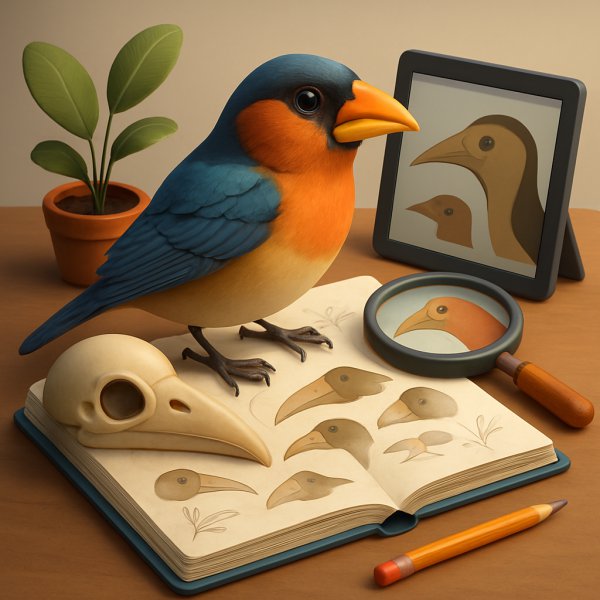
Why a bird’s beak is more than a pretty face
Look at a robin, a heron, and a toucan and you will notice something obvious - their faces wear different tools. Those tools are beaks, and they tell dramatic stories about how each bird lives, hunts, sings, nests, and even cools itself. A beak is not merely a “bird mouth.” It is a multi-purpose instrument shaped by millions of years of evolution, and learning what beaks do helps you read the lives of birds like an open book.
Understanding beaks matters because it is a shortcut to big ideas in biology - adaptation, trade-offs, and how form follows function. When you see a thin, needlelike beak, you should immediately think “nectar” or “insects in tight places.” When you see a crushing, cone-shaped beak, your brain should jump to “seeds.” Those visual clues let you make educated guesses about behavior and habitat without watching the bird for hours.
Beyond science, beaks are brilliant examples of elegant engineering. Think of a beak as a Swiss Army knife - lightweight, strong, and specific parts optimized for different tasks. This little toolset helps birds survive in deserts, cities, rainforests, and tundras, and it also teaches us about materials, trade-offs, and creativity in natural design.
By the end of this piece you will not only be able to identify common beak types, but you will also understand why these shapes exist, how they evolved, and how to test beak function with simple backyard activities. Expect a mix of science, short stories, questions to spark thinking, and practical steps you can try today.
What a beak actually is - anatomy, materials, and how it grows
A bird’s beak is composed of a bony core covered by a sheath of keratin, the same protein that makes fingernails and hair. The bony core comes from the skull - the maxilla and mandible - and determines the basic shape and strength. The keratin sheath, called the rhamphotheca, can show ridges, serrations, and color patterns that may change over time or with wear.
Beaks grow continuously at their tip in many species, much like human nails. Wear from feeding and other behaviors shapes the tip, so a beak’s appearance is a balance between growth and erosion. In some species, the upper and lower beak must wear at compatible rates to prevent misalignment - too much growth or too little wear can cause health problems. The presence of sensory receptors, nerves, and blood vessels makes beaks surprisingly sensitive and biologically active.
The weight-to-strength ratio of a beak is remarkable because birds need lightweight heads for flight, but they also need durable tools for feeding and other tasks. Evolution has optimized the internal bone architecture and keratin thickness for different lifestyles. For instance, seed-eating birds often have thick bone and keratin for crushing, while probe-feeders have hollow or slender structures for nimble movements.
Understanding the materials - bone plus keratin - helps explain why beaks are such versatile structures. Keratin allows for surface adaptations like serrations or broad plates, and the bone beneath can be remodeled over generations by natural selection. If you think of a beak as a living, growing tool, it becomes easier to see why birds can use them for feeding, building, fighting, and more.
Form follows function - how beak shape matches lifestyle
Beak shape is often the most reliable clue to what a bird eats and how it behaves. Natural selection favors beaks that perform essential tasks efficiently, and that leads to repeated solutions in different bird families. For example, a conical beak for cracking seeds evolved independently in finches and sparrows. A long, thin probe for nectar evolved in sunbirds, hawk-moths, and hummingbirds - different groups that found the same functional answer.
Morphology also involves trade-offs. A large, crushing beak is good for seeds but poor for catching tiny insects in flight. A slender probing beak is excellent for extracting prey from narrow crevices but cannot crack a nut. These trade-offs mean that no beak is perfect for every job, and the birds you see in a given habitat are the ones whose beaks best match available food and tasks.
Some birds display surprising combinations - the generalist beak. Species like crows and gulls have versatile, all-purpose beaks that allow flexible diets. In changing or unpredictable environments, having a “do-it-all” beak can be an advantage. But even generalists show specializations - a crow’s beak is still different in subtle ways from a gull’s, reflecting their evolutionary histories and primary food sources.
Below is a compact comparison to make these ideas concrete, pairing common beak shapes with their functions and a real-world analogy to make them memorable.
| Beak shape |
Typical species |
Primary function |
Real-world analogy |
| Conical, thick |
Sparrows, finches |
Crushing seeds and nuts |
Nutcracker or hammer |
| Hooked, sharp |
Hawks, eagles, owls |
Tearing flesh, killing prey |
Fillet knife or grappling hook |
| Long, thin probe |
Hummingbirds, sandpipers |
Reaching nectar or probing mud |
Straw or test probe |
| Chisel-like, stout |
Woodpeckers |
Drilling into wood |
Hammer and chisel |
| Wide, gular pouch |
Pelicans, frigatebirds |
Scooping or snaring fish |
Fishing net or scoop |
| Serrated or saw-toothed |
Mergansers, some gulls |
Gripping slippery prey |
Toothed pliers |
| Filter-feeder, lamellae |
Flamingos, ducks |
Straining small food from water |
Sieve or colander |
Surprising roles - beaks do much more than eat
It is tempting to think of beaks only as feeding tools, but they participate in many other vital roles. Birds use beaks for nest-building, arranging and carrying material with incredible precision. Hummingbirds tuck tiny twigs and spider silk into nests with surgical finesse, and some birds weave complex structures using beaks as both fingers and glue applicators.
Beaks are also communication devices. Colorful beaks, like those of toucans and some parrots, act as visual signals during courtship and territorial displays. The movement and clacking of beaks can be part of ritualized fighting or greeting behaviors, showing strength or intent without immediate violence. In certain species, beaks amplify sound; the shape and stiffness of the bill can influence song production in subtle ways.
Thermoregulation is a less obvious function, but an important one. Some birds lose heat through their beaks - a bit like radiators. Toucans, for example, adjust blood flow to their large bills to release heat when the environment gets hot. That means a beak serves as a physiological tool as much as a mechanical one.
Finally, beaks are grooming instruments. Birds preen their feathers with their beaks to remove parasites, realign barbs, and apply oil for waterproofing. The same structure that opens a seed may also ensure the bird’s feathers stay functional.
How beaks evolved - a short evolutionary detective story
Beaks evolved gradually, shaped by natural selection acting on small variations in jaw bones and the keratin covering them. The fossil record gives clues: early bird relatives and transitional forms show a diversity of teeth and jaw structures. Over time, tooth loss in many lineages coincided with the development of a keratin beak. That process likely reflected shifts in diet, weight-saving needs for flight, and developmental genetics.
A famous, modern example of rapid beak evolution is Darwin’s finches in the Galapagos Islands. Small differences in seed types and availability led finches to evolve different beak shapes and sizes over relatively short timescales. Kenneth and Rosemary Grant’s long-term studies have even documented beak size changes across generations in response to droughts and food supply changes. These observations make beak evolution surprisingly immediate and visible.
Genetics and developmental biology have shown how modifications in genes that control bone growth and keratin deposition can change beak shape. Think of genes like knobs on a machine - tweak a knob and the length, curvature, or depth of a beak can be adjusted in offspring. Because beaks are essential for survival, even small beneficial tweaks are strongly favored in the right environmental context.
Evolution also produces convergent solutions - different lineages evolving similar beak types for the same problem. That convergence is a powerful demonstration that function and environment shape form, not ancestry alone. When you see a spoonbill and a stork performing similar feeding moves with similar bill shapes, you are seeing the same engineering logic repeated.
Common myths and neat corrections
Myth 1: Beaks are just mouths. Correction: Beaks are complex living structures used for feeding, preening, nest-building, thermoregulation, and signaling. They contain nerves, blood vessels, and sensory cells that give birds precise control and feeling in their tips.
Myth 2: Beaks are bones. Correction: The visible outer layer of most beaks is keratin, not bone. Bone forms the internal support, but the tough sheath does most of the wear-and-tear work. That keratin sheath is what holds shape and color.
Myth 3: All birds with similar diets have identical beaks. Correction: Different evolutionary paths and trade-offs produce variety even among similar feeders. For instance, two birds that eat fish might use different capture methods - one scoops with a pouch, another dives and grips with serrations - and their beaks will reflect those behaviors.
Myth 4: You can tell everything about a bird by its beak alone. Correction: Beaks are informative but not omniscient. Behavior, habitat, and seasonal changes all influence feeding and appearance. A bird’s beak is a crucial clue, but the full story needs context.
Dispelling these myths gives a clearer, richer view of how beaks function and why they look the way they do.
How to observe and experiment with beaks - backyard science you can try
Observing bird beaks is a low-tech way to practice scientific thinking. Start by visiting a local park or your backyard and watch the birds for a few sessions at different times of day. Bring a notebook and sketch the beak shapes and what each bird does with them. Over days or weeks you will begin to match shapes to behaviors: probing, pecking, tearing, scooping, and more.
Try the following simple experiments to deepen your understanding. First, create a feeding station with a variety of foods presented on separate dishes - seeds, small fruit pieces, soft insects like mealworms, and nectar in a shallow dish. Note which species visit which dishes. Second, do the “beak tool challenge” with household implements: use tweezers, chopsticks, a spoon, and a pair of kitchen tongs to pick up different objects like rice grains, cotton balls, or gummy candies. Time yourself and notice which tool is best for each task; this simulates beak trade-offs.
A few practical steps to get started: 1) Choose a quiet spot and bring binoculars if you have them. 2) Record time of day, weather, and what the birds do when they arrive at food. 3) Try to identify the birds and their beaks using a field guide or app. 4) Repeat observations across different days to see patterns. These activities will improve your observational skills and make the link between form and function come alive.
Small behaviors, big consequences - ecological and conservation angles
Beaks influence ecological relationships and therefore ecosystems. A single bird species with a specialized beak can be a keystone for seed dispersal or pollination. For example, certain plants evolve flowers that suit specific beak shapes, and in turn those birds become essential pollinators. Remove the bird and the plant’s reproduction may suffer.
Human activities can disrupt these relationships. Habitat loss, climate change, and invasive species can shift food availability, and beak-specialized birds often cannot adapt quickly. That is why conservationists watch beak-bearing species for early warning signs. Darwin’s finch populations, for instance, have shown vulnerability when food types shift rapidly.
Conversely, some birds thrive near humans because their generalist beaks allow flexible diets - pigeons and crows are good examples. Their success is a reminder that adaptability often beats specialization in unpredictable environments. Observing how beak-specialist and beak-generalist species respond to change can help us predict which species need protection most urgently.
Reflection prompts - questions to make the ideas stick
Take a moment to think about what you have read. Try answering these prompts in a notebook or with a friend - they will help you apply the concepts to new situations and deepen understanding.
- Which beak type in your local area do you see most, and why might that be the case?
- Imagine a sudden change in your environment, such as fewer seeds or more insect outbreaks. Which birds would likely benefit and which would struggle?
- How would you design a beak for a bird that lives in a city and eats human scraps, night insects, and small rodents?
- Think of a tool you use daily. How is it similar to a particular beak, and what trade-offs does it have?
These questions encourage you to transfer knowledge from the page to your environment, strengthening memory and insight.
Quick checklist for budding beak detectives
- Look carefully at tip shape - is it hooked, pointed, or blunt? That tells you a lot about feeding method.
- Watch the bird use the beak - behavior confirms assumptions you make from shape alone.
- Note size and strength - large, thick beaks often equal strong bite force, while narrow beaks are nimble.
- Consider habitat - probe-beaks match mud or flower-rich areas, crushers match seed-filled landscapes.
- Keep records across time - seasonal changes can alter diet and beak wear patterns.
This checklist turns passive observation into an investigative habit you can repeat and refine.
Final nudge - small tools, big lessons
Beaks are nature’s tiny masterpieces: simple in concept, rich in consequence, and elegant in execution. By studying them you learn about adaptation, trade-offs, and the deep dialogue between organisms and their environments. You also gain practical skills in observation, hypothesis formation, and experimentation that work beyond ornithology.
Next time you see a bird, take a moment to look not just at its color or song, but at the shape of its tools. Try the backyard experiments, answer the reflection questions, and notice how your mental model of nature sharpens. Understanding beaks gives you a lens to read ecosystems and a reminder that even small structures can carry big evolutionary stories. Keep watching, keep asking, and let curiosity turn a simple glance into a lifelong habit of learning.