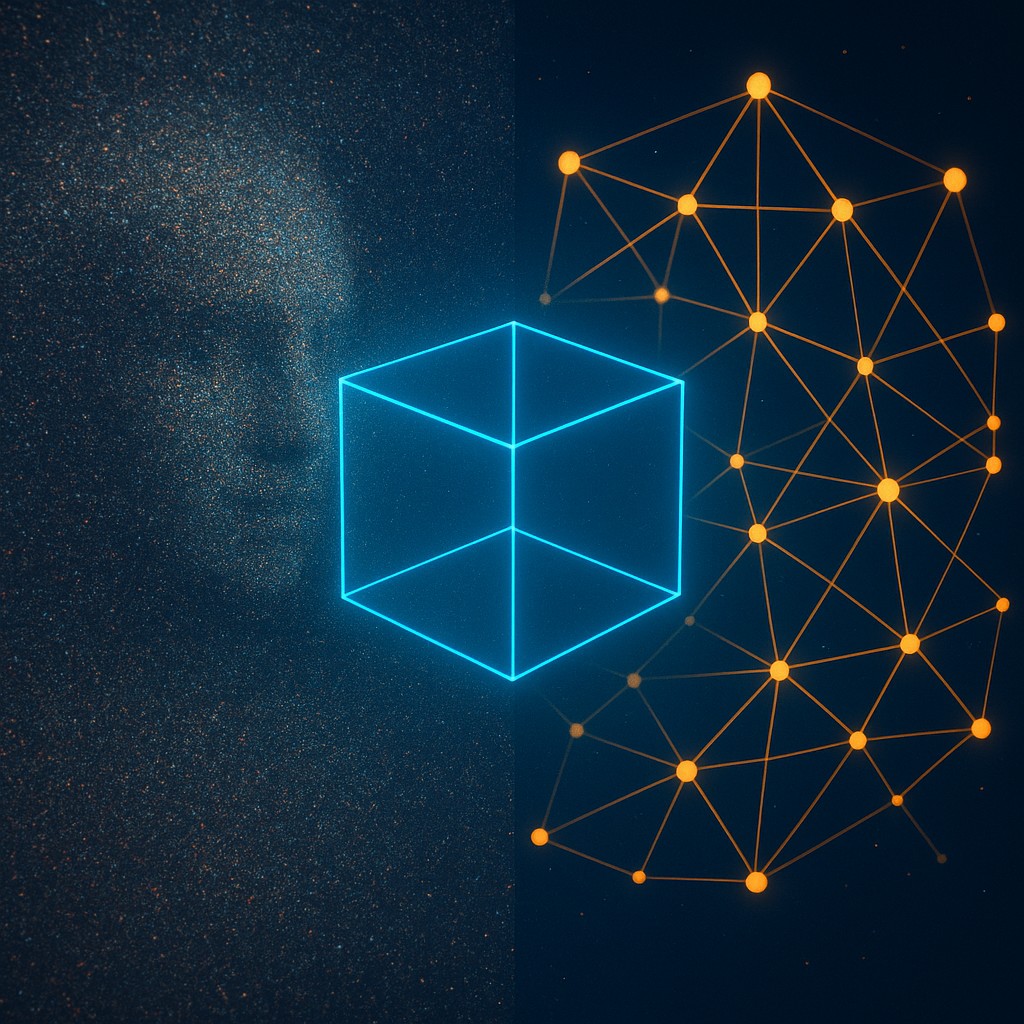
Stare long enough at the static on an old television or the way dust motes dance in a beam of light, and your brain will eventually start to play tricks on you. You might see the faint outline of a face in the white noise or a geometric pattern in the drifting debris. For centuries, we have brushed this off as "apophenia" - a psychological quirk where the human mind, desperate for meaning, projects order onto a chaotic world. We assume the universe is a messy, disorganized place and that any structure we find is just a lucky coincidence or a figment of our imagination.
However, a branch of mathematics called Ramsey Theory suggests your brain might actually be onto something. It turns out that in a large enough system - whether it is a cluster of stars, a massive financial database, or a long string of coin flips - order is not just possible; it is a mathematical certainty. The core philosophy of this field can be summed up in one startling sentence: complete disorder is impossible. As a system grows, specific patterns must appear, no matter how hard you try to keep things chaotic. Understanding this principle changes how we view everything from the constellations in the sky to the swings of the stock market.
The Logic of the Crowded Pigeonhole
To understand how math forces order out of chaos, we start with a simple concept called the Pigeonhole Principle. Imagine you have ten pigeons but only nine nesting holes. If every bird goes inside, it is a logical certainty that at least one hole must contain more than one pigeon. You do not need to see the birds or the holes to know this is true; the math dictates the outcome. It is a fundamental law of constraints. Ramsey Theory takes this basic idea and applies it to much more complex structures, moving from simple counting to the architecture of relationships.
In Ramsey Theory, researchers often look at "graphs," which are just collections of dots (points) connected by lines (edges). If you take a group of dots and color the lines between them using red and blue, you might think you could do it randomly to avoid creating any specific shapes, like a solid red triangle. However, the math proves that once you have enough dots, you lose that freedom. Eventually, the connections become so crowded that a specific pattern is forced into existence. You can try to hide the order by scattering lines or swapping colors, but the larger the system gets, the more the math squeezes those choices until a predictable structure pops out.
This tells us that "randomness" is often just a matter of scale. A small dataset can be truly messy, but a massive one is trapped by its own size. When you have billions of data points, the number of possible relationships is so vast that the laws of Ramsey Theory take over. Patterns that look like miracles are often just the mathematical "tax" a system pays for being large. We often hunt for the reason "why" a pattern exists, but in many cases, the answer is simply that the system was too big for the pattern not to exist.
The Party Problem and the Threshold of Certainty
One famous way to visualize this is the "Theorem on Friends and Strangers." Imagine you are hosting a small dinner party. You want to know the minimum number of guests needed to guarantee there is either a group of three people who all know each other, or a group of three who are all complete strangers. If you invite only five people, it is possible to arrange their relationships so that no such trio exists. You can create a perfect cycle of acquaintances that avoids any mutual groups of three.
However, the moment you invite a sixth person, the math changes instantly. No matter how you arrange the friendships among those six people, you will always find at least one trio of mutual friends or mutual strangers. This is known as the Ramsey number R(3,3) = 6. It represents a tipping point where chaos is no longer sustainable. The table below shows how these numbers grow as the patterns get more complex.
| Pattern Size (Target Group) |
Minimum System Size Required |
The Nature of the Constraint |
| Trio (3 people) |
6 Guests |
Guaranteed 3 friends or 3 strangers. |
| Quartet (4 people) |
18 Guests |
A massive jump in complexity to avoid patterns. |
| Quintet (5 people) |
43 to 48 Guests |
The exact number is still unknown to science. |
| Sextet (6 people) |
102 to 165 Guests |
Beyond our current computing power. |
The most fascinating thing about these numbers is how quickly they become impossible to calculate. While we know a pattern must exist at a certain scale, finding the exact point where it first appears is one of the hardest problems in math. The legendary mathematician Paul Erdős once joked that if a powerful alien race threatened to destroy Earth unless we found the Ramsey number for a group of five (R(5,5)), our best bet would be to link every computer on the planet to solve it. But if they asked for the number for a group of six (R(6,6)), he said we should instead try to destroy the aliens, because the math is simply too vast for us to ever solve.
Seeing Shapes in the Financial Clouds
When we move from abstract dots to the real world of money, Ramsey Theory provides a sobering look at our ability to predict the future. Financial markets generate a staggering amount of data every second. Prices, interest rates, and social media trends swirl into a giant dataset. Within this noise, analysts often find "signals" - shapes in the charts like a "head and shoulders" or a "double bottom" that they believe predict a coming trend.
Ramsey Theory suggests a different interpretation. Because the financial system is so large, the existence of these shapes is a mathematical certainty. You could take a random number generator, create a "stock chart" from its output over a long enough time, and you would eventually see the exact same patterns that expert traders use to make decisions. The patterns are real, but they are often "empty" structures forced by the sheer size of the data rather than any actual economic cause.
This creates a dangerous trap. Humans evolved to find meaning in patterns because, on the ancient grasslands, a pattern in the grass often meant a predator was hiding. But in modern high-frequency trading, a pattern might just be a Ramsey-style inevitability. This is why many data experts are skeptical of "technical analysis" that relies on visual shapes. They understand that in a system of a billion points, you can find a perfect triangle, a pentagon, or even the silhouette of a teapot if you look hard enough. The challenge isn't finding a pattern; it is figuring out if the pattern actually means anything.
The Hidden Architecture of the Universe
The implications of Ramsey Theory reach far beyond dinner parties; they touch the very structure of the universe. Consider the stars. Ancient civilizations looked up and saw hunters, bears, and gods. While we know these constellations are just chance alignments of stars at different distances, Ramsey Theory tells us that any random scattering of dots in space will eventually contain shapes that look familiar. If the universe is large enough, it is mathematically impossible for it not to look organized to someone living inside it.
This leads to a deep realization: "Order" is not the opposite of "Randomness." Instead, order is a part of randomness that emerges once you have enough data. This suggests that the laws of physics themselves might bubble up from a much larger, messy system. Just as a trio of friends is forced to exist once the sixth guest arrives at a party, perhaps the stability of atoms or the orbits of planets is a result of the sheer scale of the cosmos. We often think of "laws" as rules handed down from above, but they might actually be constraints that emerge from the bottom up when things get crowded.
This perspective also changes how we search for alien life or study genetics. When we look at the billions of letters in a DNA sequence, we see incredible patterns. Some are clearly functional, shaped by evolution to build a heart or a lung. But others might just be "Ramsey noise" - patterns that exist simply because a sequence of three billion characters is too long to be truly disorganized. Telling the difference between "meaningful" order and "inevitable" order is one of the great frontiers of modern biology.
Distinguishing Meaning from Mathematical Ghosts
One of the most important lessons of Ramsey Theory is a healthy sense of skepticism toward our own eyes. We live in an era of Big Data, where we can sift through massive amounts of information. We can find links between margarine consumption and divorce rates, or between certain words in the news and the rise of a specific cryptocurrency. Before we celebrate these finds, we must ask: Is this a meaningful connection, or is it just a Ramsey pattern?
To navigate this, scientists use statistical filters to see if a pattern is significant. If a pattern is much stronger than what Ramsey Theory predicts for a system of that size, it might be worth investigating. But if it falls within the bounds of what math says must be there by chance, it is likely just a "mathematical ghost." Learning to tell the difference separates a rigorous scientist from someone simply seeing shapes in the clouds.
A common mistake is thinking that Ramsey Theory makes the world less mysterious by explaining away patterns as simple necessities. In reality, it makes the world more incredible. It suggests there is a deep, underlying grammar to the universe that prevents true chaos from ever taking hold. Even if you tried to create a perfectly messy room or a perfectly random string of numbers, the laws of math would still act as a floor, forcing a level of structure into the mix. There is a strange comfort in knowing that the universe literally does not allow for total disorder.
Embracing the Inevitability of Order
As you move through a world that often feels unpredictable, remember that math is quietly working behind the scenes to hold things together. Ramsey Theory teaches us that structure is not a rare miracle, but an inevitable consequence of a large, complex system. Whether you are looking at how a city grows or how a social network forms, you are seeing laws that were true before the universe even began.
The next time you spot a strange coincidence or a perfect pattern, give a small nod to the Pigeonhole Principle. You are seeing the math of scale in action. While not every pattern carries a hidden meaning, the fact that patterns exist at all is a testament to the elegant rules of our reality. By understanding the difference between a meaningful signal and a mathematical certainty, you gain a clearer view of the world. You learn to appreciate the beauty of the "ghosts" while staying grounded in logic, finding a deeper sense of order in the grand tapestry of existence.