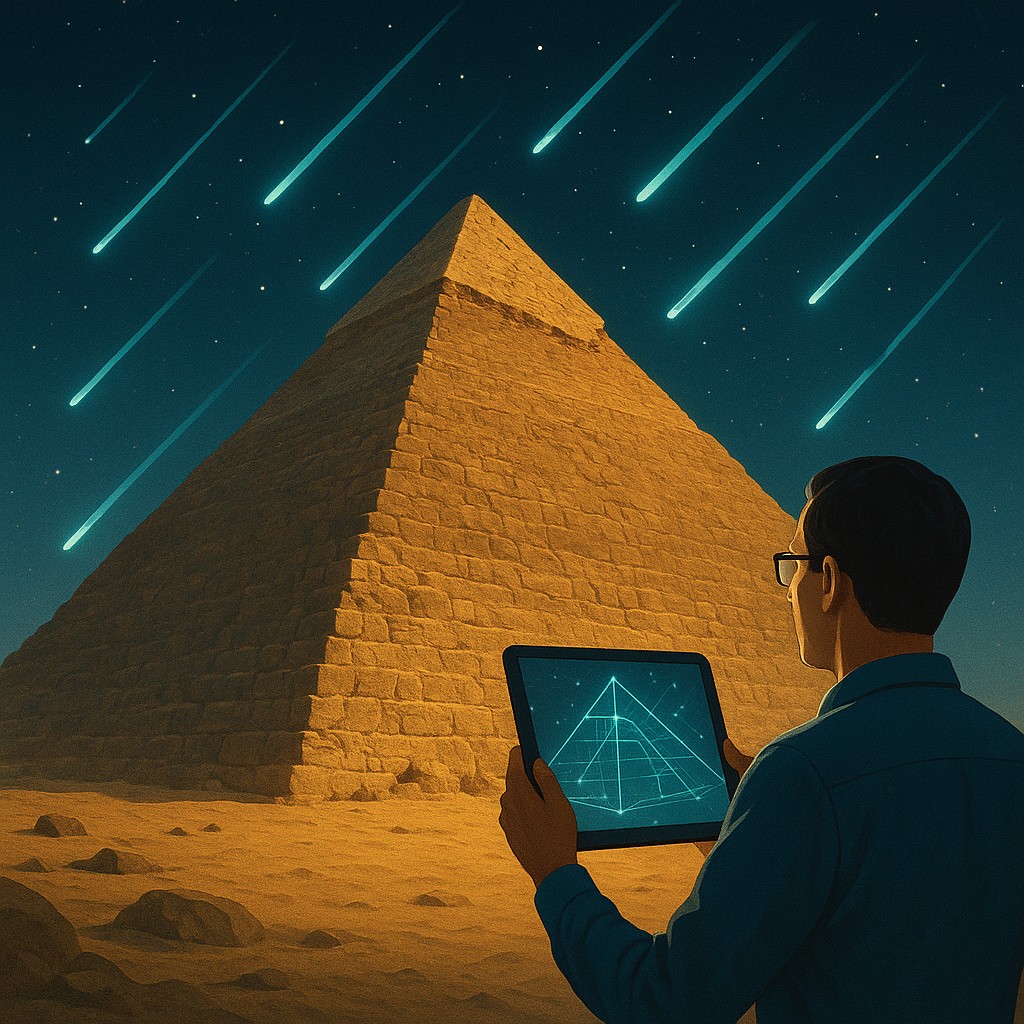
Imagine for a moment that you are standing at the base of the Great Pyramid of Giza. You are looking at several million tons of limestone and granite, a structure so massive it remained the tallest man-made object on Earth for over 3,800 years. You know secrets are hidden inside, chambers that have not felt a breath of air in millennia, but there is a problem. You cannot simply take a sledgehammer to a World Heritage site. Traditional archaeology is often a destructive process, a bit like trying to learn how a clock works by smashing it with a rock. Until recently, we were stuck on the outside looking in, limited by the very stone that preserves history so well.
Everything changed when we realized the universe is constantly shouting at us in a language of subatomic particles. High above our heads, in the upper reaches of the atmosphere, cosmic rays from deep space smash into gas molecules at incredible speeds. This celestial demolition derby produces a constant rain of tiny, invisible particles called muons. These muons are everywhere, passing through your body, your house, and even the ground beneath your feet right now. Because they can penetrate solid matter while still reacting to its density, they have become the ultimate tool for "ghost archaeology," allowing us to see through solid rock as if it were glass.
The Celestial Rain and the Physics of Penetration
To understand how we use space particles to see through a pyramid, we first have to understand what a muon actually is. Think of a muon as the heavier, slightly more rebellious cousin of the electron. It has the same negative charge but is about 200 times more massive. Because of this extra weight and the high speed at which they travel, muons are remarkably good at ignoring obstacles. They do not get bounced around easily by the electromagnetic fields of atoms. While a regular light photon is stopped by a thin sheet of paper and an X-ray by a few inches of flesh and bone, a muon can travel through hundreds of meters of solid rock before it finally loses energy and stops.
This "stopping power" of material is the key to the process. If you have a massive block of solid stone, fewer muons will make it through to the other side compared to a block with a hollow room inside. This is exactly how medical X-rays work. The X-rays pass through soft skin easily but get stuck in dense bones, creating a shadow on the film. Muon tomography is essentially an X-ray of a building, but instead of using a machine in a doctor’s office, we use the natural background radiation of the universe as our light source.
The most fascinating part of this physics is that it requires no power source. We do not have to fire a beam at the pyramid. The universe is already doing the firing for us, 24 hours a day, from every direction in the sky. All we have to do is place "buckets" (detectors) in or around the structure and wait for the muons to fall into them. By measuring the angle and the number of muons reaching the detectors, scientists can calculate exactly how much density they encountered on their way down. If more muons arrive from a specific direction than expected, it means there is a "void" or a hidden room in that direction.
Building a Map with Invisible Shadows
The technology used to catch these muons is as impressive as the particles themselves. There are several ways to detect a particle, but one of the most popular methods in archaeology involves "nuclear emulsion films." These are special plates coated with a chemical gel. When a muon passes through the gel, it leaves a microscopic silver trail, much like a footprint in the snow. Archaeologists can take these plates, place them deep inside a known tunnel or at the base of a monument, and leave them there for months. When the plates are later developed and scanned with high-speed microscopes, the millions of tiny trails reveal the shadows of the structures above.
Another method uses electronic detectors called scintillators. These are plastic bars that give off a tiny flash of light whenever a muon strikes them. This light is converted into an electrical signal and recorded by a computer. The advantage of electronic detectors is that they provide data in real time. Scientists can watch the image of the pyramid’s interior slowly form on their monitors over several months. However, because muons are relatively rare and the structures being scanned are so dense, this is not a "point and click" camera. It is a slow, methodical process of gathering evidence, particle by particle.
| Feature |
X-ray Imaging |
Muon Tomography |
| Radiation Source |
Man-made vacuum tubes |
Natural cosmic rays |
| Penetration Depth |
Centimeters (skin and bone) |
Hundreds of meters (rock and earth) |
| Time Required |
Seconds |
Months to years |
| Impact on Subject |
Minor radiation exposure |
Entirely non-invasive and passive |
| Primary Use Cases |
Medical and industrial checks |
Archaeology, volcanoes, and nuclear safety |
The Great Discovery inside Khufu's Pyramid
The most famous application of this technology occurred during the "ScanPyramids" project, which began around 2015. For centuries, people believed we knew every inch of the Great Pyramid, also known as the Pyramid of Khufu. We knew about the King’s Chamber, the Queen’s Chamber, and the Grand Gallery. But the muon detectors told a different story. In 2017, the team announced the discovery of the "Big Void," a massive hidden space at least 30 meters long, located directly above the Grand Gallery. It was the first major structural discovery inside the pyramid since the 19th century.
Refining the search in early 2023, the team and Egyptian authorities confirmed another discovery: the North Face Corridor. This is a nine-meter-long tunnel located just behind the main entrance chevron, the V-shaped stone structure on the exterior. By using muons to point the way, researchers narrowed down the exact location of this void. Once they were certain it existed, they used a tiny endoscope camera, a flexible tube just a few centimeters wide, to peek through a small gap between the stones. For the first time in 4,500 years, human eyes saw a vaulted ceiling and a corridor that had been perfectly preserved since the days of the Pharaohs.
The beauty of this discovery was that it caused zero damage to the pyramid. No dynamite, no drills, and no heavy machinery were used. Before muon tomography, confirming such a chamber would have required digging exploratory shafts, which would have permanently scarred the monument and potentially weakened its structure. This technology allows us to satisfy our curiosity without sacrificing our heritage. It turns out that being a patient observer of the universe is far more effective than being an aggressive excavator.
Beyond the Pyramids: Volcanoes and Nuclear Voids
The success of muon tomography in Egypt has opened doors in other fields that have nothing to do with mummies. One of the most critical applications is in volcanology. Much like a pyramid, a volcano is a giant pile of rock, and knowing what is happening inside it is a matter of life and death. By placing muon detectors on the slopes of an active volcano, scientists can monitor the density of its interior. If the density begins to decrease in certain areas, it suggests that magma is rising and creating "voids" of less dense liquid rock. This could provide an early warning system for eruptions that is far more accurate than traditional earthquake monitoring.
In the realm of industrial safety, muon tomography has also been used to peer into the hearts of damaged nuclear reactors. After the Fukushima Daiichi disaster in Japan, the environment inside the reactor buildings was far too radioactive for humans or even most robots to enter. However, muons are not affected by radioactivity. Researchers were able to place detectors outside the buildings to see where the nuclear fuel had melted and pooled. This gave engineers the critical information they needed to plan a cleanup strategy without ever stepping foot inside the danger zone.
There is even talk of using muon tomography to scan cargo containers at major ports. Because muons are highly sensitive to "high-Z" materials, which are very dense substances like lead, uranium, or plutonium, a muon scanner could theoretically detect shielded nuclear material hidden inside a shipping crate full of legal goods. Unlike X-ray scanners, which can be fooled by lead shielding, muons are actually stopped or deflected more by lead, making the hidden object stand out even more clearly. It is a rare case where the harder you try to hide something, the more obvious it becomes to the sensor.
The Future of the Invisible Lens
As the technology behind these detectors improves, we are moving toward a more portable version of muon tomography. Early detectors were the size of small vans and required massive cooling systems. Modern detectors are becoming smaller, more rugged, and more energy-efficient. This means we could soon be taking muon "cameras" into remote jungles to find lost Mayan cities buried under mounds of earth, or using them to inspect the structural health of aging bridges and dams from the inside out. We are learning how to use the "trash" of the universe, the leftover particles from cosmic collisions, to build a sophisticated map of our world.
The transition from destructive archaeology to non-invasive sensing marks a philosophical shift in how we interact with the past. We no longer see the earth as something to be conquered and dug up, but as a complex system to be understood through observation. Muon tomography reminds us that the answers to our greatest historical mysteries are not always found by looking down into the dirt, but by looking up into the sky and listening to the silent rain of particles that has been falling since the beginning of time.
Armed with this new perspective, you might find yourself looking at the world a bit differently. The next time you walk past a massive stone building or a mountain, remember that it is currently being scanned by the stars. There is no such thing as a "solid" object if you have the right kind of eyes. We are living in an age where the invisible is becoming visible, and where the secrets of the ancients are finally being whispered to us through the language of subatomic physics. All we have to do is be patient enough to listen.