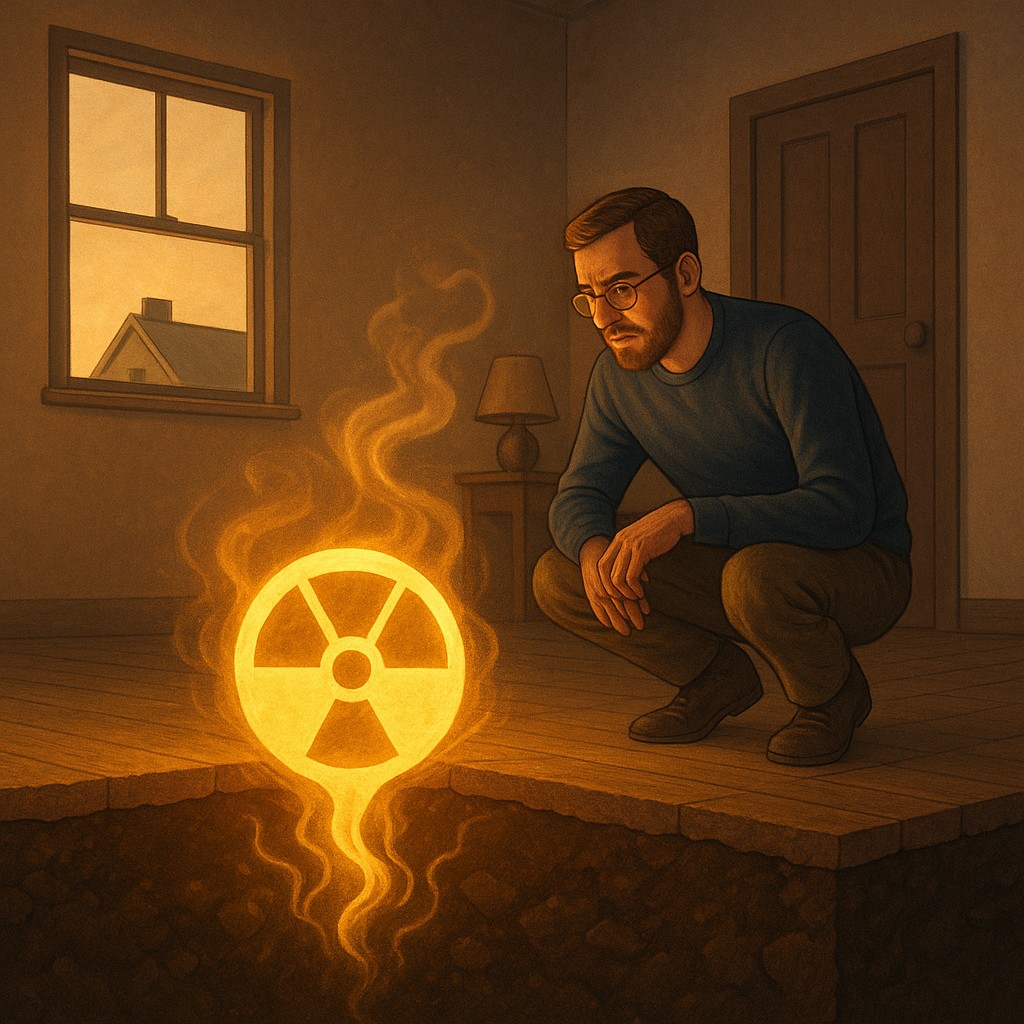
Imagine an invisible guest that slips into your home without ever knocking. It has no smell and leaves no trace on your walls. This intruder isn't a typical burglar; it is a remnant from the birth of the Earth, hunker down in the soil beneath your feet for billions of years. This is radon. Despite a name that sounds like a comic book superhero, this noble gas has a much less heroic personality once it drifts into your lungs. We spend a lot of time worrying about outdoor air pollution or the additives on our plates, yet this silent visitor is the most dangerous roommate you’ve likely never heard of.
The real paradox of radon is how discreet it is. It is impossible for human senses to detect. You cannot smell, see, or taste it, making it the ultimate stealth hazard. However, public health statistics are clear: radon is the leading cause of lung cancer in people who have never smoked. Understanding how a natural gas rising from rocks ends up damaging human DNA is a fascinating journey through geology, atomic physics, and cell biology. By getting to know this invisible enemy, we learn that it isn't an unavoidable fate, but a risk we can measure and manage with a little science and common sense.
The Underground Origins of a Gaseous Traveler
To understand where radon comes from, you have to dig deep - literally - into the Earth's crust. It all starts with uranium, a heavy, unstable element found naturally in many rocks like granite, shale, and phosphates. Uranium is a long-term time traveler that decays very slowly over billions of years. During this long radioactive decline, it transforms into other elements, including radium. Radon is born from radium in the form of a gas. While the elements that came before it were solids trapped in rock, radon is free to move and desperately seeks a path to the surface.
This gas takes advantage of every tiny crack in the bedrock, the pores in the soil, or underground gaps to escape. Once it reaches the open air, it dilutes quickly in the atmosphere. At that point, the concentration becomes tiny and poses almost no health risk. The problem starts when we build airtight boxes - also known as houses or buildings - right in its path. Radon seeps in through cracks in concrete slabs, construction joints, gaps around pipes, or even through floor drains. Once inside, it gets trapped. This is when the concentration starts to climb, turning a natural geological event into a major household health risk.
How the Invisible Attack on Cells Works
You might wonder how a gas that you eventually breathe out can cause permanent damage like cancer. The secret lies in what scientists call "radon progeny." Radon itself is a noble gas, meaning it doesn't like to react chemically with other molecules. However, it is radioactive and has a short half-life of about 3.8 days. When a radon atom decays in your living room air, it transforms into solid particles that are also radioactive, such as polonium-218 and polonium-214. Unlike the radon gas you exhale, these tiny metallic dust motes stick to the delicate tissues in your lungs.
Once they latch onto your bronchial tubes, these particles act like miniature cannons. They fire off "alpha particles," which are essentially heavy atomic projectiles. For our cells, an alpha particle is a devastating cannonball. It doesn't have enough energy to break through your skin, but against the exposed cells of the respiratory system, it is lethal. The physical impact of an alpha particle can snap the DNA strands inside the nucleus of a lung cell. Most of the time, the cell repairs the damage or dies, but sometimes the repair is flawed. This specific mutation, repeated over years of exposure, is what can trigger the uncontrolled cell division that leads to cancer.
Why Non-Smokers Are the Primary Victims of This Gas
We often link lung cancer exclusively to smoking, but the reality is more complex. Radon is the "number one killer" for non-smokers because it works entirely independently of cigarette chemicals. For someone who has never touched a cigarette, long-term radon exposure represents the highest environmental risk for developing a serious lung disease. It is a cumulative risk: a single exposure isn't the danger. Instead, the danger comes from living for twenty years in a home with high radon levels, breathing in those alpha particles day after day, hour after hour.
However, there is a terrifying synergy between tobacco and radon. If you smoke and live in a high-radon home, your cancer risk doesn't just add up - it multiplies. Cigarette smoke creates particles that radon progeny can easily hitch a ride on, increasing the amount of radioactive material deposited in the lungs. Furthermore, lungs already irritated and weakened by smoke are much less capable of repairing the genetic damage caused by alpha radiation. Here is a comparison table to help visualize how these risks interact over a lifetime.
| Exposure Profile |
Estimated Lung Cancer Risk |
Main Cause of Cell Damage |
| Non-smoker / Low radon level |
Very low (~0.7%) |
Natural mutations or city pollution |
| Non-smoker / High radon level |
Moderate to high (~3.6%) |
Constant alpha particle bombardment |
| Smoker / Low radon level |
High (~12%) |
Chemical toxins and tars |
| Smoker / High radon level |
Very high (~62%) |
"Chemistry + Radiation" multiplier effect |
Identifying the Risk Without Panicking
The good news in this radioactive ghost story is that radon is one of the easiest health risks to identify and fix. Because every house is different, even two neighboring homes can have radically different radon levels depending on the soil under the foundation or the quality of the ventilation. The only way to know if you are living with this unwanted guest is to run a test. You can use small devices called dosimeters - passive, affordable tools that you place in your basement or most-used room for a few months. This is ideally done in winter when windows stay shut.
If the test results show levels higher than health guidelines (often set at 200 Bq/m³ or 400 Bq/m³ depending on the country), there is no need to move out in a panic. Technical solutions are very effective. The most common method is a soil depressurization system. A pipe is installed through the floor slab and, with a small fan, it sucks the radon from under the house and vents it outside before it can ever enter your living space. It’s like installing a safety valve for your home. In just a few hours, radon levels can drop dramatically, making the indoor air as healthy as mountain air.
Debunking Myths About Home Radioactivity
Several myths about radon persist, which sometimes stop people from taking action. Some believe that if their home is new or "well-built," they are safe. Often, the opposite is true: modern homes are so well-insulated and airtight to save energy that they trap radon much more effectively than drafty old houses. An airtight house without proper mechanical ventilation acts like a bell jar that concentrates underground gases. Another myth suggests radon only affects mountainous or volcanic regions. While some geological areas are higher risk, health authorities have detected radon in nearly every type of soil worldwide.
Finally, it is important to note that radon does not cause other symptoms like headaches, allergies, or fatigue. Unlike carbon monoxide, which can kill you in a night, radon is a long-term predator. Its only known biological effect at these low doses is an increased risk of lung cancer. Just because you don't feel sick doesn't mean the air is pure. This lack of early warning signs is exactly why routine testing is so crucial. By realizing that our indoor environment is constantly interacting with deep geology, we move from being unaware victims to being responsible, protected residents.
Taking care of your home means paying attention to what is invisible. Knowledge is often the best shield against irrational fears and silent dangers. Radon reminds us that we live on a vibrant planet where chemical and nuclear processes continue to simmer quietly beneath our feet. By running a simple screening test, you take back control over the quality of the air you and your loved ones breathe every moment. There is nothing more satisfying than knowing your home is a safe sanctuary, where the only welcome guests are the ones you choose to invite. Stay curious, be proactive, and breathe easy knowing your environment is as healthy as it looks.