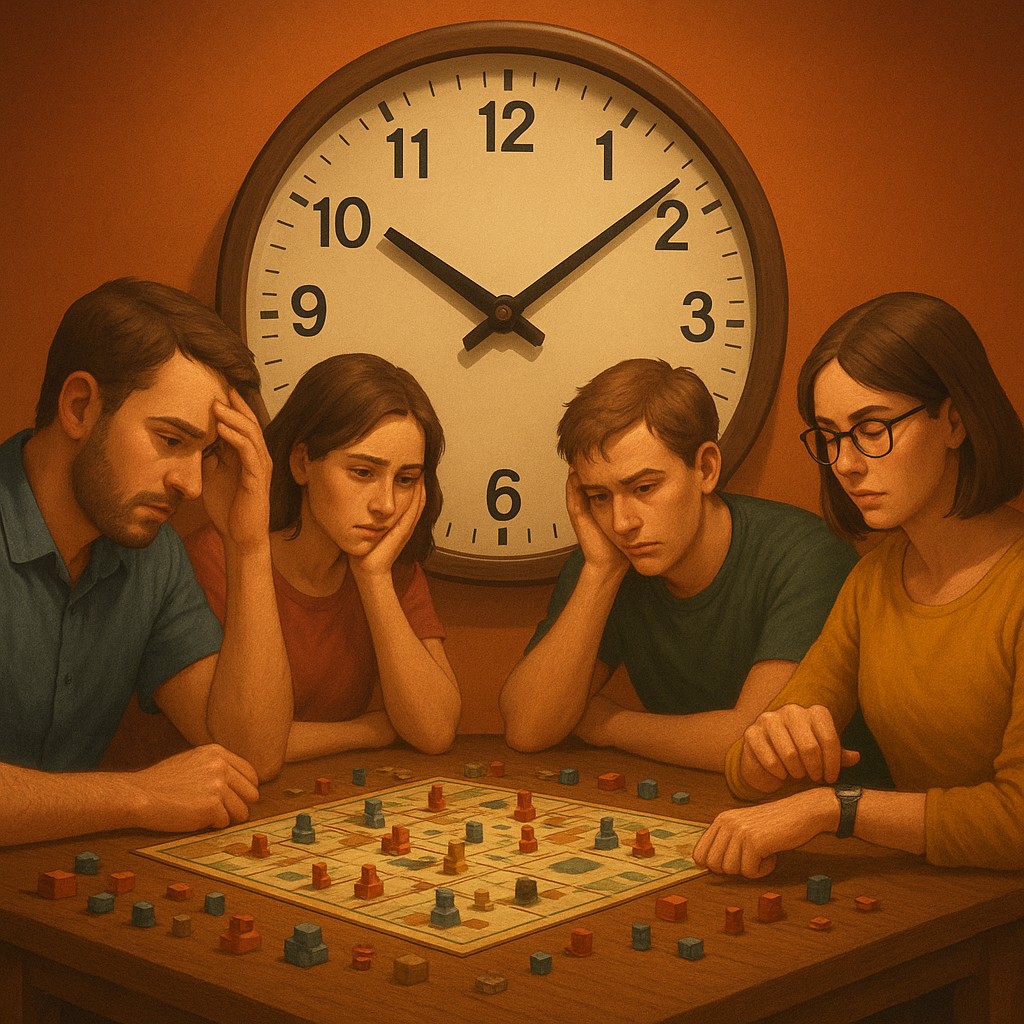
Imagine you are sitting around a table with friends, locked in a tense strategic battle that has lasted three hours. The board is a mess, the scores are neck and neck, but suddenly, the momentum dies. No one wants to make a move because losing a single piece might hand the victory to a rival. You have entered a stalemate, where the most logical strategy is to do absolutely nothing. Instead of a cinematic finale, the game feels like a chore, dragging toward an exhausting conclusion that leaves everyone checking their watches.
Tabletop designers call this "end-game dragging," and it is the enemy of a good time. When a game lacks internal pressure, players often play it safe. They hoard resources and avoid risks, leading to a frozen board. To fix this, modern designers use "accelerating exhaustion" mechanics. By building a ticking clock directly into the rules, they ensure the game doesn't just stop eventually; it builds to a climax where the stakes rise with every passing second.
The Invisible Hand of the Game Clock
In the early days of board games, matches ended when a player reached a certain score or eliminated all opponents. While this sounds logical, it often fails because it puts the entire responsibility of ending the match on the players. If everyone plays defensively, the end never comes. To solve this, designers now include "forcing functions" - built-in countdowns that trigger regardless of player skill. This shifts the goal from simply hoarding points to racing against a fading reality.
Take the classic rule of a deck that does not get reshuffled. In many card games, the game ends when the deck is empty. However, more clever systems go a step further by punishing players for every turn they take after the cards run out. This is often called a "fatigue" mechanic. If you can’t draw a card because the pile is gone, you might start losing health instead. Suddenly, the deck is no longer just a toolbox; it is your lifeblood. This forces a psychological shift: players realize that waiting for the perfect hand now costs more than acting with an imperfect one.
This design is not about rushing the players. It is about making sure decisions matter. In a game with infinite time, you can fix any mistake or recover from a loss over dozens of turns. In a game with a shrinking horizon, every error is amplified because you literally do not have the time to fix it. This creates the tension and drama essential for a memorable experience, as the environment itself squeezes the players toward an inevitable final showdown.
From Wide Horizons to Shrinking Borders
One of the best examples of a forcing function is spatial constraint. This mechanic was made famous by "Battle Royale" video games, but it is deeply rooted in board game theory. At the start, the map is huge, giving players room to hide, gather resources, and build strength. As the game goes on, the playable area shrinks. Whether it is a spreading fire, a rising tide, or a closing magical barrier, the result is the same: players are physically pushed together.
This "spatial exhaustion" changes your strategy as the clock ticks down. Early on, the game is about exploration. In the middle, it is about positioning. By the end, it has turned into a high-stakes brawl because there is nowhere left to run. This prevents the middle of the game from sagging, as players must stay on the move to stay alive. The environment becomes an extra opponent that cannot be defeated, only managed, keeping the pace brisk.
| Mechanic Type |
How it Exhausts |
Psychological Effect |
| Deck Fatigue |
Players lose health or resources when the draw pile is empty. |
Prevents hoarding and creates a "use it or lose it" mentality. |
| Shrinking Map |
The physical board or map becomes smaller over time. |
Forces direct conflict and stops players from stalling. |
| Escalating Costs |
Actions get more expensive or enemies get stronger each turn. |
Encourages efficiency and punishes long, slow setups. |
| Visible Countdown |
A marker moves toward a "Game Over" space every round. |
Creates a sense of urgency and focuses long-term planning. |
The Mechanics of Necessary Sacrifice
An elegant version of this appears in games like Gloomhaven, where your deck of ability cards represents both your moves and your stamina. To pull off a powerful move, you might have to lose a card for the rest of the session. Even if you play it safe, you eventually have to rest to get your cards back, which also requires losing one permanently. This system is brilliant because it turns time into a physical resource you can hold in your hand.
When you start with ten cards, you feel invincible. You have dozens of combinations and plenty of time to explore. But when you are down to your last three cards, the game becomes a desperate puzzle. You stop asking what the "best" move is and start asking which move will let you survive one more turn. This creates an emotional arc like a real battle: you start fresh and capable, but you end bruised and exhausted, stumbling across the finish line with your last ounce of energy.
This also solves "analysis paralysis," where players spend too long thinking. When a player has infinite options, they might spend minutes calculating every outcome. When that same player has only two cards left and knows the game ends in three turns, the decision becomes simpler. The game gets easier to manage precisely because it has become limited. By taking options away, the designer makes the remaining choices feel more important.
Clarity and the Fairness of the End
For an exhaustion mechanic to feel like smart design rather than a cheap trick, it must be "legible." This means players can clearly see the end coming and plan for it. If a game ends suddenly because of a hidden trigger or a random dice roll, it feels unfair. It ruins the long-term strategy the players have built, leading to frustration rather than a satisfying finish.
A well-designed clock is usually right there on the table. It might be a token on a track, a thinning pile of gold, or a shrinking deck of cards. When players know exactly how many turns are left, the game becomes a lesson in timing. Do you spend your second-to-last turn setting up a massive combo, or do you take a small, guaranteed gain now because you know you won't get another chance? This tension between long-term goals and immediate needs is where the best decisions happen.
Furthermore, these mechanics should speed up. A steady clock is predictable, but an accelerating one creates a true climax. In many modern games, early turns might take away one resource, while late turns take away three. This ensures the final rounds feel frantic and high-stakes. It prevents the game from just stopping; instead, it explodes. By the time the final whistle blows, the board should be so depleted or the pressure so high that the game could not possibly continue, leaving everyone breathless and ready to play again.
Designing for Longevity Through Limits
Understanding these mechanics changes how we look at almost any system. Whether it is a deadline at work or a phone’s battery life, constraints drive us to be creative and efficient. In game design, the paradox is that by taking away a player’s freedom to play forever, you give them the freedom to make choices that actually matter. The focus shifts from mindless hoarding to the art of the perfect moment.
The next time you play a game where the map is shrinking or your resources are vanishing, don't see it as a limit. See it as a challenge to be brilliant. These clocks protect you from the boredom of playing it safe. They are the engines of drama, ensuring that every session ends not with a whimper, but with a roar. When the end is in sight and resources are low, your true strategy is revealed, and the most unforgettable victories are won.