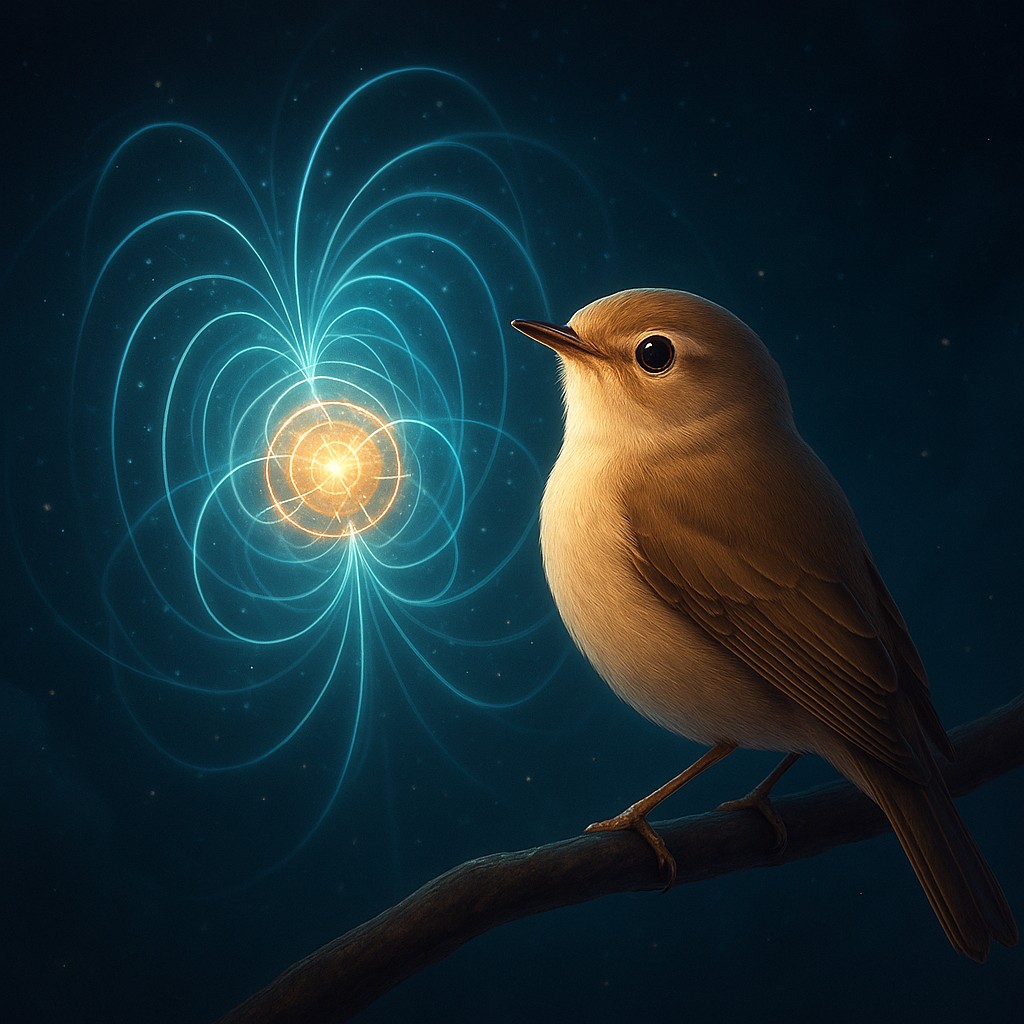
Imagine for a moment that you are a Garden Warbler, a tiny ball of feathers weighing barely as much as a AAA battery. Following a deep-seated biological urge, you take off from a forest in Germany at midnight, bound for the African plains. You have no maps and no GPS. Tonight, a thick blanket of clouds has swallowed the moon and stars. To a human pilot, this would be a recipe for a fatal crash, yet you fly with the confidence of a seasoned captain on a clear day. You aren't just guessing the way; you are following a glowing, ethereal blueprint that exists everywhere but remains invisible to almost every other creature on Earth.
For decades, we assumed birds navigated using simple landmarks or perhaps a "sixth sense" in their beaks that acted like a physical compass needle. However, recent breakthroughs in quantum biology have revealed a reality that is far more cinematic. It turns out that birds don't just "feel" the north; they likely see it. Through a complex interaction between light, chemistry, and the strange laws of subatomic physics, birds have developed a biological head-up display. This allows them to perceive the Earth's magnetic field as a visual layer, transforming the planet's invisible forces into a guiding light that cuts through the darkest night.
The Quantum Engine Inside the Eye
The secret to this biological superpower is a specific protein called cryptochrome 4, located in the retinas of migratory birds. Cryptochromes are ancient proteins found in many species; they usually regulate circadian rhythms, which is the internal clock that tells you when to sleep. In songbirds, however, evolutionary pressure has repurposed these proteins into a high-powered magnetic sensor. When blue light from the sky enters the bird's eye and hits these proteins, it triggers a chain reaction that defies the logic of our everyday world. it starts a process in the realm of quantum mechanics, the branch of physics that governs how atoms and subatomic particles behave.
To understand how this works, we have to look at electrons, the tiny particles that buzz around the center of an atom. When light hits the cryptochrome protein, it knocks an electron from one molecule to another nearby. This creates what scientists call a "radical pair." These are two molecules that each have an unpaired electron. Because these electrons were born from the same event at the same time, they are "entangled." This means their fates are linked; what happens to one instantly affects the other, no matter the distance between them. It is one of the most famous and baffling phenomena in physics, which Albert Einstein famously called "spooky action at a distance."
In the bird's eye, these entangled radical pairs exist in a delicate, wobbling state between two different chemical setups. What makes this a compass is that the Earth’s magnetic field, though incredibly weak, is just strong enough to nudge this quantum wobble. As the bird turns its head, the angle of the magnetic field changes relative to the eye, which alters how long the radical pairs stay in a certain state. This, in turn, changes the chemical signals sent to the bird's brain. Effectively, the bird’s eye is a quantum laboratory, performing trillions of subatomic experiments every second to figure out which way is north.
A Visual Filter for the World
If the brain is receiving these chemical signals from the retina, what does the bird actually experience? While we cannot climb inside the mind of a robin, researchers have developed models to simulate how this information might merge with a bird's vision. The leading theory suggests that the magnetic field appears as a shaded pattern, like a dark spot, a bright flare, or a gray smudge placed over their normal view. Imagine wearing high-tech glasses that highlight the path home with a faint, glowing arrow that gets brighter as you face the right direction.
This visual overlay is incredibly sophisticated because it is based on the "inclination" or dip of the magnetic field lines, rather than just a simple North-South pole. The Earth’s magnetic field lines do not just run flat along the ground; they curve into the Earth at the poles and run parallel to the ground at the equator. By "seeing" the angle at which these lines hit the planet, a bird can tell not just which way it is facing, but also its latitude. This gives them a built-in map that tells them, "You are 500 miles south of your starting point, and the turn-off for the Mediterranean is coming up on your left."
This system is elegantly designed to work during peak migration times. Since cryptochromes need blue light to activate the radical pair reaction, birds are most sensitive to the magnetic field during the twilight hours of dusk and dawn. This is exactly when many species begin their long flights. Even on a cloudy night, there is often enough blue light scattered in the atmosphere to keep the quantum compass running. It is a masterpiece of biological engineering that turns the entire atmosphere into a readable map.
Comparing Biological Navigation Systems
To appreciate the elegance of these quantum eyes, it helps to compare them to other ways animals and humans find their way. While many animals use a combination of these methods, the songbird's quantum compass is unique because it relies on subatomic physics.
| Navigation Method |
Primary Mechanism |
Pros |
Cons |
| Landmark Navigation |
Recognizing mountains, rivers, or coastlines. |
Very reliable in familiar areas; easy to process. |
Useless in fog, at night, or over the open ocean. |
| Celestial Navigation |
Tracking the sun or star patterns. |
Great for long distances; provides a clear heading. |
Requires clear skies; stars shift position over time. |
| Olfactory Maps |
Detecting "scent" gradients in the air. |
Effective for finding a specific home (like salmon). |
Easily disrupted by wind or pollution; short range. |
| Quantum Magnetoreception |
Seeing the magnetic field via radical pairs in the eye. |
Works in total darkness; shows direction and latitude. |
Can be confused by man-made electronic interference. |
The Fragility of a Quantum Sense
As impressive as this system is, it has a significant downside. Quantum states are famously fragile. In a lab, physicists have to cool experiments to near absolute zero to keep particles entangled. The fact that a bird can maintain this quantum state inside a warm, busy biological eye is nearly a miracle. However, because the system is so sensitive, modern human technology easily disrupts it. We have unintentionally filled our world with "electromagnetic noise" from radio towers, power lines, and even common household electronics.
Research shows that low-frequency radio waves and electronic interference can essentially "jam" the bird’s quantum compass. In controlled experiments, birds were placed in wooden huts that let the Earth’s magnetic field pass through but exposed them to the "buzz" of electronics from a nearby city. The birds became completely disoriented. They hopped in random directions, unable to find their route. When researchers shielded the huts with aluminum to block the electronic noise, the birds immediately regained their sense of direction and pointed toward their migratory goals.
This discovery has serious stakes for conservation. As we cover the planet in 5G networks, Wi-Fi, and electronic grids, we may be "blinding" migratory species. If a bird's navigation system is flooded with static, it is like trying to drive through a blizzard with a flickering GPS. Understanding the quantum nature of bird eyes reminds us that our technological footprint extends far beyond what we can see or hear; it reaches into the subatomic processes that have guided life for millions of years.
Correcting the Magnetite Myth
For a long time, the leading theory was that birds navigated using magnetite, a natural magnetic mineral. Scientists found tiny clusters of magnetite in the beaks of some birds and assumed these acted like mechanical compass needles that pulled on nerves to signal direction. While magnetite does play a role in some animals, such as fish and perhaps some birds for sensing the strength of a magnetic field, it is not the main engine for songbirds.
The "beak-compass" theory had a major flaw: it could not explain why birds needed light to navigate. If the sensor were a mechanical piece of iron in the beak, a bird should be able to navigate in pitch-black darkness or even with a blindfold. However, decades of experiments showed that if you change the color of light available to a bird, or take it away entirely, their ability to find North vanishes. This "light-dependent" navigation was the smoking gun that led scientists away from the beak and toward the retina, eventually uncovering the role of cryptochromes and the quantum radical pair mechanism.
It is likely that birds use multiple senses at once. They might use the quantum compass in their eyes for a general heading and use magnetite sensors elsewhere to feel the strength of the field. This backup system makes them incredibly resilient, but the visual quantum component is the star of the show when it comes to steering the flight.
Lessons from the Avian Aviator
The realization that a common songbird masters quantum physics in a way humans are only beginning to copy in multi-million dollar labs is a true wonder. It challenges the old view of animals as "simple" creatures driven purely by instinct. Instead, we see them as sophisticated biological machines capable of interacting with the fundamental forces of the universe. This isn't just a fun fact for birdwatchers; it is a scientific frontier that could lead to new types of sensors or navigation technology for humans that don't depend on fragile satellite networks.
Beyond the science, there is a poetic beauty in the journey of a migratory bird. Every year, billions of tiny hearts beat across oceans and deserts, guided by a hidden light we can only imagine. It reminds us that there are still mysteries hiding in plain sight, tucked away in the eyes of a bird singing on a backyard fence. By protecting these creatures and the invisible highways they travel, we aren't just saving a species; we are preserving one of the most incredible examples of natural engineering in the universe. Next time you see a flock of birds overhead, remember they aren't just flying; they are navigating a world of light and shadows that we are only just beginning to see.