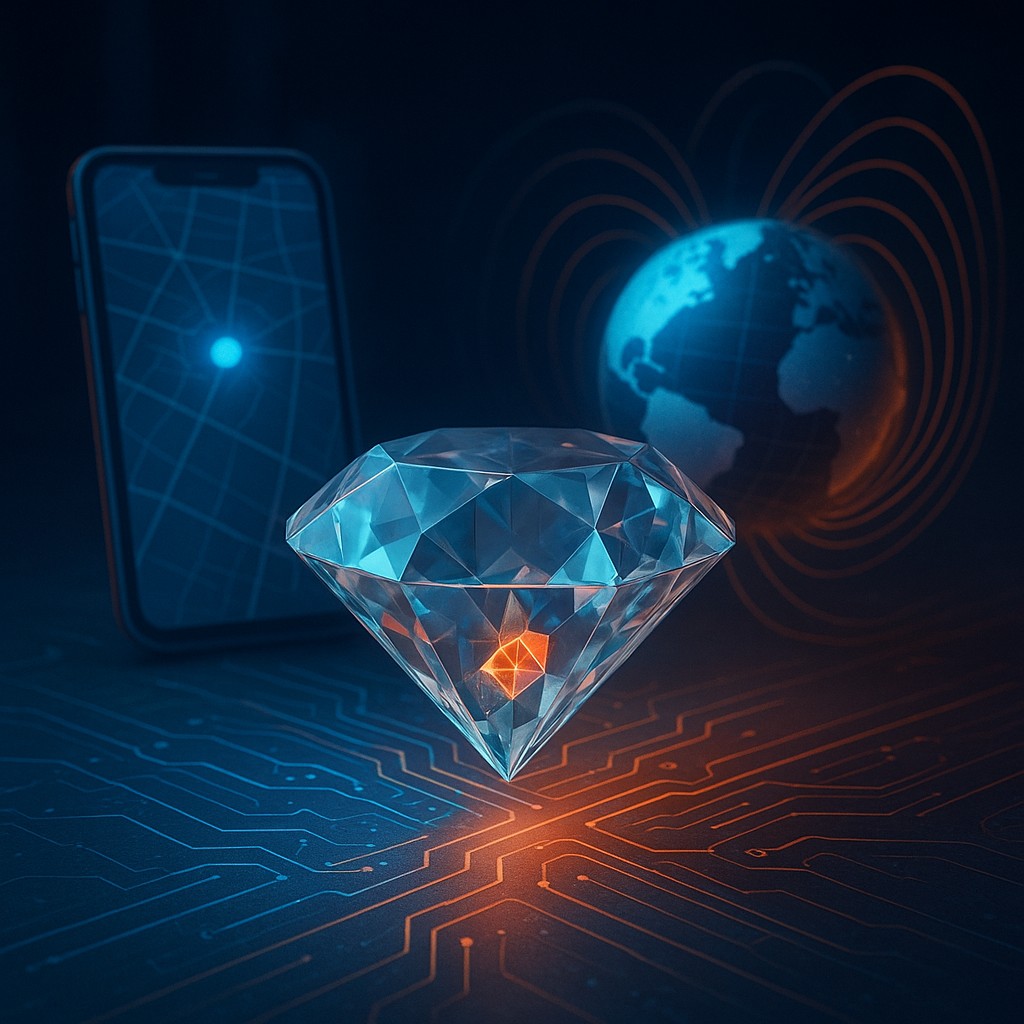
Imagine you are deep inside a concrete parking garage or weaving through a forest of skyscrapers in a sprawling city. Suddenly, the blue dot on your digital map begins to flicker, dance across the screen, or freeze entirely. We have become incredibly dependent on Global Positioning System (GPS) signals, which are essentially faint whispers from satellites orbiting thousands of miles above us. These signals are remarkably weak, easily blocked by physical barriers, and increasingly vulnerable to "jamming" or "spoofing" by bad actors who aim to scramble or fake the data. When those signals fail, we are as lost as a Victorian traveler without a compass, despite the supercomputers in our pockets.
But what if the Earth itself could guide us? Instead of a signal sent from space, we could use a permanent, invisible map that exists everywhere. The Earth’s magnetic field is a constant presence, flowing through every mountain, ocean, and building. While traditional compasses give us a general sense of north, they aren't precise enough to steer a self-driving car through a narrow alley or guide a submarine through a jagged underwater trench. To turn magnetism into a reliable navigation tool, we need a sensor that is incredibly sensitive, durable, and tiny enough to work at a microscopic level. This is where a small, intentional flaw in a diamond enters the story, promising a future where losing a signal is a thing of the past.
The Brilliant Imperfection of Synthetic Diamonds
When we think of diamonds, we usually focus on their clarity and the way they sparkle. However, for a quantum physicist, the most interesting diamonds are the ones that are "broken" in a very specific way. In a perfect diamond, every atom is carbon, arranged in a rigid, beautiful lattice. Scientists have learned how to create synthetic diamonds and then intentionally knock out a few carbon atoms. In their place, they insert a nitrogen atom and leave an empty hole, or a "vacancy," right next to it. This structural hiccup is known as a Nitrogen-Vacancy (NV) center, and it acts as a tiny, trapped laboratory for quantum physics.
These NV centers are essentially "artificial atoms" with their own electronic spin. Because they are encased in the rigid structure of the diamond, they are protected from the "noise" and interference that usually destroys quantum states. Most quantum technologies require extreme cold, often near absolute zero, to function. But the NV center is a rare beast: it can maintain its quantum properties at room temperature. This makes it a prime candidate for real-world hardware that doesn't need a vat of liquid nitrogen just to stay turned on.
The magic happens when you shine a green laser on these diamond defects. The NV center absorbs the light and glows back, usually in red. However, the intensity of that red glow is not constant. It changes based on the magnetic field surrounding the diamond. By measuring the brightness of the light, scientists can determine the strength and direction of the local magnetic field with staggering precision. It is like having a microscopic lighthouse that changes its brightness every time a magnet moves even a fraction of a millimeter nearby.
Mapping the Invisible World Through Magnetometry
To understand how this helps us find our way, we have to view the Earth differently. The planet’s magnetic field isn't a smooth, uniform blanket; it is more like a wrinkled, textured landscape. As you move, the magnetic field changes slightly based on the geology beneath your feet, the presence of iron ore, or even large buildings nearby. If you have a sensor sensitive enough to detect these tiny "wrinkles," you can create a high-resolution map of the magnetic field. Once you have that map, you don't need a satellite to tell you where you are; you just look at the magnetic "scenery" around you.
This process is known as magnetic anomaly navigation. By comparing real-time magnetic readings from a diamond sensor against a pre-recorded magnetic map, a vehicle can find its location with pinpoint accuracy. Unlike GPS, which can be turned off or blocked, the Earth’s magnetic field is always "on." It cannot be jammed by a transmitter because you cannot "jam" the planet’s own physics. This makes it an ideal backup system for military vessels, aircraft, and critical infrastructure that cannot afford to go blind due to a lost satellite connection.
| Feature |
GPS Navigation |
Quantum Magnetic Navigation |
| Data Source |
Satellites in orbit |
Earth's natural magnetic field |
| Reliability |
Can be jammed or blocked by buildings |
Permanent and unjammable |
| Environment |
Best under an open sky |
Works underwater, underground, and in cities |
| Hardware |
Small chips in every phone |
Currently bulky (shrinking fast) |
| Precision |
High, but fluctuates with signal |
High, based on local field textures |
The move from traditional magnetometers to quantum diamond sensors is like switching from a blurry Polaroid to a high-definition digital photograph. Traditional sensors often suffer from "drift," where their accuracy slowly fades over time. Quantum sensors, however, are tied to fundamental constants of physics. The way an NV center reacts to a magnetic field depends on the laws of quantum mechanics, which remain constant. This provides a level of stability and trust essential for autonomous systems like self-driving cars or drones.
Shrinking the Quantum Laboratory
You might wonder why your smartphone doesn't already have a tiny diamond to help you find the nearest coffee shop. The challenge isn't the diamond itself, which can be smaller than a grain of sand, but the "support crew" it requires. To read a quantum state, you currently need a laser to excite the diamond, a microwave generator to manipulate its spin, and a high-quality light detector to measure the glow. While the "heart" of the sensor is microscopic, the machinery surrounding it is currently the size of a shoebox or a large desktop computer.
Engineers are now racing to shrink these parts. They are working on "lab-on-a-chip" designs that build tiny lasers and microscopic antennas directly onto the diamond's surface. We saw a similar path with computers; the first ones filled entire rooms, yet today we carry thousands of times that power in our pockets. The goal is to create a "plug-and-play" quantum module that fits into a car dashboard or a ship’s hull without taking up space.
There is also the matter of data. To navigate this way, we need incredibly detailed maps of the Earth's magnetic field. Governments and private companies are using airplanes and ships equipped with high-end sensors to survey the globe and build these digital "magnetic charts." It is a massive task, but once a region is mapped, that data remains useful for a very long time. Miniaturized hardware and comprehensive mapping will be the twin pillars of this navigation revolution.
Overcoming Environmental Noise and Practical Hurdles
If these sensors are so sensitive, wouldn't they be driven crazy by a passing truck or a nearby power line? This is one of the biggest hurdles in quantum sensing. In a noisy city, magnetic signals are everywhere. The challenge for researchers is to distinguish between the "background noise" of the city and the "signal" of the Earth's magnetic field. It is like trying to hear a specific bird chirping in the middle of a loud rock concert.
To solve this, scientists use "differential" or "vector" sensing. By using multiple NV centers at different angles or positions, they can cancel out local interference. If a car drives by, it might create a huge magnetic spike on one side of the sensor but not the other, allowing the system to filter it out. Additionally, sophisticated AI algorithms are being trained to recognize the specific "signature" of the Earth's magnetic field and ignore the static created by human technology.
Then there is the question of cost. Synthetic diamonds are cheaper than natural ones, but the specialized craftsmanship required to create perfect NV centers is still expensive. However, as manufacturing scales up and demand grows, especially in the shipping and car industries, we expect to see prices drop. The history of technology shows that today’s exotic laboratory experiment is tomorrow’s mass-produced gadget.
A Future Guided by Physics
The potential for this technology goes far beyond just replacing the GPS on your phone. In medicine, these same diamond sensors are being tested for their ability to detect the tiny magnetic fields produced by the human heart or brain. This could lead to diagnostic tools you wear like a simple patch. In deep-sea exploration, quantum sensors could allow autonomous submarines to map the ocean floor with incredible precision, navigating through the dark where no GPS signal can ever reach.
We are standing at the threshold of a new era of "silent navigation." It is a future where our devices no longer just listen for a ping from a satellite, but are intimately aware of the physical forces of the planet itself. This shift represents a move toward greater independence and resilience. When we learn to read the invisible language of the Earth's magnetic field, we are never truly lost, as long as we have a little bit of "flawed" diamond to show us the way.
As you look at the jewelry in a shop window or consider the complexity of your smartphone, remember that the next great leap in technology might not come from building something bigger or faster, but from looking closer at tiny imperfections in a crystal. The quantum world is often described as strange and distant, but through the diamond sensor, it is becoming a practical tool that will keep us on the right path.