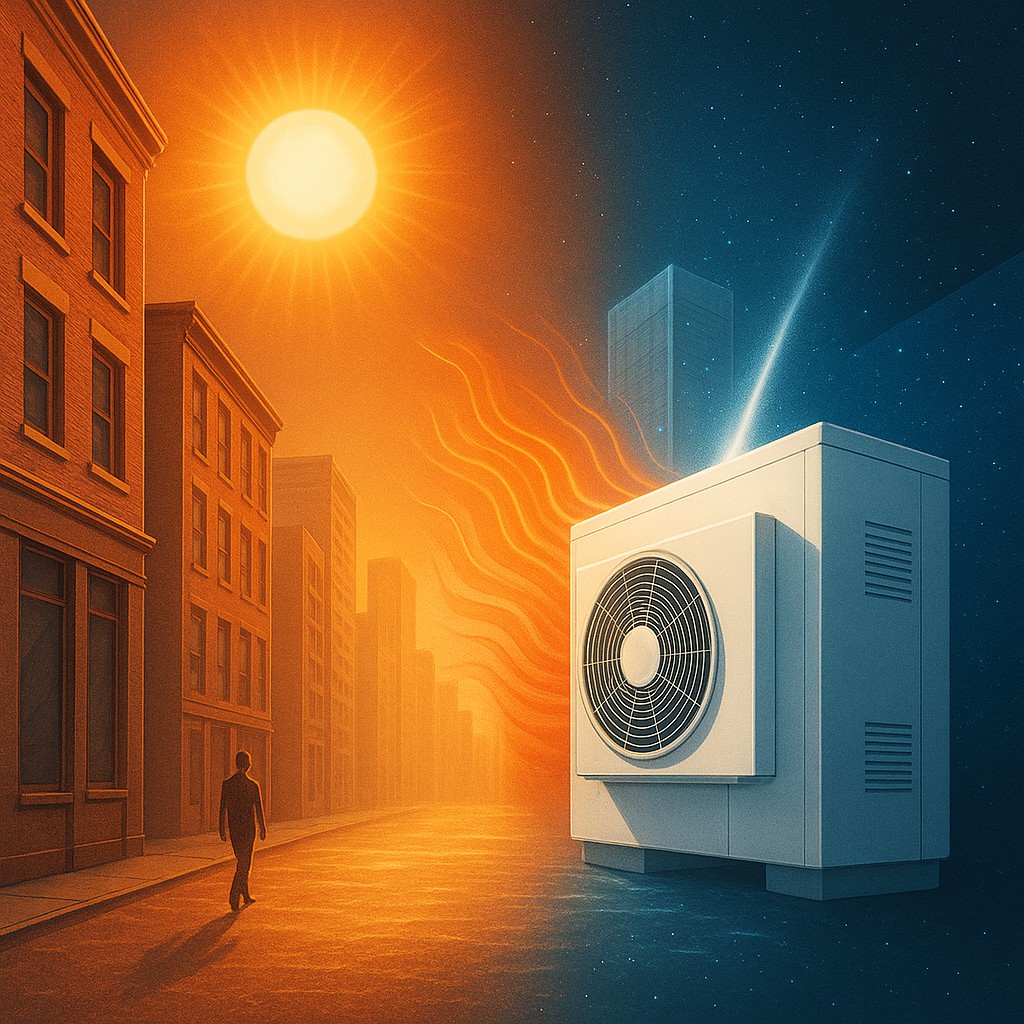
Imagine standing on a city sidewalk in the middle of July. The air feels like a thick, invisible blanket, the pavement radiates a shimmering haze of heat, and the brick buildings around you seem to be breathing fire. This is not just your imagination or a personal dislike of humidity; it is a documented phenomenon known as the Urban Heat Island effect. While the countryside enjoys the cooling touch of grass and trees, our cities have become giant, accidental batteries for heat. They soak up sunlight all day in dark asphalt and concrete, then release that trapped energy slowly throughout the night. This makes cities significantly hotter than their rural neighbors.
For decades, our main solution to this sweltering reality has been to fight heat with more power. We bolt massive air conditioning units to our windows and rooftops, cranking them up until the electrical grid groans under the pressure. The irony is that these machines cool our indoor spaces by pumping that heat directly back outside, further cooking the city and demanding even more power. It is a feedback loop that drains our wallets and strains the environment. However, a revolutionary shift is occurring in the world of materials science. Instead of just trying to hide from the sun, engineers have developed a way to literally beam our excess heat into the freezing void of deep space.
The Concrete Jungle as a Giant Thermal Sponge
To understand why cities get so hot, we have to look at the chemistry of our streets and roofs. Most urban infrastructure is built to be durable and cheap, which often means using dark materials like asphalt roads or black tar roofing. These materials are incredibly good at absorbing solar radiation across the entire spectrum. When a particle of light from the sun hits a dark roof, it does not bounce away. It is absorbed, causing the molecules in the roofing material to vibrate faster and generate heat. This heat then travels into the building, raising the temperature of the rooms below and forcing your AC to work overtime.
This stored energy creates a massive reservoir of warmth. In a dense city, tall buildings create what scientists call "urban canyons." During the day, sunlight bounces between these vertical walls, getting absorbed at every turn. At night, when the earth should be cooling down, these massive structures continue to bleed heat back into the narrow streets. This trapped energy is why a city can remain ten degrees warmer than the surrounding woods long after the sun has gone down. This is a structural problem that requires a structural solution, rather than just a more powerful fan.
Beyond Simple Reflection and Surface Shading
When we think of staying cool, we often think of wearing a white t-shirt. White paint is a step in the right direction because it reflects a good portion of visible light, but standard white paint has a dirty little secret: it is actually quite bad at reflecting the invisible parts of the solar spectrum, like ultraviolet and near-infrared light. Most commercial white paints use titanium dioxide as their main pigment. While it looks bright to our eyes, it still absorbs about 10% to 15% of the sun's energy. Over a large rooftop, that 10% adds up to a staggering amount of heat being pulled into the building.
Ultra-white paints - representing the next generation of cooling technology - take a completely different approach. Instead of titanium dioxide, researchers have turned to barium sulfate, a compound often used in photo paper and cosmetics. By using very high concentrations of this mineral and varying the sizes of the particles within the paint, they have created a surface that reflects up to 98.1% of all sunlight. This is a massive leap forward. Because the particles are different sizes, they can scatter different wavelengths of light. The paint effectively acts like a mirror that works against the entire solar spectrum, not just the parts we can see.
The Physics of Beaming Energy into the Void
The most impressive aspect of this technology is not just that it reflects light, but that it uses a phenomenon called "passive radiative cooling." This sounds like science fiction, but it relies on a specific quirk of our atmosphere. Our air is quite good at trapping heat, which is generally helpful for keeping the planet livable. However, there is a narrow "window" in the infrared spectrum where the atmosphere is transparent. If you can make heat vibrate at just the right frequency, it passes through the air like a ghost and heads straight out into the universe.
This ultra-white paint is designed to be an exceptional emitter of heat at these specific frequencies. It does not just act as a barrier; it acts as a highway. It takes the thermal energy from the building and broadcasts it into the coldness of outer space, which sits at a chilly near-absolute zero. This allows the painted surface to actually become colder than the air surrounding it, even while the sun is beating down on it at noon. It is an active cooling process that requires zero electricity and has no moving parts. It essentially turns every square inch of a rooftop into a tiny, silent refrigerator.
Comparing Traditional Methods and Radiative Cooling
To appreciate the impact of this shift, it helps to see how the new technology stacks up against the tools we have used for the last century. While insulation and standard cool roofs were better than nothing, they were essentially defensive maneuvers. Advanced radiative cooling is an offensive strike against rising temperatures.
| Feature |
Standard Insulation |
Standard Reflective Paint |
Ultra-White BaSO4 Paint |
| Primary Function |
Slows heat transfer |
Reflects visible light |
Reflects light + Emits IR heat |
| Solar Reflectance |
Not applicable |
80% to 90% |
98.1% and above |
| Cooling Method |
Passive resistance |
Reduced absorption |
Active radiative cooling |
| Temps vs. Ambient |
Always warmer/same |
Slightly warmer/same |
Can be 8-19°F cooler |
| Energy Usage |
Zero |
Zero |
Zero (and reduces AC load) |
| Mechanism |
Physical barrier |
Titanium dioxide scattering |
Barium sulfate particle variety |
As the table suggests, the jump from 90% reflectance to 98% might look small on paper, but in terms of heat absorption, it is a game changer. A roof that absorbs 10% of the sun's energy is going to get significantly hotter than one that only absorbs 2% or less. When you combine that tiny absorption rate with the ability to dump internal heat out into space, you change the fundamental physics of how we build structures.
Correcting the Misconception of Passive Insulation
A common misunderstanding is that this paint is just a fancy form of insulation. It is vital to distinguish between the two. Insulation is like a thick winter coat; it is designed to slow down how fast heat moves from a hot area to a cold one. If it is 100 degrees outside, insulation just tries to prevent that heat from leaking into your 70-degree living room. However, insulation eventually "saturates," and if the sun stays out long enough, the heat will eventually soak through.
Radiative cooling paint is more like a high-tech exhaust pipe. It does not just block the heat; it actively removes it. Because it reflects almost all incoming energy and then radiates away the energy it already has, it can stay cooler than the surrounding air. You could touch a standard white roof on a hot day and it might feel warm; if you touched an ultra-white radiative roof, it would actually feel cold. This means the pressure on the building's internal cooling system is not just reduced, but sometimes eliminated entirely during milder months.
Scaling Solutions for a Warming World
The beauty of this technology lies in its simplicity and how easily it can be spread. We do not need to invent a brand-new way to build skyscrapers or pave roads to benefit from it. Because the solution is a liquid coating, it can be applied to existing buildings with a roller or a spray gun. It is a "retrofittable" solution for a planet that is already built. We can take the millions of square miles of dark rooftops already in existence and turn them into a massive network of cooling panels.
Furthermore, the environmental benefits go beyond lower electricity bills. By cooling city surfaces, we reduce the formation of ground-level ozone (smog), which forms more easily in high heat. We also reduce "thermal shock" to local waterways. Usually, when it rains in a city, the water hits a blazing hot parking lot, heats up instantly, and then flows into local streams where it can kill fish. If the pavement is cool to begin with, the runoff stays at a safe temperature. This paint represents a rare "win-win-win" scenario for residents, city planners, and the environment.
Embracing a Brighter and Cooler Future
As we look toward the future of city living, the tools we use must be as clever as our problems are complex. The transition from materials that trap heat to materials that actively reject it is a milestone in our relationship with the environment. We are no longer just trying to survive the heat of our own making; we are learning to use the laws of physics to restore a balance that was lost when we first paved our streets. This technology offers a glimpse into a world where our cities can be sanctuaries of cool, quiet efficiency, blending with the natural world rather than creating pockets of artificial heat.
There is something poetic about the idea that we can solve a global warming problem by looking at the stars. By engineering surfaces that "see" the coldness of deep space, we are connecting our buildings to the vast, icy universe to find relief. It reminds us that science is not just about making bigger machines, but about finding more elegant ways to live within the systems that already exist. As these ultra-white coatings move from the lab to our rooftops, they bring the promise of more breathable cities, lower energy costs, and a much-needed breath of fresh air for a warming planet.