Imagine for a moment that the world as we know it has suffered a catastrophic setback. Perhaps a massive solar flare has knocked out power grids, or a local conflict has devastated a region's farming heartland. In the middle of the chaos, the one thing we absolutely cannot afford to lose isn't our digital photos or our bank accounts, but the biological blueprints for the food we eat. If a specific variety of wheat or rice disappears from the earth, it is gone forever, taking with it thousands of years of history and natural evolution. This isn't just a plot for a post-apocalyptic movie; it is a very real risk that scientists have been working to prevent for decades.
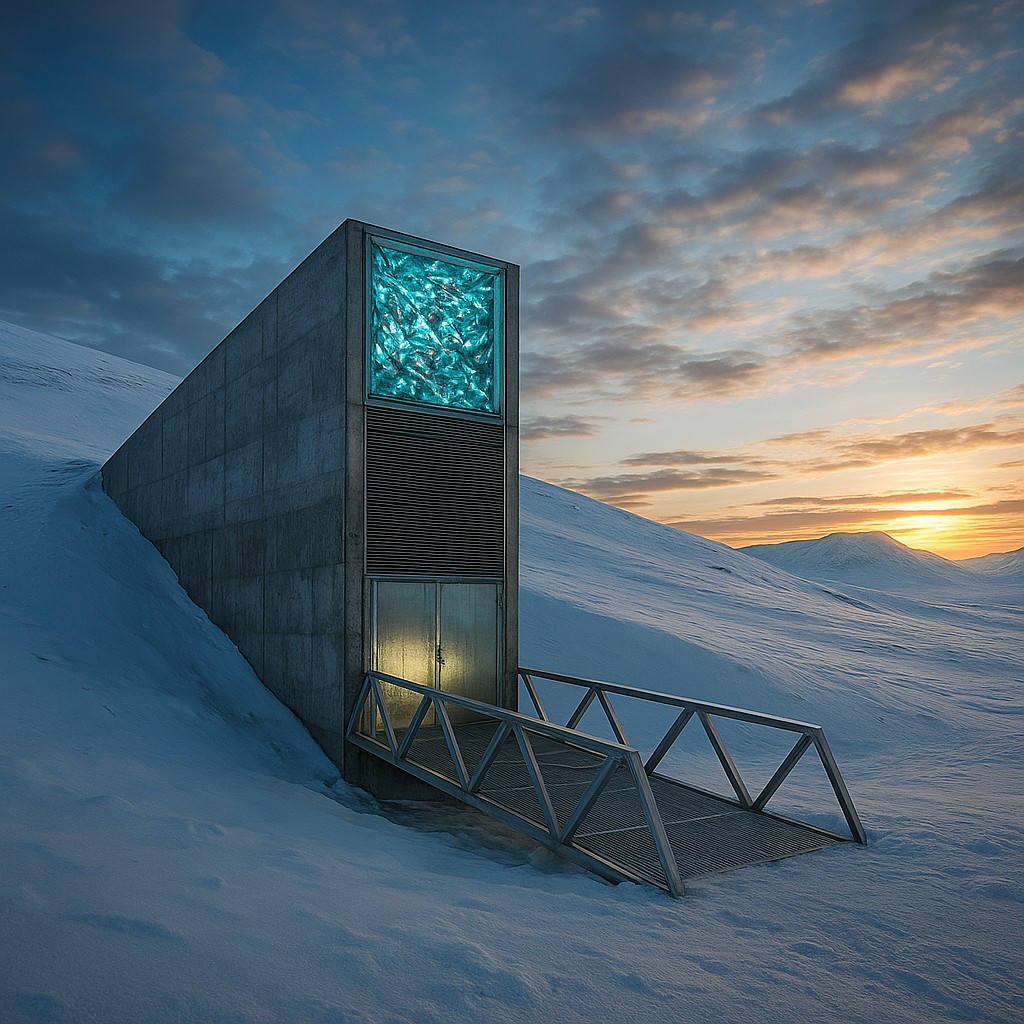
Tucked away in the freezing isolation of the Arctic Circle, there is a facility designed to be the ultimate safety net for humanity’s food supply. Although the media often calls it the "Doomsday Vault," the people who run it prefer the more professional name: the Svalbard Global Seed Vault. It is a place where time stands still and the most precious treasures of our civilization are kept in a deep freeze. This fortress of biodiversity ensures that no matter what happens on the surface of our planet, the genetic variety of our crops remains safe and sound, ready to be replanted if the world ever needs a fresh start.
The Fortress in the Permafrost
To understand why this vault exists where it does, you first have to look at a map and find the Svalbard islands. This archipelago belongs to Norway and sits about halfway between the Norwegian mainland and the North Pole. It is a land of polar bears, northern lights, and permafrost-ground that stays frozen all year round. The vault itself is dug deep into the side of a mountain called Platåberget, near the tiny town of Longyearbyen. Choosing this location was a stroke of geographical genius. Because the mountain is made of thick sandstone and sits high above sea level, the seeds are safe from rising tides, earthquakes, and even the heat of a potential nuclear blast.
The vault is reached through a long tunnel that cuts 150 meters into the rock. At the end of this tunnel are three massive chambers, though currently, only one is in active use. The natural cold of the surrounding frozen ground acts as a "fail-safe" cooling system. Even if the mechanical cooling equipment failed entirely, the seeds would remain frozen at temperatures well below zero for decades. However, to keep the seeds in perfect condition for hundreds or even thousands of years, the vault is artificially cooled to a crisp -18 degrees Celsius (-0.4 degrees Fahrenheit). At this temperature, the seeds' internal activity slows to a near-halt, effectively putting them into a state of suspended animation.
What makes the Svalbard vault unique compared to other seed banks is its role as a "backup of backups." There are over 1,700 genebanks around the world that actively manage seed collections. These local banks provide seeds to researchers and farmers on a regular basis. However, these facilities are vulnerable. They can be destroyed by war, fires, floods, or even a simple lack of funding. The Svalbard Global Seed Vault does not give seeds to individuals or researchers. Instead, it acts as a giant safe-deposit box where other seed banks can store duplicates of their collections. If a national seed bank loses its collection due to a disaster, they can ask Svalbard to return their backup copies.
A Botanical Library of Human History
When we talk about "seeds," it is easy to picture a simple packet of tomatoes from the local hardware store. But the vault is actually a massive library of genetic history. Since humans first began farming roughly 10,000 years ago, we have developed thousands of varieties of crops, each adapted to specific climates, pests, and soil types. In our modern industrial age, we have moved toward using only a handful of high-yield varieties. This is dangerous because it makes our food system fragile. If a new disease emerges that targets one specific type of corn, and that is the only corn we grow, we face a global famine. The vault preserves "wild relatives" and ancient varieties that might hold the secret genes for surviving droughts or resisting new diseases.
Walking into the storage chamber is like entering a silent, frozen cathedral of life. The walls are covered in frost, and the air is so cold it bites. Thousands of black crates are stacked on metal shelving units, each containing hundreds of silver foil envelopes. Inside these envelopes are the seeds. The variety is staggering. You will find samples of rice from the terraces of the Philippines, drought-resistant sorghum from Africa, and ancient corn varieties from Mexico. It is a collection that represents the collective labor of every farmer who has ever lived, a testament to the relationship between humans and the earth.
The vault manages these deposits using a strict "black box" system. This means that the Norwegian government and the Crop Trust (the organizations that manage the vault) do not own the seeds. The country or institution that deposited the seeds remains the sole owner and is the only entity that can authorize their withdrawal. This legal framework ensures that everyone, regardless of political tensions, feels safe storing their agricultural heritage in this neutral Arctic ground. It is one of the few places on Earth where countries that might be at odds politically are neighbors on a shelf, their seeds resting side by side in the cold.
| Feature |
Svalbard Global Seed Vault |
Standard Regional Seed Bank |
| Primary Purpose |
Global safety net and emergency backup |
Active research, breeding, and distribution |
| Accessibility |
Restricted; only for depositors in emergencies |
Open to scientists, farmers, and researchers |
| Temperature |
Constantly maintained at -18°C (-0.4°F) |
Varies; often involves active freezing |
| Location |
Deep inside a remote Arctic mountain |
Often in cities or farm research hubs |
| Ownership |
Black box system; depositor retains all rights |
Usually owned by the host nation or university |
| Natural Cooling |
Permafrost provides a permanent fail-safe |
Relies entirely on mechanical refrigeration |
The First Emergency Withdrawal
For many years, people thought the vault would stay sealed for centuries, a silent guard waiting for a distant catastrophe. However, the first real-world test of the system came much sooner than anyone expected. It wasn't a global asteroid strike or a zombie outbreak that triggered the first withdrawal, but a regional conflict. The International Center for Agricultural Research in the Dry Areas (ICARDA) was originally based in Aleppo, Syria. This seed bank held one of the world's most important collections of crops from the "Fertile Crescent," the region where agriculture first began. These seeds were uniquely adapted to dry, harsh environments, making them incredibly valuable for climate change research.
When the civil war in Syria intensified, the researchers at ICARDA realized their collection was in grave danger. Fortunately, they had been diligent about sending duplicates of their seeds to Svalbard for years. As the facility in Aleppo became impossible to reach, the scientists were able to restart their operations in Lebanon and Morocco. To do this, they needed their seeds back. In 2015, the first boxes were pulled from the Arctic shelves and shipped across the world. The seeds were planted, grown, and "multiplied" (meaning they harvested new seeds from the plants), and a few years later, newly grown samples were sent back to Svalbard to restock the backup.
This event proved that the concept works. It wasn't just a theoretical exercise; it was a practical tool that saved a vital piece of human history from the flames of war. The ICARDA withdrawal showed that the vault isn't just for "the end of the world." It is for the many smaller, devastating "ends" that happen in different corners of the globe. It transformed the vault from a passive museum into an active participant in global food security. It was a moment of triumph for the international community, proving that when we work together, we can protect the things that truly matter.
Challenges in a Warming World
Even a fortress built into an Arctic mountain isn't entirely immune to the changes happening to our planet. One of the ironies of the Svalbard Seed Vault is that while it is designed to protect us from the effects of climate change, it is also being threatened by it. The Arctic is warming faster than almost anywhere else on Earth. A few years ago, an unusually warm winter and heavy rains (which are rare in the high Arctic) caused the permafrost around the entrance tunnel to melt more than expected. Water seeped into the first few meters of the entrance tunnel and then froze. While the water never reached the seeds themselves, it was a major wake-up call for the engineers.
In response, the Norwegian government invested millions of dollars to upgrade the facility. They replaced the original steel entrance tunnel with a waterproof concrete one and improved the drainage systems around the site. They also moved the cooling equipment to a different building to ensure that heat from the machinery wouldn't affect the mountain. These upgrades have made the vault even tougher. It was a reminder that even our best-laid plans require constant attention. We cannot simply build a "set it and forget it" solution for the future; we have to actively maintain and protect these vital resources as the environment around them changes.
The logistics of getting seeds to Svalbard are also a marvel of international cooperation. Shipping seeds from a remote village in the Andes or a research station in Southeast Asia to a remote island in the Arctic requires careful coordination. The seeds must be dried to exactly the right moisture level (usually around 5 to 6 percent) and sealed in specialized three-layer foil bags. If the moisture is too high, the seeds will crack when they freeze; if it is too low, the life within them might fade away. The process is a delicate dance of science, logistics, and diplomacy, all aimed at ensuring that the tiny sparks of life inside those seeds remain viable for centuries.
Clearing Up the Doomsday Myths
Because of its remote location and slightly mysterious nature, the vault has become a magnet for conspiracy theories and myths. Some people believe it is a secret laboratory for genetic engineering, while others think it is a luxury bunker for the world's elite to hide in during an apocalypse. In reality, the vault is quite the opposite of a secret lair. It is a highly transparent project run by the Norwegian Ministry of Agriculture and Food, the Nordic Genetic Resource Center (NordGen), and the Crop Trust. The list of what is inside the vault is available online for anyone to see. You can look up exactly how many varieties of chickpeas or lentils are sitting in the mountain right now.
Another common misconception is that the vault only holds "Old World" or organic seeds. People sometimes think it is a fortress against modern agriculture or genetically modified organisms. While the vault does prioritize "landraces" (traditional crops adapted to local settings over a long time), it actually welcomes a wide variety of seeds. Its goal is not to take a political stance on farming methods but to preserve genetic variety. If a type of seed is important to a nation's food security or history, it has a place in the vault. The only real restriction is that the seeds must be from crops important for food and medicine; you won't find many decorative flower seeds or trees in the main collection.
Finally, there is the myth that the vault is "full." While it currently holds over one million distinct seed samples, it has the capacity to hold millions more. As new varieties are developed and as we discover more about the wild ancestors of our modern crops, the collection will continue to grow. It is a living project, not a stagnant tomb. Every time a new box is carried into the mountain, it represents another layer of insurance for our species. It is an ongoing conversation between our past and our future, held in the quiet, frozen heart of a mountain.
Planting Seeds of Hope for the Future
The Svalbard Global Seed Vault is more than just a cold room full of boxes; it is a profound expression of human optimism. It represents a rare moment where nations have looked past their immediate differences and decided to invest in the survival of generations they will never meet. By saving seeds, we are essentially saving the ability to adapt. We are keeping our options open. Whether we face a world that is much hotter, much drier, or plagued by new biological threats, the genetic variety stored in that vault gives us the raw materials to innovate and survive. It is a reminder that while the future is uncertain, it is also something we can prepare for with care and foresight.
Learning about the vault changes the way you look at a simple bowl of rice or a slice of bread. Behind every grain is a story of survival, migration, and human creativity that spans thousands of years. Knowing that there is a quiet, frozen fortress in the north guarding these stories provides a sense of deep security. It inspires us to be better caretakers of the planet and to value the incredible biological wealth that nature provides. The vault is an anchor in the storm of a changing world, ensuring that no matter how much the landscape shifts, the seeds of our civilization will be ready to sprout once more when the light returns.