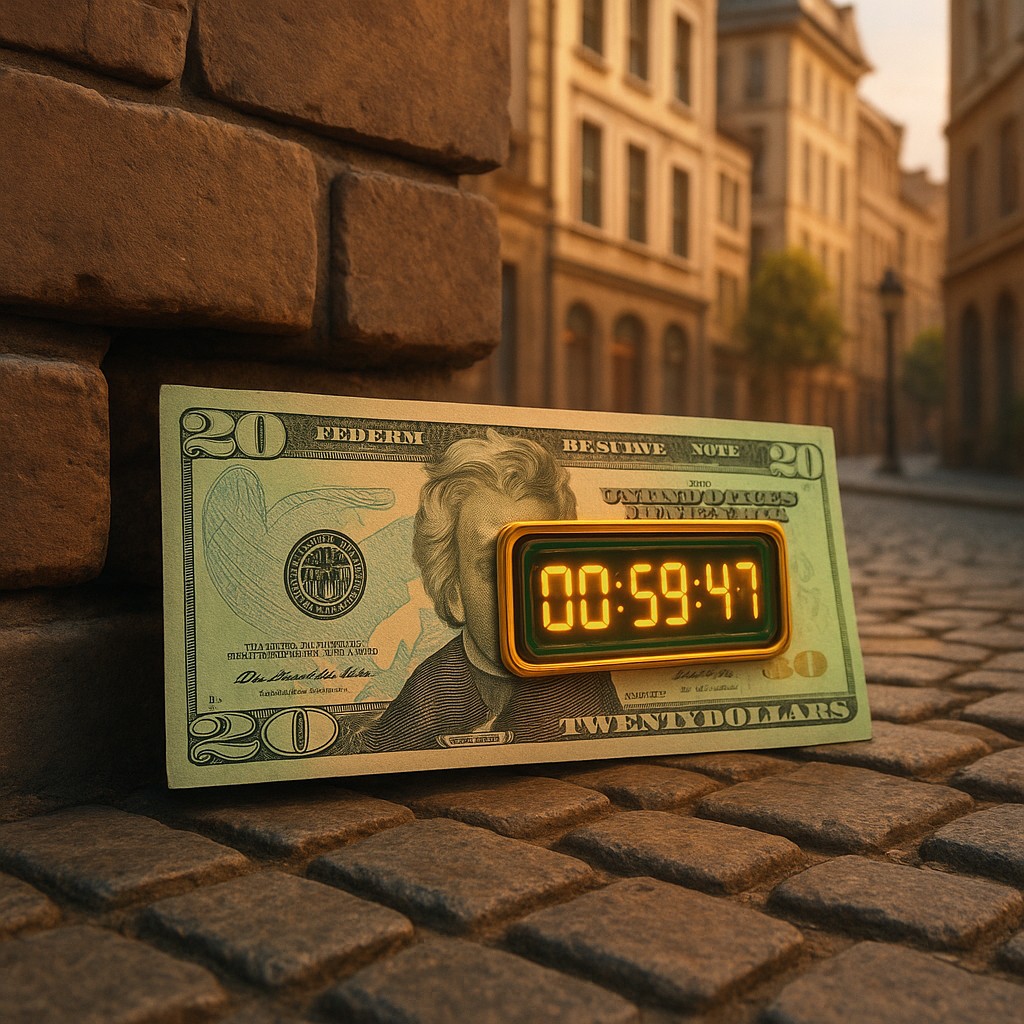
Imagine you are walking down a cobblestone street in a charming city and find a twenty-dollar bill tucked under a loose brick. In the traditional world of finance, that bill is a patient little object. You could tuck it into your wallet, leave it in a drawer for five years, or bury it in a time capsule. When you finally decide to spend it, it will still represent twenty dollars of legal tender. It has no memory, no agenda, and certainly no heartbeat.
But in the labs of the world's most powerful central banks, scientists and economists are tinkering with a version of that twenty-dollar bill that has a mind of its own, a countdown clock, and a very specific set of instructions.
This concept, known as "programmable money," is the next frontier for Central Bank Digital Currencies (CBDCs). Unlike the digital balance you see in your current bank app, which is essentially just a record in a digital ledger, these new currencies are built on "smart contracts." These are bits of computer code that can dictate exactly how, where, and when the money can be used. One of the most radical features being tested in pilot programs from Shenzhen to the Caribbean is the "use it or lose it" function. By giving currency an expiration date, central banks aren't just making trade easier; they are actively directing the pulse of the economy. They are ensuring that stimulus funds don't sit idle in a savings account but flow immediately into the registers of local businesses.
The Shift from Passive Cash to Active Code
To understand why this is such a major change, we first have to look at how our current money system works. Right now, when a government wants to jumpstart the economy, they often send out checks or offer tax rebates. This is a bit like splashing water onto a dry garden with a bucket. Some of it hits the plants, but a lot of it evaporates or gets absorbed into deep, underground reservoirs-like high-interest savings accounts-where it doesn't help the surface grow. Economists call this "liquidity preference," which is the tendency for people to hoard cash during uncertain times. Unfortunately, this behavior keeps the economy stalled.
Programmable money changes the bucket into a precision irrigation system. By embedding code directly into the "digital token" itself, the central bank can define its entire lifespan. If a stimulus token is issued on the first of the month, the code might dictate that its value drops by 5% every week it remains unspent after the thirty-day mark. This is not a tax in the traditional sense, but a built-in incentive. It fundamentally changes how a consumer thinks. Instead of wondering, "Should I save this for a rainy day?" the consumer thinks, "I need to buy those new work boots before my digital wallet shrinks."
This mechanism relies on a technology stack often derived from blockchain, the database system used for cryptocurrencies. However, unlike Bitcoin, which is decentralized and unregulated, a CBDC is centralized and disciplined. The central bank maintains a ledger where every unit of currency is a unique piece of "smart" software. This allows for "purpose-bound" money. For example, a digital voucher might only be valid for groceries or green energy upgrades. This ensures that public funds are used exactly for their intended social or economic goals without the need for massive paperwork or manual audits.
The Economic Logic of Controlled Decay
The idea of expiring money sounds like something out of a science fiction dystopia, but it actually has deep roots in history. In the early 20th century, an economist named Silvio Gesell proposed "stamp scrip," a type of money that required periodic stamps to stay valid. His goal was to stop money from being used to hoard power rather than to exchange goods. He argued that since potatoes rot and steel rusts, money should also have a "carrying cost" to keep it moving. Programmable CBDCs are essentially Gesell’s dream realized through modern digital security.
When an economy enters a recession, "velocity" is the most important factor. Velocity refers to how many times a single dollar changes hands in a year. One dollar spent at a bakery becomes wages for the baker, who then spends it at the hardware store, and so on. If that dollar is saved, its velocity is zero. By implementing expiration dates or "demurrage"-a term for a fee charged for holding money-central banks can artificially speed up this movement. This ensures that a stimulus package creates a "multiplier effect" that ripples through the economy fast enough to prevent small businesses from closing.
| Feature |
Cash / Standard Digital Banking |
Programmable CBDC |
| Duration |
Lasts forever; value stays until spent. |
Can be temporary; set to expire or decay. |
| Control |
User decides when and where to spend. |
Issuer can limit spending to certain areas. |
| Velocity |
Low during crises (people hoard cash). |
High (pushed by expiration dates). |
| Visibility |
Anonymous or tracked by private banks. |
Fully visible on the Central Bank ledger. |
| Method |
Physical printing or bank credit. |
Custom code and smart contracts. |
Balancing Economic Stimulus with Personal Freedom
While the economic perks look good on a spreadsheet, the human element creates a lot of tension. The move toward programmable money changes the social contract between a citizen and the state. For most of history, once you earned a dollar, it was yours to manage as you saw fit. If the currency in your pocket has an expiration date, money loses its role as a reliable way to store wealth. This creates a conflict between the government’s need to manage the broad economy and the individual’s need for financial security and long-term planning.
Privacy is the main battlefield. If a central bank can program money to expire, it can also program it to be blocked from being spent on certain "vices" or restricted to specific regions. This level of transparency means the state could, in theory, see every transaction in the nation in real time. This is why many pilot programs, such as those discussed by the European Central Bank regarding a potential Digital Euro, try to reassure the public. Most Western central banks are currently suggesting that while they want the efficiency of digital currency, they may avoid "forced spending" for the general public, focusing instead on big bank-to-bank transfers or specific, optional stimulus programs.
There is also the risk of "unintended consequences." If people know their money will expire, they might rush to buy gold, cigarettes, or Bitcoin-anything that works as a store of value that doesn't disappear. This could lead to price bubbles or the rise of "shadow currencies" that people use to bypass the official system. For a CBDC to work, it has to be more convenient and stable than the alternatives, not just a tool for heavy-handed government control.
The Global Laboratory of Digital Finance
We are currently in a period of intense global testing, with different nations taking very different paths. In China, the digital yuan (e-CNY) has already been used in large lotteries where the "winnings" had to be spent within a few weeks at specific stores. This served two purposes: it got the public used to the digital wallet app and gave an immediate boost to local shops after pandemic lockdowns. These trials proved that programmable money is a functional tool that can be turned on with the flip of a switch.
In contrast, countries that focus heavily on individual privacy, like those in the Eurozone or the United Kingdom, are moving much more slowly. The Bank of England has looked into "user-led" programming. In this model, you might program your own money to pay your rent automatically or limit your own coffee spending, but the central bank would not set expiration dates from the top down. This approach treats programmability as a tool for consumer convenience rather than state control.
Meanwhile, developing nations see CBDCs as a way to skip over old banking systems. For a farmer in a remote area without a bank, a programmable digital wallet could receive a government subsidy that is automatically "locked" for buying fertilizer or seeds. This prevents the money from being spent on other things or lost to middle-men. In these cases, the "restriction" on the money is actually a form of protection, ensuring the aid reaches its goal.
Designing the Future of the Digital Wallet
As we move toward a world where "smart money" is real, the look and feel of the app becomes just as important as the economic theory. Imagine an app on your phone that shows your balance in two different colors. The "green" balance is your standard savings, which earns interest and lasts forever. The "yellow" balance is a temporary stimulus grant from the government, with a tiny "sand timer" icon showing it must be spent at a local grocery store within the next fourteen days.
This transparency is the only way to make the system work without causing panic. If a central bank wants to use expiring money to jumpstart the economy, it must be clear and predictable. The rules of the code must be as easy to understand as laws written in a book. We might even see a "gamified" economy, where people get notifications like, "Spend $50 more this week to support local shops and avoid a 1% fee." While it sounds strange today, we already accept similar ideas, like credit card points that expire or gift cards that lose value over time. The only difference is the scale and the fact that the government is holding the timer.
The ultimate goal of these trials is to find a "just right" level of intervention. Too much control and you destroy public trust; too little and you miss the chance to prevent a deep economic depression. As these experiments continue, the very definition of a "dollar" or a "euro" will expand. Money will no longer be a static object in your pocket, but a digital flow that can be tuned to the needs of the world.
We are watching the literal reinvention of one of humanity's oldest tools. Money has evolved from seashells to gold coins to paper bills, and now it is becoming a living line of code. As you watch these developments, remember that the goal is not just to change how we pay, but to find ways technology can keep resources moving to the people who need them most during a crisis. The future of your wallet might have a built-in heartbeat. While that requires us to stay alert about our privacy, it also offers a way to build a more resilient economy. Stay curious about how this works, and you will be ready for the day your digital twenty-dollar bill starts ticking.