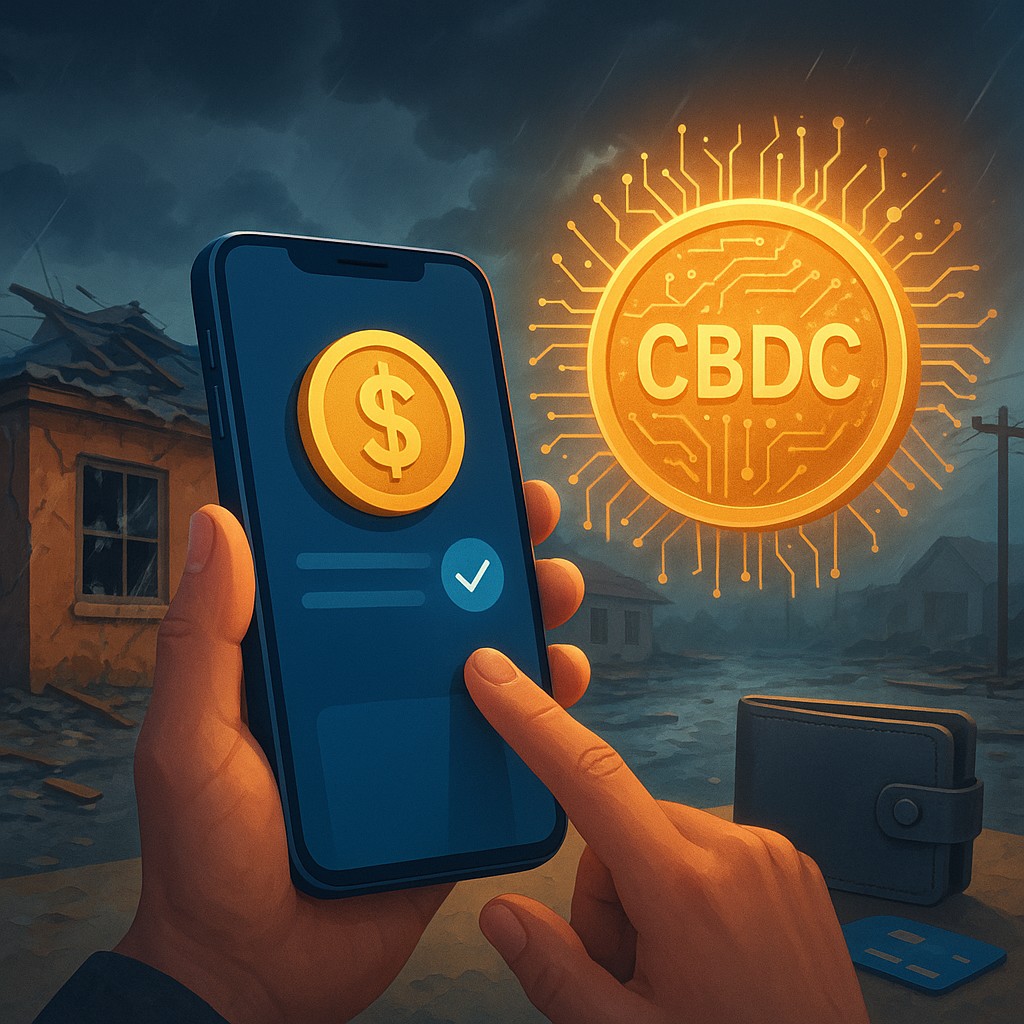
Imagine standing in line at a local hardware store after a devastating storm has torn through your town. The roof is leaking, the windows are shattered, and your bank account is looking painfully thin. Suddenly, your phone pings. The government has sent emergency relief funds directly to your digital wallet. You do not have to wait for a check to clear, and you do not have to fill out a dozen forms at a local bank branch that might not even have power. You tap your phone to buy plywood and nails, and the transaction is instant. However, if you had tried to use that same relief money to buy a high-end gaming console or a designer handbag, the payment simply would not have gone through.
This is the promise of money that is not just a way to pay for things, but a piece of software. We are entering an era where the cash in your pocket is being redesigned into something fluid and intelligent. Central Bank Digital Currencies, or CBDCs, are the next version of the official money issued by nations like the United States, China, or the European Union. Unlike the digital numbers you see in your current banking app, which are essentially private promises from a commercial bank, a CBDC is a direct claim on the central bank itself. When you add "programmable logic" to that mix, the money becomes capable of making its own decisions based on a set of pre-set rules.
The Transformation of Currency from Static Paper to Active Code
For most of human history, money has been a passive object. Whether it was a gold coin, a paper note, or a digital entry in a ledger, the money itself did not care how it was spent. It sat in a vault or a database until a person decided to move it. Programmable logic changes this basic nature by embedding "smart contracts" into the currency itself. A smart contract is essentially an "if/then" statement written in computer code. For example, if a student uses their government education grant at a university bookstore, then the payment is approved. If they try to use it at a casino, the "if" condition is not met, and the money stays put.
By turning currency into code, governments can automate complex tasks that currently take thousands of hours of paperwork. In the current system, giving out a grant involves a long chain of command. The central treasury sends money to a regional office, which sends it to a local bank, which eventually deposits it into a citizen's account. At every step, there is a risk of delay, human error, or even corruption. With a programmable CBDC, the middleman is replaced by a secure computer protocol. The money is sent directly to the person who needs it, but it remains "locked" until it is used at a verified shop or meets a specific deadline.
This shift represents a move toward "purpose-bound money." In this framework, the value is not just the amount of the currency, but the set of permissions attached to it. While this might sound like a radical change, it is actually just a high-tech version of the food stamps or vouchers we have used for decades. The difference is that instead of a physical coupon that is easy to lose or forge, the rules are built into the digital DNA of the money itself. This makes the entire economy more efficient and responsive to real-time needs.
Automated Relief and the End of Bureaucratic Deadlock
One of the most important uses for programmable money is disaster relief and social welfare. When a natural disaster strikes, speed is the most important factor in saving lives and rebuilding communities. Unfortunately, traditional banking systems often struggle in these moments. With programmable CBDCs, a government could "airdrop" funds to every resident in a specific disaster zone instantly. These funds could be programmed to expire after 30 days to encourage immediate local spending, or they could be limited to essentials like food, medicine, and building supplies.
This level of automation ensures that the stimulus actually helps the intended part of the economy. In traditional economics, central banks have a "blunt instrument" problem. They can lower interest rates to encourage spending, but they cannot control exactly where that extra cash goes. Programmable logic gives them a "scalpel." They can ensure that a small business loan is actually used to pay employees, or that a green energy subsidy is spent on solar panels and not on a corporate retreat. This precision reduces waste and ensures that taxpayer money achieves the specific goals intended.
The efficiency gains extend to the business world as well. Imagine a supply chain where a manufacturer only gets paid the moment a delivery truck passes a specific GPS coordinate, or a sensor confirms the goods have been unloaded. Currently, businesses deal with payment delays that can last months, forcing them to take out high-interest loans just to keep running daily operations. Programmable money allows for "atomic settlement," where the delivery of goods and the payment happen at the exact same time automatically. This removes the need for expensive third-party services and reduces the overall cost of doing business globally.
Balancing Technological Efficiency with Personal Sovereignty
Whenever the topic of programmable money comes up, the conversation inevitably turns to the "Big Brother" factor. If a government can program what you spend your money on, can they also use it to monitor your every move? Could they "turn off" your ability to buy food if they disagree with your politics? These are valid and vital concerns that central banks are currently facing in their test programs. The tension lies between the desire for transparency to prevent crime and the fundamental right to financial privacy that physical cash has provided for centuries.
It is important to understand that the loss of privacy is not a required feature of CBDCs, but a design choice. Some test programs, like those being explored by the European Central Bank for the digital euro, are looking at "privacy by design." This could include systems where small, everyday purchases are kept anonymous, similar to cash, while only large transfers are reported to regulators. Another solution involves using "Zero-Knowledge Proofs," a coding method that allows a user to prove they have the right to spend money without revealing their identity or the details of the purchase to the government.
To visualize how different systems might handle these concerns, we can compare the traditional banking system with two different potential CBDC models:
| Feature |
Traditional Banking |
Centralized CBDC |
Privacy-Focused CBDC |
| Transaction Speed |
Hours to Days |
Instant |
Instant |
| Middlemen |
Banks involved |
None |
None |
| Programmability |
Very Limited |
High (Government Control) |
High (User Control) |
| Privacy Level |
High (Bank sees all) |
Low (Government sees all) |
High (Encrypted Anonymity) |
| Risk of Censorship |
Moderate |
High |
Low |
As the table shows, the way the digital currency is built determines the outcome for society. A centralized model might focus entirely on control and data collection, while a privacy-focused model uses the same technology to protect the user. For instance, you could program your own money to only be spent if your digital identity is verified by a service that does not share your name with the shop. In this scenario, the technology actually improves your privacy rather than destroying it. The goal for free societies is to build a system that captures the efficiency of automation while protecting legal rights and personal liberty.
Bridging the Gap Between Traditional Finance and the Future
A common mistake is thinking that CBDCs will immediately replace the physical cash and credit cards we use today. In reality, the change is likely to be much slower and will use a mix of both. Most central banks view digital currencies as a partner to cash, not a total replacement. You might use your "standard" digital money for your morning coffee and your "programmable" digital money for specialized student loan payments or business expenses. This hybrid approach lets the public get comfortable with the technology while the system is tested.
Another myth is that programmable money requires everyone to be a computer expert. For the user, the experience will look much like the digital wallets we already use, such as Apple Pay or Google Pay. The complex "smart contracts" will run in the background, managed by simple apps. If you receive a "Green Energy Credit" from the government, your wallet will simply highlight the shops where that credit is valid. You won't see the lines of code; you will only see a system that works exactly as it is supposed to.
The real magic happens in the "plumbing" of the global financial system. Currently, sending money across borders is a slow and expensive process because different countries use different systems that do not speak the same language. Programmable CBDCs are being tested for "interoperability," meaning the code used by one country can talk seamlessly with the code of another. This could lead to a world where international payments are as fast and cheap as sending a text message, potentially saving billions of dollars in fees for workers sending money home to their families.
Harnessing the Power of Smart Money for a More Resilient Society
As we look toward the horizon, the shift toward programmable logic in our currency is more than just a technical upgrade; it is a new way of organizing our society. We are moving away from a world where money is a simple, passive tool and toward a future where it actively helps achieve our common goals. Whether it is ensuring that aid reaches a refugee faster, verifying that a green initiative actually planted a tree, or simply making sure a teenager's lunch money is spent on lunch, the potential for positive impact is huge.
You are now witnessing the birth of a new financial layer for the internet. By understanding that money can be programmed, you are ahead of the curve in recognizing the next great shift in how value moves through the world. This journey will require us to stay alert about our privacy and demand high standards from our institutions, but the rewards of a more transparent and efficient economy are well worth the effort. The next time you see a headline about a digital currency test, remember that it is not just about moving numbers on a screen; it is about building a smarter, fairer way for us to support one another in a digital age.