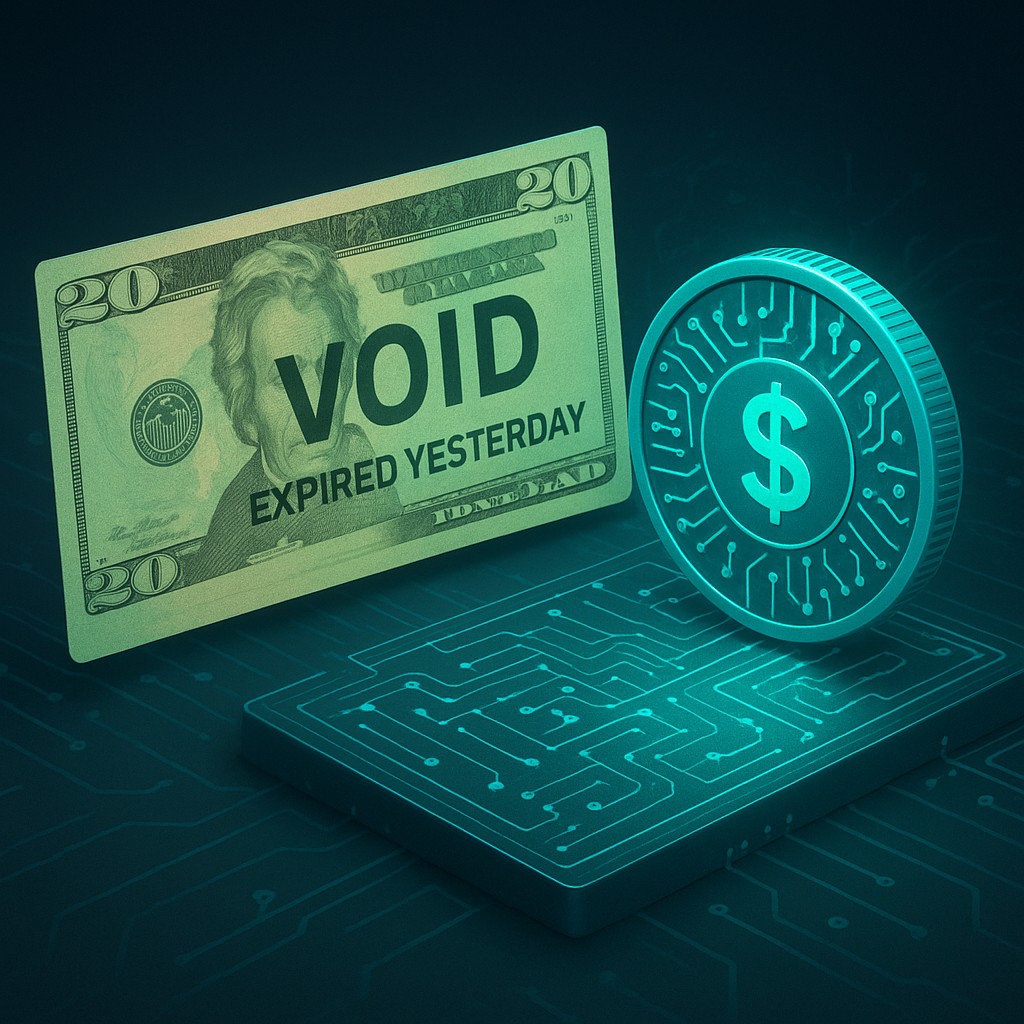
Imagine reaching into your wallet for a twenty dollar bill you have been saving, only to find the ink has faded. In its place, a message appears: "Void: Expired Yesterday." In our world, this sounds like a nightmare or a cheap magic trick. For centuries, we have treated money as a permanent "store of value," a way to preserve wealth across time. Whether it is gold coins in a chest or numbers in a savings account, we expect our currency to wait for us until we are ready to use it. However, the basic nature of money is undergoing a quiet shift that could turn your savings into something more like a ticking clock.
Central banks around the globe are currently testing Central Bank Digital Currencies, or CBDCs. These are digital versions of a nation's official money. While this might sound like the "digital cash" you already use through apps or credit cards, the technology under the hood is fundamentally different. Unlike the passive balance in your current bank account, these new digital tokens can include "smart contracts." These are essentially small pieces of computer code that define exactly when, where, and how that money can be spent. For the first time in history, a government could issue money with a "best before" date, designed to force people to stop saving and start spending to jump-start a stalled economy.
The Economy's Engine and the Speed of Money
To understand why a government would want your money to expire, we have to look at what economists call the "velocity of money." Think of the economy not as a stagnant pool of cash, but as a plumbing system. If you spend ten dollars at a local bakery, the baker uses that money to pay the flour miller, who then uses it to pay for a haircut. In this scenario, a single ten dollar bill has powered thirty dollars worth of economic activity. This is "high velocity," a sign of a healthy economy where everyone is trading and earning.
When a recession hits, people get nervous and start hoarding cash. While this is a smart choice for an individual, it is a disaster for the system. If everyone stops spending at once, the velocity of money slows to a crawl, businesses fail, and the recession gets worse. Traditionally, central banks try to fix this by lowering interest rates or sending out stimulus checks, hoping people will buy a new TV. But the old system has a flaw: the government can give you money, but they cannot force you to spend it. If you tuck that check under your mattress, the economic engine stays stalled. Programmable money solves this by turning cash into a temporary tool rather than a permanent asset.
From Permanent Wealth to High-Stakes Coupons
The shift toward programmable money redefines what a dollar actually is. Historically, money has served three roles: a way to trade, a way to measure value, and a way to store wealth. Programmable CBDCs begin to dismantle that third pillar. By adding an expiration date, money behaves less like a piece of gold and more like a restaurant coupon or a gift card. It is useful for a specific window of time; after that, it becomes worthless.
This system relies on "conditional logic." In computer programming, this is a simple "if/then" statement: if the date is past December 31 and the balance hasn't been spent, then the balance resets to zero. This allows leaders to perform "surgical" economic moves. Instead of just hoping a stimulus package works, they can guarantee it by making the funds disappear if they aren't spent within ninety days. This creates intense pressure on consumers, as the fear of losing the money entirely outweighs the instinct to save it. While this is very efficient for the government, it forces a radical change in how families plan for the future.
Comparing Traditional Money and Programmable Tokens
The differences between the cash in your wallet and the experimental tokens being tested today are significant. While both might be called "legal tender," they operate under different rules and affect your personal freedom in different ways.
| Feature |
Cash or Standard Deposits |
Programmable CBDC |
| Duration |
Permanent; no expiration date |
Can be programmed to expire |
| Storage |
Private; can be kept at home |
Held on a central digital ledger |
| Control |
User decides when and how to spend |
Government can set conditions |
| Traceability |
Low; largely anonymous |
High; every move is recorded |
| Economic Impact |
Passive; depends on public mood |
Active; speed is forced by code |
The Technology of Smart Contracts and Digital Ledgers
The "magic" that allows money to have its own rules is the "smart contract." This technology was made famous by blockchain platforms like Ethereum, but central banks are now adapting it for national use. A smart contract is a self-executing agreement where the terms are written directly into code. When you receive a "smart" digital dollar, it isn't just a number; it is a tiny piece of software. That software is constantly checking its surroundings, asking: "What is the date?" "Is this an approved shop?" and "Has my owner already hit their monthly limit on coffee?"
These transactions are recorded on a "distributed ledger," a centralized record controlled by the central bank. This ledger is a permanent history of every movement of every cent in the country. This level of oversight is a double-edged sword. On one hand, it makes tax evasion and money laundering nearly impossible because the government can see every dollar in real time. On the other hand, it removes the privacy of everyday life. In an era of programmable money, the central bank doesn't just manage the supply of money; they can potentially manage the behavior of the people using it.
Navigating the Ethical and Social Trade-offs
Moving toward programmable money is more than a technical upgrade; it is a massive social experiment. Supporters argue it can improve social fairness. For example, the government could issue digital "food stamps" that only work for healthy groceries and expire every month. This "targeted spending" could ensure that emergency aid is used exactly as intended, preventing funds from being spent on gambling or other unintended uses.
However, critics point out that this level of control can quickly feel like "financial paternalism," where the state acts like a strict parent. If the government can make your money expire in thirty days, could they also stop you from buying certain products? Could they program your money to work only within ten miles of your home during a public health emergency? The shift from "money as a right" to "money as a permission" makes many people uncomfortable. It moves power away from the individual and toward central planners. The convenience of a digital world comes at the cost of the private nature of physical cash.
Preparing for the Future of Fluid Finance
As central banks continue their pilot programs, we will likely see a hybrid world emerge. We might have "permanent" money for long-term savings and "active" money provided for government incentives. Understanding this shift is vital because it changes what it means to be "good with money." In the past, it meant knowing how to save. In the future, it might mean managing several different "buckets" of currency, each with its own expiration date and spending rules.
We are moving into an era of "fluid finance," where money is no longer a static object you hold, but a flow you manage. While the idea of expiring money feels alien now, the history of finance is a story of constant change. From bartering salt to trading gold to swiping plastic, we have always adapted to tools that make the economy more efficient. Programmable money is simply the next leap, turning our currency into a thinking participant in our lives. By staying informed, you can ensure you stay in control of your financial future, even when your dollars have a mind of their own.