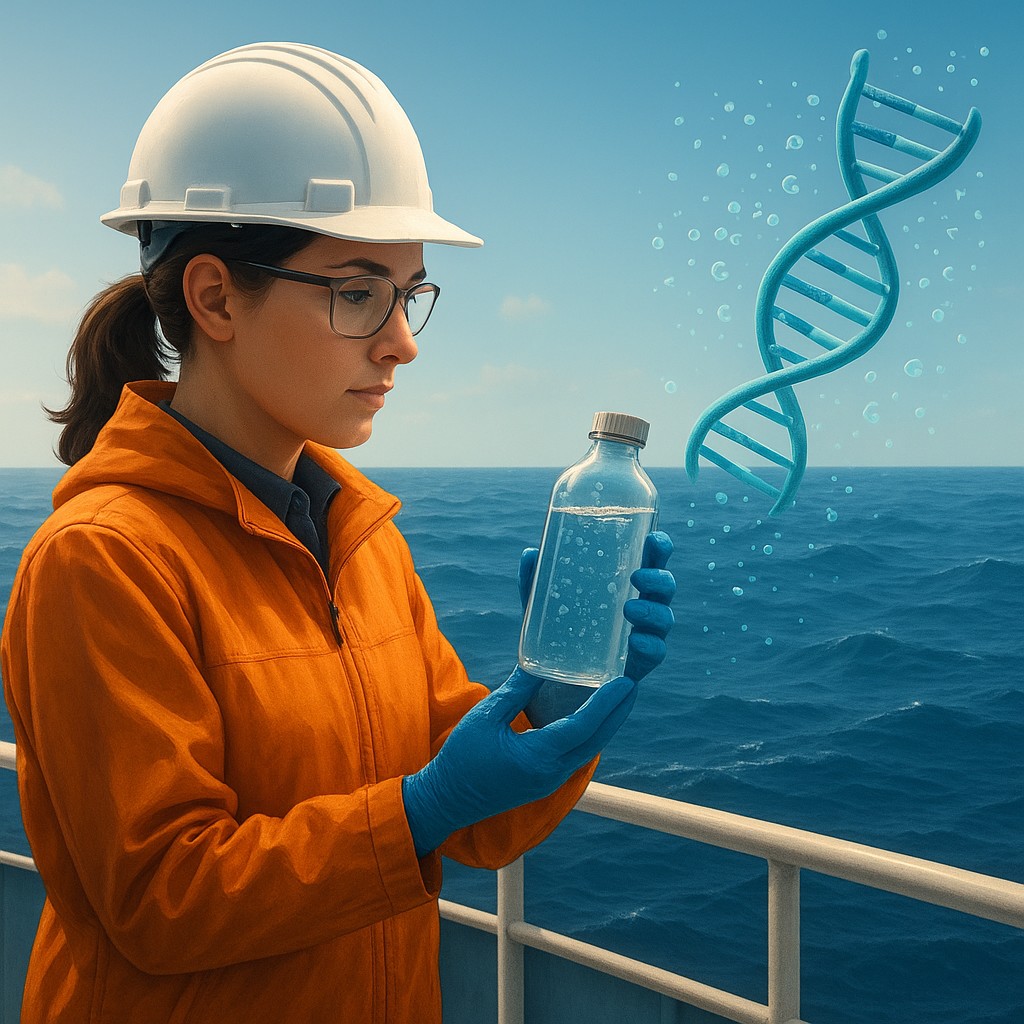
Imagine standing on the deck of a research ship, looking out at the vast, slate-blue Pacific. Somewhere beneath those rolling waves, thousands of species are living out their lives in a hidden drama. Historically, if you wanted to know what lived down there, you had to be lucky with a net or patient with a camera. You might drag a massive trawl along the seabed, accidentally crushing delicate coral just to see if a specific snapper lived in the area. Or you might spend thousands of dollars on a remote-controlled robot that only sees what happens to swim directly in front of its bright lights. It is a bit like trying to understand all of New York City by peering through a single keyhole on 5th Avenue.
But the ocean is leakier than we ever imagined. Every creature, from the massive blue whale to the tiniest clear shrimp, is constantly shedding bits of itself into the water. They lose skin cells, produce waste, bleed slightly, and leave behind trails of mucus. This microscopic confetti carries the most valuable information on the planet: the genetic code of the animal it came from. By simply dipping a clean bottle into the sea and pulling out a single liter of water, scientists can now capture this invisible trail. This is the world of environmental DNA, or eDNA. It is a technological breakthrough that is turning the entire ocean into a searchable library of life.
Reading the Genetic Ledger of the Deep
To understand how we can identify a Great White shark without ever seeing a fin, we have to look at how genes linger in the environment. DNA is a remarkably tough molecule. While it eventually breaks down due to sunlight or bacteria, it can last in seawater for anywhere from a few hours to several days. When a fish swims through a patch of water, it effectively signs a guestbook. Scientists take that liter of water and pass it through an extremely fine filter to catch the drifting cells. They then use a process called metabarcoding, searching for specific, well-known segments of DNA that act like a universal barcode for each species.
Once the DNA is taken from the filter, researchers use a technique called PCR (Polymerase Chain Reaction) to make millions of copies of those specific barcodes. If the code for a Bluefin tuna shows up in the digital results, you know for certain that one was there recently. This method allows us to find species that are notoriously shy. Some deep-sea creatures are so sensitive to light and sound that they vanish long before a submarine or a diver gets near them. With eDNA, their physical presence does not matter because they cannot hide their molecular trace. We are no longer limited by what we can see, but by what we can decode.
The Forensic Science of Modern Marine Surveys
The shift from catching physical samples to analyzing molecules represents a massive change in how we manage natural resources. In the past, if a biologist wanted to track an invasive species, they had to wait until there were enough of them to be caught in a net by accident. By that point, the "invasion" was usually over, and the new species was already taking over the ecosystem. With eDNA, we can act like detectives at a crime scene. We can detect the very first few individuals of an invasive species long before they become a visible problem, giving conservationists a head start that was previously impossible.
This forensic approach also breathes new life into the study of rare and endangered animals. Consider the "sea monsters" of the deep or rare sturgeon in rivers. Traditional netting can actually hurt the very animals you are trying to protect. In contrast, eDNA is entirely non-invasive. You do not have to touch the fish, trap it, or even disturb its home. You just take a "sip" of its environment. This allows for constant, quiet monitoring of protected areas, ensuring that our rules are actually helping the creatures we want to save.
| Feature |
Traditional Biodiversity Surveys |
eDNA Sampling Surveys |
| Impact |
Invasive (nets, hooks, noise) |
Non-invasive (water collection) |
| Detection |
Depends on luck and visibility |
Captures shy and hidden species |
| Cost |
High (large crews, heavy gear) |
Lower (bottles and lab time) |
| Data Type |
Physical counts and measurements |
Presence and genetic diversity |
| Speed |
Instant ID but slow to cover areas |
Delayed lab results but massive scale |
Navigating the Limitations of Molecular Shadows
While eDNA feels like a superpower, it is not a magic wand that solves every mystery. There is a reason why marine biologists have not thrown away their binoculars and nets just yet. The biggest hurdle is the "location" problem. Because DNA can drift with ocean currents, finding salmon DNA might not mean the fish is right in front of you. That DNA could have been shed five miles away and carried to your site by a strong tide. Furthermore, DNA does not come with a timestamp. While we know the sample is relatively fresh, we cannot always tell if the animal passed by ten minutes ago or a full day ago.
Another major challenge is the question of "biomass," or total weight. If you find a lot of DNA from a specific fish in your sample, does that mean there is one very large, "leaky" shark nearby, or a massive school of thousands of small fish? Currently, eDNA is excellent at telling us who is in the water, but it is still learning how to tell us how many there are. Factors like water temperature, salt levels, and local bacteria all affect how fast DNA breaks down. Until we have better models for these variables, eDNA remains a tool for identifying types of animals rather than counting exact numbers.
Correcting the Myths of the Invisible Census
As with any high-tech breakthrough, several misconceptions have surfaced. One common myth is that eDNA will eventually replace all other forms of marine science. In reality, eDNA is a "partner" tool. While it can identify a species, it cannot tell you the age of the fish, its health, its sex, or what it has been eating. To understand the "how" and "why" of an ecosystem, we still need to observe animals directly. eDNA tells us the cast of characters, but it does not always tell us the plot of the play.
Another misconception is that eDNA is only for the ocean. While the sea is the most exciting frontier, this technology is being used in lakes, rivers, and even in the air. Researchers have started taking air samples from zoos to see if they can detect the animals inside just from the floating genetic dust. There is also the fear that eDNA might be "too sensitive," picking up DNA from a fish that was actually inside the stomach of a seagull flying overhead. While this "secondary transport" is a real factor, scientists are developing math models to filter out these false leads, ensuring the data reflects the local habitat rather than a bird's lunch.
Scaling the Search from Puddles to Oceans
The future of this field lies in automation and making data available to everyone. Imagine a fleet of self-driving underwater drones gliding through the ocean's "twilight zone." Instead of just taking photos, these drones would have tiny labs inside them to automatically filter water, decode the DNA, and beam the results to a satellite in real-time. This would create a live "weather map" of global wildlife. We could track whale migrations as they happen or watch a harmful algae bloom grow at a molecular level before the water even changes color.
This technology also allows for "citizen science" on a massive scale. Since collecting a water sample is simple, fishing boats, cruise ships, and even weekend sailors can contribute to a global database. A sailor in the middle of the Atlantic can take a sample, freeze the filter, and mail it to a lab once they reach port. This turns every boat on the ocean into a research ship, providing a level of coverage that government agencies could never afford on their own. We are moving toward a future where the health of the ocean is no longer a mystery, but a data stream that we can monitor and protect with precision.
Our relationship with the ocean has always been defined by its size and our limited vision. We have treated the sea like a dark basement where we only see what our flashlights happen to hit. eDNA changes the basic rules of that relationship. It reminds us that every living thing is deeply connected to its environment, literally leaving parts of itself behind in the water it calls home. By learning to read these molecular whispers, we aren't just counting fish; we are beginning to understand the intricate, flowing language of life itself. The next time you look at the ocean, remember that the water isn't just salt and H2O. It is a thick, swirling soup of stories, waiting to be read by anyone with a bottle and the curiosity to look.