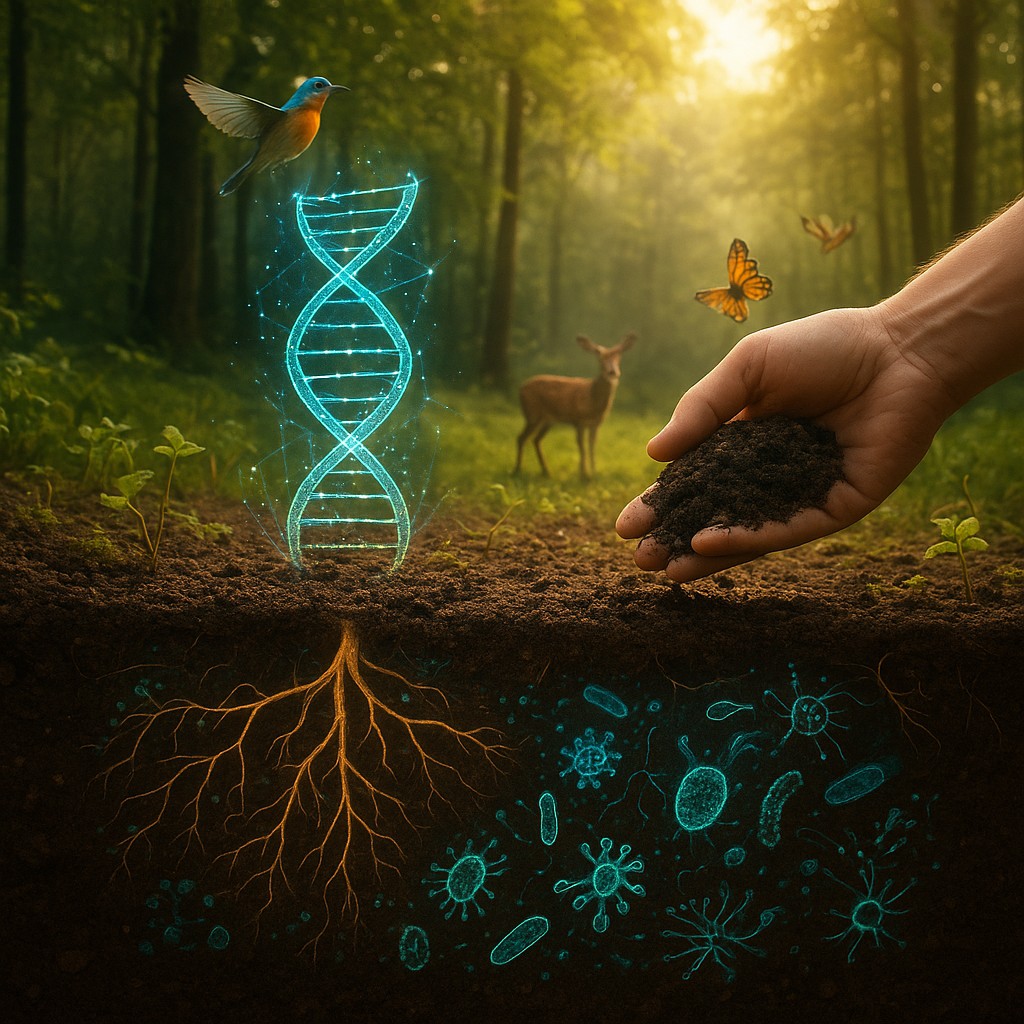
Imagine standing in the middle of a thick, buzzing forest or a quiet, golden prairie. For decades, our way of measuring the "health" of these places was fairly literal and a bit superficial. We would send a researcher out with a clipboard to count how many colorful birds flew by or how many deer tracks they could find near a watering hole. While charming, this "visual census" approach is like trying to judge the health of a massive library by only looking at the gold lettering on the book spines in the front window. It misses the millions of stories happening on the dusty back shelves and in the tiny notes scribbled in the margins.
However, the world of environmental conservation is currently undergoing a quiet, high-tech revolution. The focus is moving from what we can see to what is invisible. As corporations face pressure to prove they aren't just doing "less bad" but are actually "nature positive," the demand for a precise way to measure biodiversity has skyrocketed. We are moving past the era where a company can simply plant a few rows of identical pine trees and call it a day. In this new landscape, a single handful of dirt is becoming the most valuable ledger in the world, containing a biological record of every creature that has touched, crawled through, or decayed within that soil.
Decoding the Hidden Language of the Underground
To understand how we can turn "nature" into a measurable asset, we first have to look at the magic of environmental DNA, known as eDNA. Every living thing leaves behind fragments of itself: shed skin cells, waste, pollen, or microscopic bits of hair and feathers. In the soil, this creates a swirling genetic soup that tells the story of an ecosystem's true diversity. Instead of waiting weeks for a rare beetle to show its face, scientists can now take a soil sample, sequence the DNA found within it, and receive a digital fingerprint of the entire neighborhood. This includes the bacteria that fix nitrogen for plants, the fungi that form a sort of "underground internet" for the woods, and the tiny insects that serve as the foundation of the food chain.
This shift is crucial because "charismatic megafauna" (famous animals like pandas, tigers, and eagles) are often poor indicators of day-to-day ecological stability. An ecosystem can look beautiful to the human eye but be functionally collapsing at a microbial level. By using soil DNA, we get a high-resolution snapshot of the land's "working parts." It provides a level of objectivity that used to be impossible. When a company claims they have restored a patch of worn-out farmland, eDNA doesn't just show that grass is growing; it proves that the complex microbial life needed for a self-sustaining habitat has actually returned.
The process of reading this data has become remarkably efficient. We are no longer limited to slow, expensive laboratory tests that take months to return results. Modern genomic tools allow for a process called metabarcoding, where thousands of species can be identified at once from a single sample. This allows researchers to create a "biodiversity baseline" for a piece of land. Once you have that starting point, you can track changes over time with extreme precision. If the DNA of helpful pollinators and soil-enriching microbes increases over five years, you have hard, scientific proof of ecological improvement.
From Genetic Sequences to Tradable Assets
Once we can measure biodiversity with laboratory precision, a fascinating question arises: can we turn that health into a financial incentive? This is the core idea behind "biodiversity credits." For years, the main way companies interacted with environmental markets was through carbon credits, which essentially measure how much carbon dioxide is being pulled out of the sky. While carbon is a great metric for climate change, it is "flat." One ton of carbon in a forest in Brazil is, for the atmosphere’s sake, the same as one ton of carbon in a peat bog in Scotland. Biodiversity, however, is deeply local and incredibly complex.
Biodiversity credits are designed to be more sophisticated than their carbon cousins. Instead of just measuring a gas, these credits represent a real improvement in the "biological integrity" of a specific plot of land. This is where the soil DNA comes in. By using a standardized scale to rank that DNA data, scientists and economists can create a "unit" of nature. This unit can then be bought and sold. A developer building a new warehouse might buy biodiversity credits to fund a project that is restoring an ancient woodland nearby. The money from the developer goes directly to the landowner who is doing the hard work of bringing the land back to its wild state.
This creates a brand-new economy where "protecting the dirt" becomes a profitable business for farmers and foresters. For a long time, the financial incentive for a landowner was almost always to "extract" from the land by logging it, mining it, or farming it intensely. Biodiversity credits flip the script by putting a price tag on "regeneration." If a farmer can prove through DNA sequencing that their soil is becoming 20% more diverse every year, they can issue credits that companies are eager to buy to meet their environmental and social goals.
The Mechanics of Measuring Nature Quality
Managing these markets requires a strict framework to ensure that "quality" is actually being delivered. You cannot simply compare an acre of desert to an acre of rainforest; they have different natural potentials. To solve this, new international guidelines emphasize "ecological uplift." This means we measure how much better a site has become compared to its own starting point or compared to a nearby "reference site" that is already healthy. This prevents people from claiming credits for land that was already pristine, ensuring the money actually drives new restoration efforts.
| Feature |
Carbon Credits |
Biodiversity Credits |
| Primary Goal |
Reducing greenhouse gases |
Restoring complex ecosystems |
| Measurement Unit |
Metric tons of CO2 equivalent |
Multi-layer scores (including soil eDNA) |
| Swapability |
High (1 ton is 1 ton anywhere) |
Low (Specific to the site and unique) |
| Technical Edge |
Satellites and remote sensors |
Genetic sequencing and field samples |
| Main Beneficiary |
The global atmosphere |
Local plants, animals, and soil health |
The table above highlights why biodiversity credits are considered a "second generation" environmental asset. They require more data and more hands-on field work than carbon credits, but they provide a much richer picture of planetary health. Using soil DNA also helps solve the "permanence" problem. While trees can burn down and release their carbon back into the air in a single afternoon, a healthy soil microbiome is a massive underground engine that keeps an ecosystem resilient against droughts and floods. By investing in the soil, companies are investing in the very foundation of Earth's life support system.
Navigating the Complexity of Biological Trade-Offs
While the idea of trading credits sounds like a perfect solution, there are significant ethical and scientific "guardrails" that must be respected. One of the most important concepts in the new international guidelines is the "non-fungibility" of nature. In the world of finance, if you have a hundred dollars, it doesn't matter which specific bill you have; they are all the same. Nature does not work this way. You cannot destroy a rare, ancient wetland in one country and "offset" it by planting a bunch of trees in another. A high eDNA score in a new meadow cannot simply cancel out the loss of a 500-year-old oak forest.
This is why the new guidelines focus on "contribution" rather than just "offsetting." Instead of viewing these credits as a "license to trash the planet" elsewhere, they are increasingly seen as a way for companies to invest in the global good. The goal is to create a "nature-positive" world where the total amount of life on Earth is increasing. To prevent "greenwashing" (making false environmental claims), the data from soil DNA sequencing must be transparent and checked by independent experts. It isn't enough for a company to say they are doing a good job; the microbes in the mud have to testify on their behalf.
Another challenge is the "time lag" of nature. You can trade a stock in a millisecond, but it takes years for a worn-out field to regain its biological complexity. This means biodiversity markets need long-term thinking. Credits are often issued in stages, with some being released when the project starts and more being released only when the DNA samples prove that the restoration is actually working. This "pay for performance" model keeps everyone honest and ensures that financial rewards are tied to real, physical improvements in the dirt under our feet.
Correcting Myths About Measuring Life
As with any new technology, there are several misconceptions about what eDNA and biodiversity credits can actually do. One common myth is that eDNA is a "crystal ball" that can tell you everything. While it is incredibly powerful, it is still a tool that requires human interpretation. If a sample is taken right after a heavy rain, or if it isn't stored at the right temperature, the results can be off. DNA also sticks around; sometimes a sample might pick up the genetic signature of a bird that flew over the area two weeks ago but doesn't actually live there.
Another misconception is that biodiversity credits will replace carbon credits. In reality, they are designed to work together. A forest managed for high biodiversity is often much better at soaking up carbon than a farm with only one type of tree. By layering these two types of credits, we create "high integrity" projects that solve two problems at once. We shouldn't think of it as a competition between carbon and nature; we should think of it as upgrading our global accounting system to reflect the true value of a living, breathing world.
Finally, some worry that putting a price tag on nature is a dangerous path that strips the environment of its spiritual value. However, supporters argue that we have valued nature at zero dollars for centuries, which is exactly why it has been so easy to destroy. By giving a formal economic value to the microscopic life in the soil, we are finally acknowledging that our global economy is a "wholly owned subsidiary of the environment," not the other way around. We aren't just selling the soil; we are finally paying the soil for the services it has been providing us for free since the beginning of time.
The Future of Living Assets and Stewardship
We are entering an era where the divide between the corporate boardroom and the forest floor is disappearing. The ability to translate the beautiful complexity of a meadow into a digital data stream is a superpower that comes with massive responsibility. It allows us to hold the most powerful organizations on Earth accountable for the footprints they leave behind, not just in terms of the smoke they emit, but in terms of the life they displace. As these international guidelines become the standard, we can expect to see a shift in how we define "land ownership," moving from a right to extract to a responsibility to protect.
Imagine a future where every purchase you make is linked to a verified "nature score," backed by real DNA samples from the ground. This isn't just about corporate transparency; it is about rebuilding our relationship with the planet one handful of soil at a time. The microbes, fungi, and insects that have been working in the shadows for eons are finally getting their seat at the table. By learning to listen to the genetic stories hidden in the earth, we are discovering that the true wealth of our world isn't found in what we can take from the soil, but in the vibrant, invisible life that we can help flourish within it.