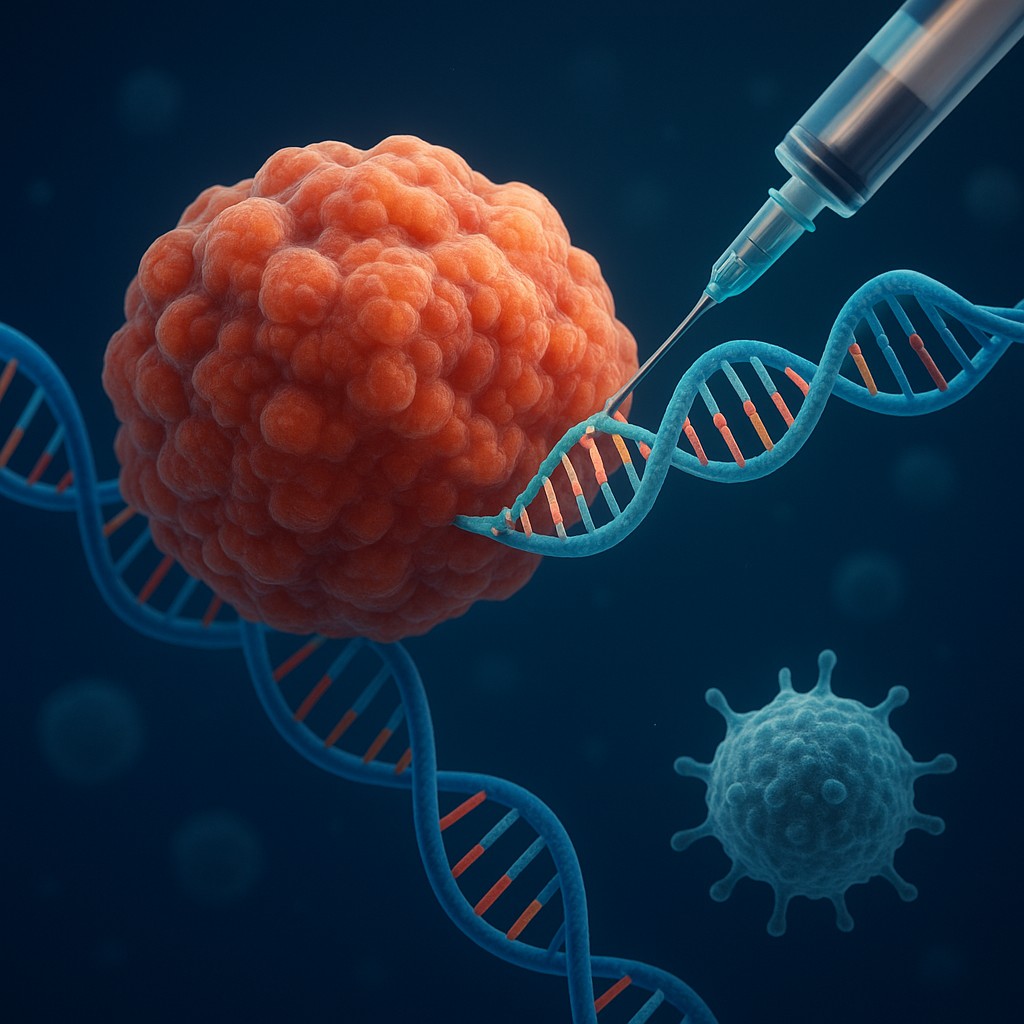
For decades, the standard approach to fighting cancer has felt like trying to put out a kitchen fire by flooding the entire neighborhood. While modern chemotherapy and radiation are life-saving miracles, they are relatively blunt instruments. They work by attacking any cells that grow quickly. Unfortunately, this include your hair follicles, your digestive lining, and your immune cells, right along with the actual tumor. Patients often endure a grueling match of physical stamina, hoping the treatment kills the cancer before the collateral damage becomes too much for the body to handle. It is a biological war of exhaustion where the "good guys" and "bad guys" are often caught in the same crossfire.
But imagine if, instead of a blanket bombing campaign, we could give the body a high-definition photograph of the enemy. Imagine if your immune system, which is already designed to hunt pathogens, could be given the exact molecular coordinates of a tumor’s unique mutations. This is the promise of personalized mRNA cancer vaccines. We are moving away from the "one-size-fits-all" medicine of the twentieth century and toward a custom-made era. In this new age, the treatment is printed specifically for you, based on the genetic glitches found only in your specific tumor. This marks a shift from simply attacking a disease to teaching the body how to defend itself with surgical precision.
The Genetic Fingerprint of a Tumor
To understand how this works, we first have to look at what makes a cancer cell different from a healthy one. Every cell in your body follows a set of genetic instructions, but cancer cells have "typos" in their code. These mutations cause the cell to behave erratically, growing when it should stay still and refusing to die when its time is up. When these genetic typos occur, they often cause the cell to produce slightly misshapen proteins that do not belong in a healthy human body. These broken, unique proteins are called neoantigens.
Think of a neoantigen as a very specific, accidental uniform worn only by the rebel forces within your body. Because these proteins are "new" (the meaning of the prefix "neo") and unique to the tumor, they are the perfect targets for the immune system. In a perfect world, your T-cells, the elite soldiers of your immune system, would spot these strange proteins and destroy the cells carrying them. However, cancer is famously deceptive. It often develops "invisibility cloaks" or sends out chemical signals that tell the immune system to move along, claiming there is nothing to see. The goal of neoantigen mapping is to strip away that invisibility by pointing a giant, neon arrow at those specific proteins.
Mapping the Most Wanted List
The creation of a personalized vaccine begins with a high-stakes search called "Neoantigen Mapping." Doctors take a biopsy of the patient’s tumor and a sample of their healthy blood. They then sequence the DNA and RNA of both samples to compare them. By looking at the healthy code alongside the cancerous code, scientists can identify exactly where the mutations are happening. This isn't a generic search; they are looking for the specific "typos" that are unique to that one individual's cancer. No two patients, even those with the same type of lung or breast cancer, will have the exact same set of mutations.
Once the mutations are identified, sophisticated computer algorithms take over. Not every mutation results in a protein that the immune system can easily recognize. The software predicts which of these neoantigens are the "most wanted" - that is, which ones are most likely to trigger a strong reaction from T-cells. Usually, researchers select about 10 to 20 of these top targets. This list becomes the blueprint for the vaccine. It is a data-heavy process that relies on a partnership between cancer research, genetics, and artificial intelligence to ensure the final product hits the mark with incredible accuracy.
Printing the Biological Instruction Manual
This is where mRNA technology, made famous by COVID-19 vaccines, enters the spotlight. In this context, mRNA acts like a temporary set of instructions or a "software update" for your cells. Once the scientists have their list of 20 neoantigens, they encode the instructions for making those specific protein fragments into a strand of messenger RNA. This mRNA is then wrapped in a tiny bubble of fat, known as a lipid nanoparticle, which protects it and helps it enter your cells.
When the vaccine is injected, it does not actually contain any cancer cells. Instead, it tells your own cells to briefly produce those specific, harmless protein fragments. Your immune system sees these "foreign" proteins and goes into a state of high alert. It begins training an army of T-cells to recognize those specific shapes. It is essentially a dress rehearsal for a battle. Once the immune system has learned what the enemy looks like, those T-cells circulate through the body, searching for anything that matches the description. When they find a cancer cell wearing those exact proteins, they move in for the kill, leaving the surrounding healthy cells completely untouched.
Comparing Traditional and Personalized Approaches
The shift from broad treatments to personalized mRNA vaccines is a fundamental change in philosophy. To see the difference, it helps to compare the old methods of cancer treatment with the new method of targeting specific tumor proteins.
| Feature |
Traditional Chemotherapy |
Personalized mRNA Vaccine |
| Primary Target |
All fast-growing cells |
Unique tumor mutations (Neoantigens) |
| Customization |
Standard based on cancer type |
100% unique to the specific patient |
| Mechanism |
Uses toxins to kill cells directly |
Trains the immune system to attack |
| Side Effects |
Body-wide (hair loss, nausea, fatigue) |
Localized (fever, soreness, immune response) |
| Development Time |
Available immediately on the shelf |
Takes weeks to sequence and manufacture |
| Memory |
Works only while the drug is present |
Can create long-term immune memory |
The Hurdles of Custom-Made Medicine
While the science is breathtaking, we have to admit that this is not yet as simple as getting a flu shot at the local pharmacy. The primary challenge right now is time. Because each vaccine must be custom-designed and manufactured for one specific person, the process can take several weeks or even months. For a patient with a fast-moving terminal illness, time is a luxury they might not have. Reducing this "vein-to-needle" time is one of the biggest priorities for researchers today as they work to speed up genetic analysis and automated manufacturing.
Then there is the matter of resources. Creating a unique drug for every single patient is expensive. It requires specialized labs, high-speed machines, and highly trained data experts. While the cost of genetic sequencing has dropped over the last decade, the logistics chain needed to produce these vaccines on a global scale is still under construction. Furthermore, cancer is an evolving target. Sometimes, a tumor can "escape" the vaccine by mutating again, losing the very proteins the immune system was trained to find. This is why doctors often test these vaccines alongside "checkpoint inhibitor" drugs, which help keep the immune system's "on" switch flipped to the maximum setting.
Correcting Common Misunderstandings
When people hear the word "vaccine," they often think of prevention, like the shots we get for polio or measles. A common misconception is that these cancer vaccines will be given to healthy people to prevent cancer from ever forming. In reality, personalized mRNA vaccines are currently "therapeutic vaccines." They are given to people who already have cancer, or who have had a tumor removed and are at high risk of it returning. The goal is to treat the existing disease or to act as a cleanup crew, hunting down any microscopic rogue cells that a surgeon might have missed.
Another myth is that mRNA changes your DNA. This is biologically impossible. mRNA is like a disposable sticky note; it enters the cell, delivers its message to the protein-making machinery, and is then broken down and recycled by the body. It never enters the nucleus of the cell where your DNA is stored. It does not rewrite your genetic code; it simply provides a temporary training manual for your immune system. Understanding this distinction is vital for appreciating how safe and elegant the technology is, as it uses the body’s natural processes without interfering with our fundamental genetic blueprint.
A Future of Precision and Hope
The journey from broad, toxic treatments to precise, molecular tools is one of the most exciting chapters in modern medical history. We are entering an era where a diagnosis that once felt like a generic death sentence can be met with a highly specific, data-driven counterattack. By turning the immune system into a specialized security force with a personalized "most wanted" list, we are giving patients a fighting chance that is as unique as their own DNA. While there are still mountains to climb regarding speed, cost, and access, the proof of concept is a testament to human ingenuity.
The work being done today in labs around the world is more than just a scientific advancement; it is a profound shift in how we view disease. We are no longer just passive recipients of standard treatments; we are the source code for our own cures. As sequencing technology becomes faster and our understanding of the immune system deepens, the day may soon come when a custom vaccine is the standard of care for every cancer patient. The future of medicine isn't found in a mass-produced pill, but in the unique markers of your own cells, waiting to be mapped, mastered, and used to reclaim your health.