For decades, the standard way to manage large farms has felt more like carpet bombing than surgery. To protect a field of onions or kale from weeds, a farmer’s most efficient choice was to drive a massive machine across the land, coats of chemical herbicides soaking everything in sight. While the crops were either genetically modified or naturally tough enough to survive the poison, the weeds withered. This method supported the Green Revolution of the 20th century, but it came with a steep price: chemicals leaking into our groundwater, the accidental killing of helpful insects, and the rise of "superweeds" that have evolved to thrive on the very toxins meant to kill them.
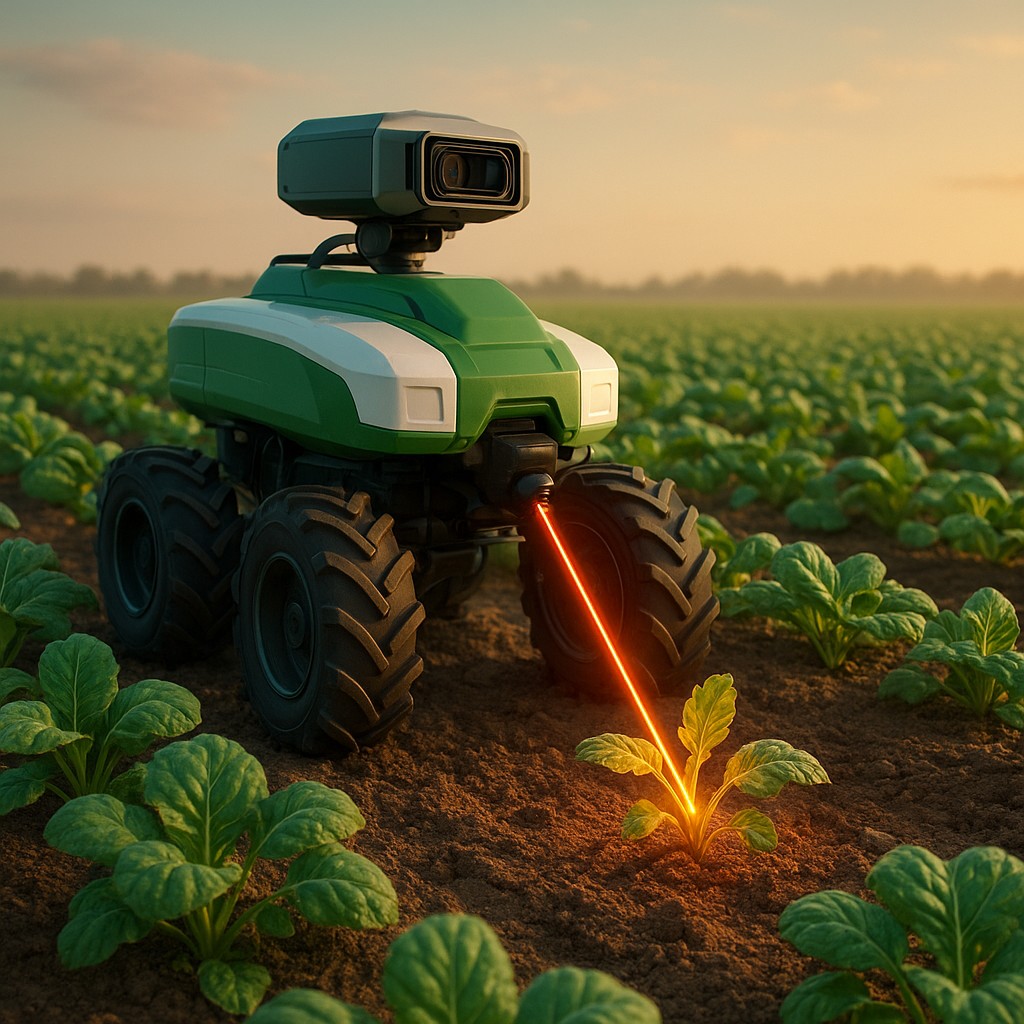
Today, we are seeing a shift from chemical warfare to precision physics. Imagine a robotic platform rolling slowly through a field, fitted with high-resolution cameras and artificial intelligence that can "see" more clearly than any human. Instead of a spray nozzle, this machine carries a set of high-energy thermal lasers. As it moves, it spots a weed, finds its exact growth point, and fires a concentrated pulse of light. In a fraction of a second, the light boils the moisture inside the weed. This is spectral weeding. It is a technology that treats the farm not as a single blank space, but as a complex map of individual plants, each requiring its own specific care.
Beyond the Chemical Blanket
To understand why this change matters, we have to look at the flaws of the traditional chemical model. Herbicides act like biological wrenches thrown into a plant's internal gears. They might stop a plant from making proteins or interfere with photosynthesis, the process plants use to turn sunlight into food. However, biology is incredibly adaptable. When we spray the same chemical over millions of acres for years, we force weeds to evolve. The few weeds with a lucky mutation survive and pass those traits on. Eventually, entire populations become immune to our best chemistry. This has created a "treadmill" where chemical companies must constantly invent stronger or different poisons just to keep up.
Spectral weeding ignores the weed's biology and focuses on its physics. No matter how much a weed evolves, it cannot develop a biological resistance to being boiled from the inside out. A high-energy laser pulse sends heat directly to the meristem, which is the "brain" or growth center of the plant where new cells are made. By destroying this specific spot, the machine ensures the weed cannot grow back. This approach effectively ends the arms race between chemical engineering and plant evolution, replacing a messy biological problem with a straightforward heat-based solution.
The Eyes and Brain of the Machine
The hardware needed to make this work is a masterpiece of modern engineering. It starts with "computer vision," a type of AI that teaches machines to recognize patterns. For a spectral weeder, this means telling the difference between a young carrot leaf and a common ragweed leaf while moving over bumpy dirt at three miles per hour. The machine takes thousands of pictures every second. It processes them using on-board computers that work without needing an internet connection. These computers use "deep learning" models to draw a digital box around every living thing in view, instantly labeling them as "crop" or "target."
Once the target is found, the focus shifts to the light. Modern robotic weeders often use Carbon Dioxide (CO2) lasers or concentrated Ultraviolet (UV) pulses. These are not the laser pointers used to play with pets; they are industrial-strength beams that can cut through wood or metal. The system must aim these beams with incredible precision, down to a fraction of a millimeter, while accounting for the shaking of the tractor and the uneven ground. This requires a "gimbal" system, much like the stabilizers that keep a drone's camera steady, to make sure the light hits the weed and not the valuable crop just an inch away.
Physics vs. Chemistry in the Field
Switching to spectral weeding introduces new factors that farmers have never had to manage before. In the old model, the main concerns were wind speed, which could blow spray onto the wrong fields, and rain, which could wash chemicals away. With laser weeding, the variables are technical and environmental. A farmer no longer worries about the mineral balance of their spray water; instead, they focus on the "duty cycle" of their lasers and keeping camera lenses clean in a dusty field.
| Feature |
Traditional Chemical Weeding |
Spectral (Laser) Weeding |
| Primary Tool |
Chemical Herbicides (Glyphosate, etc.) |
High-Energy Thermal Lasers / UV |
| Selection Method |
Based on chemicals (Crops must resist poison) |
Based on sight (AI identifies leaf shapes) |
| Environmental Impact |
Risks contaminating soil and water |
No chemical residue or runoff |
| Resistance |
Weeds become immune "superweeds" |
No known biological resistance to heat |
| Soil Health |
Can harm tiny organisms in the soil |
Leaves soil biology completely alone |
| Operating Cost |
High ongoing costs for chemicals |
High start-up cost; low cost per acre |
When we compare these two methods, it is clear that spectral weeding is much kinder to the land. Because the laser only touches the weed, the surrounding soil remains still. Traditional mechanical weeding involves pulling a metal blade through the dirt to rip up weeds, which often damages the helpful fungal networks in the soil and releases stored carbon into the air. Laser weeding works perfectly with "no-till" farming, a method that keeps carbon in the ground and the soil structure strong. This is a major win for regenerative agriculture, a movement focused on healing the land while farming it.
The Challenge of Speed and Precision
The main obstacle to using spectral weeding everywhere is the incredible speed required to make it work on large farms. A standard farm might have millions of weeds per acre. For a robot to replace a wide sprayer, it has to "zap" weeds fast enough to let the tractor move at a normal pace. If the tractor has to crawl at a snail's pace to give the lasers time to aim, the farmer loses too much time during the busy planting season.
Engineers are solving this through "parallelization," which means doing many things at once. Instead of one laser, these machines often carry dozens in a row, like a high-tech printing press. Each laser handles a small strip of the field. As the machine rolls forward, the lasers fire in rapid bursts that sound like a quiet popcorn machine. The main bottleneck is "latency," the tiny delay between the camera seeing the weed, the computer thinking, and the laser firing. Because the tractor is moving, if the system takes even 50 milliseconds too long, the laser will hit the dirt behind the weed instead of the weed itself. Reducing this delay to near-zero is the current "holy grail" of high-tech farming.
The Economic Shift for the Modern Farm
Moving to spectral weeding changes the entire business model of a farm. For the last fifty years, weed control has been a "variable cost." Every year, a farmer has to buy new seeds and new chemicals, meaning their costs stay high every single season. A laser weeder moves the farm toward a "fixed cost" model. The machine is expensive to buy, often costing hundreds of thousands of dollars, but once it is paid for, the cost to kill a weed is basically just the price of the electricity or fuel used to run the lasers.
This shift makes it easier to grow organic food at a large scale. Historically, organic food has been more expensive because "organic weeding" usually meant hiring teams of people to pull weeds by hand. By automating this with lasers, we can produce huge amounts of chemical-free food at prices that compete with traditional farming. It makes clean food more available to everyone by using robots for the boring, back-breaking work that humans have done for ten thousand years.
A New Era of Environmental Care
The most inspiring part of spectral weeding is its potential to repair the relationship between farming and nature. When we stop blanket-spraying chemicals, local wildlife returns almost immediately. Pollinators like bees and butterflies, which are often killed by mistake during chemical weeding, can thrive nearby. Water in local streams stays free of chemicals, protecting fish and the people living downstream. We are essentially teaching our machines to be as careful as a master gardener, but with the tireless speed of a computer.
As this technology improves, we will likely see it combined with other smart tools. Imagine a fleet of small, solar-powered "weeding rovers" that live in the field, wandering day and night to zap weeds while they are only a few millimeters tall. This would stop weeds from ever stealing nutrients from the crops, which could significantly increase the amount of food we grow. We are moving toward a future where the "farm of the future" does not look like a sterile factory, but like a healthy ecosystem where technology protects nature instead of trying to dominate it. This shift to precision physics is more than just a clever invention; it is a vital step toward feeding the world without wearing out the planet.