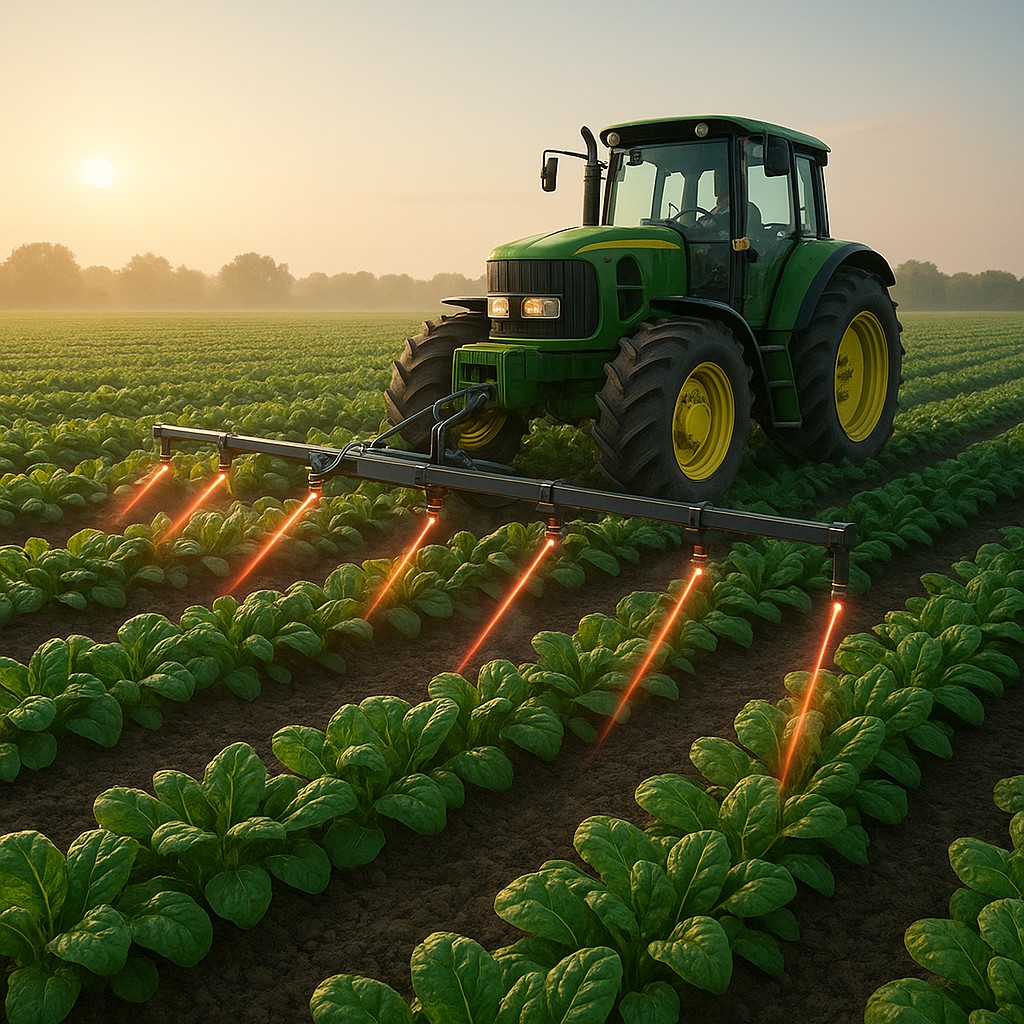
Imagine standing in a lush spinach field on a quiet morning. In the distance, a tractor crawls slowly down the rows, but something is different. You don't smell the sharp, chemical sting of weedkillers, nor do you see a crew of dozens of workers hunched over with short-handled hoes. Instead, you hear a soft, rhythmic clicking, like a high-speed stapler, followed by the faint scent of toasted greens. This is the sound of modern farm technology at work with surgical precision. Beneath the tractor, a fleet of high-powered lasers systematically hunts down every unwanted plant, leaving the crops and the soil completely untouched.
For decades, fighting weeds meant choosing between two clumsy options. You could soak the entire field in chemicals, which kills weeds but can also damage the soil and create "superweeds" that are immune to poison. Your other choice was to hire a massive team for manual weeding, which is backbreaking, expensive, and increasingly hard to staff. Laser weeding offers a third way. It treats the farm not as a floor to be mopped with chemicals, but as a complex map of individual living things. By combining the processing power of an AI supercomputer with the heat of a CO2 laser, farmers can now wipe out threats at the cellular level without touching a single leaf of their harvest.
From Wide Sprays to Targeted Strikes
The big shift here is moving from "broadcasting" - spraying everything at once - to managing plants one by one. In traditional farming, a sprayer moves across a field and coats everything in its path. Even if the weedkiller is designed to only kill weeds and spare the crop, it still stresses the harvest and affects the healthy microbes in the dirt. Laser weeding changes the rules. It uses a "see and shoot" system that treats every square inch of the field as its own data set. The machine doesn't just look at the field as a whole; it identifies every single green sprout sitting in front of its sensors.
This transition is much like how medicine moved from general treatments to "precision medicine" based on a person's DNA. As a laser weeder moves, it takes high-resolution photos of the ground so fast it would make a professional photographer dizzy. The onboard AI has been trained on millions of images, allowing it to tell the difference between a baby kale plant and a tiny sprig of a weed like purslane in a fraction of a second. Once it finds a weed, the system calculates its exact center. This allows the laser to fire with such accuracy that it can kill a weed less than a centimeter away from a crop without causing any side damage.
The Physics of a Cellular Explosion
We often think of lasers as futuristic tools or office pointers, but in the field, they act as rapid heat delivery systems. These machines typically use a CO2 laser, which beams infrared light at a frequency that water absorbs perfectly. Since plants are essentially high-pressure bags of water, this is the perfect weapon. When the laser hits the "meristem" - the growth point or the "brain" of the weed - the water inside the plant's cells doesn't just get hot; it turns into steam almost instantly.
Because steam takes up much more space than liquid water, the internal pressure causes the cell walls to burst. This isn't a slow burn like a campfire; it is a micro-explosion that destroys the plant’s ability to move nutrients or grow new leaves. Within seconds of being hit, the weed begins to wilt. Within a day, it has shriveled into a tiny bit of organic matter that will rot and return its nutrients to the ground. This "thermal shock" is effective because it ignores the chemical defenses weeds have built up. A plant might evolve to survive a specific poison, but no plant can evolve a way to survive its own internal fluids boiling in a millisecond.
The Silicon Brain Behind the Beam
The real magic isn't actually the laser; it is the sophisticated computer "eyes" that direct the fire. If the laser shot at everything green, it would destroy the farmer's crop in minutes. To prevent this, the machine uses "deep learning," the same tech used in self-driving cars. These models are trained to recognize specific features, like the jagged edge of a leaf, a certain shade of green, or the pattern of veins. This allows the tractor to tell the difference between a "volunteer" potato left over from last year and the organic carrots it is supposed to be protecting.
Because lighting in a field can change from a blinding noon sun to a dark, cloudy afternoon, these machines carry their own lights. They often operate under a protective cover, using powerful LED panels to ensure the cameras see the same thing every time. The speed of this processing is incredible. A commercial laser weeder might have dozens of cameras and lasers working at the same time, processing huge amounts of data every minute as the tractor moves. This lets the machine maintain a steady pace, covering several acres a day with a level of detail that no human could match.
Comparing Weed Control Methods
| Feature |
Chemical Herbicides |
Manual Hand Weeding |
Laser Weeding |
| Precision |
Low (Field-wide) |
High (Plant by plant) |
Extremely High (Pinpoint) |
| Environmental Impact |
High (Runoff into water) |
Low (Treads on soil) |
Negligible (Light and heat) |
| Scalability |
High (Very fast) |
Low (Needs many people) |
Medium to High (Automatic) |
| Resistance Risk |
High (Superweeds) |
None |
None |
| Startup Cost |
Low (Per spray) |
Moderate (Wages) |
High (Expensive equipment) |
Overcoming the Hurdles of High-Energy Farming
While zapping weeds with light sounds like a perfect fix, it comes with engineering challenges. The biggest obstacle is power. Generating enough electricity to run several high-powered lasers while also running cooling systems and AI servers takes a lot of energy. Most current models are pulled by large tractors or are massive units that act as rolling power plants. Unlike a chemical sprayer, which only needs a small pump to push liquid through a nozzle, a laser weeder has to manage extreme heat and electrical loads in a dusty, vibrating field.
The "terrain" also matters. Right now, laser weeding works best on specialty crops grown in flat, well-prepared rows, such as onions, broccoli, and leafy greens. These are "high-value" crops where the cost of the machine is balanced out by what the farmer saves on labor and the higher price of organic food. On a hilly, uneven corn field covering thousands of acres, the technology isn't yet as cheap or easy as traditional methods. However, as lasers become more efficient and AI gets cheaper, these "light-powered hoes" will likely become a common sight on farms of all sizes.
The Shift Toward Healthy Soil
One of the most exciting side benefits of laser weeding is what it does for the ground. Traditional weeding involves pulling a metal blade through the dirt to chop up roots. While this works, this "tillage" breaks up the helpful fungi and tiny organisms living in the top layer of soil. It also brings buried weed seeds to the surface where they can get enough light to grow, creating a never-ending cycle. By using a laser, the farmer leaves the soil completely alone. This "no-till" approach is a major part of healthy farming, as it helps the soil hold water, trap carbon, and maintain a healthy home for the crop.
This technology also solves the problem of growing organic food on a large scale. Many farmers want to go organic but find it impossible because they can't find enough people to pull weeds by hand. By automating the hardest part of the job, laser weeding allows one person to manage hundreds of acres of pesticide-free food. it bridges the gap between the speed of big industry and the care of a small organic garden. We are moving toward a future where "smart" farming isn't just about spreadsheets, but about physical tools that respect the biology of the land.
Redefining the Future of the Harvest
As the world's population grows and the climate changes, we must learn to grow food efficiently without destroying our natural resources. Laser weeding shows that digital and biological worlds are merging in a way that helps everyone. It takes the power of industrial technology and shrinks it down to a needle point, ensuring we only destroy what is necessary and protect what is vital. This is the heart of precision - turning a rough struggle against nature into a high-tech partnership.
The next time you eat a crisp salad or a bunch of organic carrots, think about the invisible work that went into growing them. We are entering an era where the most advanced tool on the farm isn't a plow or a chemical drum, but a beam of light guided by an intelligent eye. By mastering the ability to boil a single cell from across a row, engineers are proving that we don't have to choose between feeding the world and protecting the planet. With enough curiosity and a bit of concentrated light, we can build a food system that is as clean as it is plentiful.