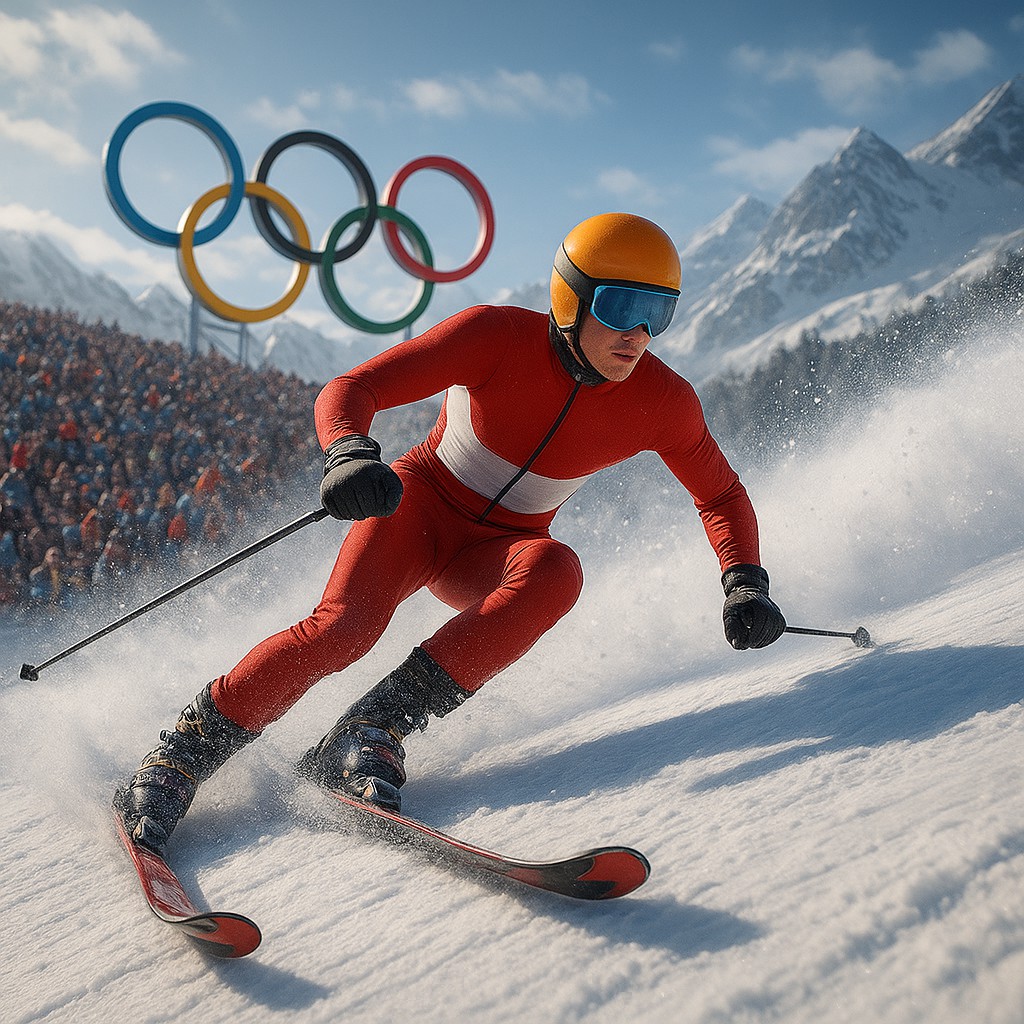
Imagine standing at the peak of a mountain, your breath forming thick clouds in the sub-zero air while thousands of spectators roar your name. Below you lies a ribbon of ice or a sheer drop of packed snow. Between you and a gold medal is a high-speed dance with gravity that could end in glory or a painful, freezing crash. This is the heart of the Winter Olympics, an event where athletes push physics to the limit in environments naturally hostile to human life. It is a celebration of sub-zero temperatures, razor-sharp blades, and the strange human urge to strap wooden planks to our feet and fly.
While the Summer Games often feel like a massive global festival of traditional sports, the Winter Olympics have always been the cooler, faster, and slightly eccentric sibling. It is a world where "sweep!" is a vital tactical command and where sliding face-first down an icy tunnel at eighty miles per hour is a respected hobby. To understand these games is to see how we conquered the cold, turning survival skills into high-stakes art. From the fjords of Scandinavia to the high-tech ice of modern arenas, the Winter Olympics are our most creative response to the harshest season of the year.
The Curious Birth of a Frozen Tradition
The story of the Winter Olympics does not begin with a snowy opening ceremony, but rather with an awkward scheduling problem. In the early 20th century, the International Olympic Committee realized that sports like figure skating and ice hockey were incredibly popular but did not fit the atmosphere of a mid-July track meet. Figure skating actually debuted at the Summer Games in London in 1908, but as you can imagine, maintaining an ice rink in the summer heat was a nightmare. The world needed a separate stage where "white sports" could shine without the scenery melting.
In 1924, a "Winter Sports Week" was held in Chamonix, France, as a lead-up to the Paris Summer Games. It featured only sixteen events and athletes from just sixteen nations. It was such a massive success that officials later decided to call it the very first Winter Olympic Games. This humble start set the stage for a century of growth. Sports evolved from amateur hobbies performed in wool sweaters to high-tech disciplines where a thousandth of a second is the difference between becoming a legend or going home empty-handed. Unlike the Summer Games, which date back to ancient Greece, the Winter Games are a modern invention, born from our ability to manipulate ice and our obsession with speed.
Mastering the Science of the Slide
To a casual observer, many winter sports look like controlled falling, but there is incredible science happening beneath those skis and skates. Take curling, for example, often called "chess on ice." It is the only sport where athletes frantically scrub the ground in front of a moving object. This isn't just for show; the friction from the brooms slightly melts the "pebbled" ice (ice with tiny bumps on the surface), creating a thin film of water. This reduces friction and allows the heavy granite stone to travel further and straighter. It is a masterclass in thermodynamics disguised as an intense cleaning session.
In the world of alpine skiing and snowboarding, the science shifts toward aerodynamics and edge control. Athletes wear skin-tight suits designed in wind tunnels to minimize drag. At ninety miles per hour, the air feels less like a gas and more like a solid wall pushing back against you. The edges of a ski are sharpened until they are sharper than a chef's knife, allowing the skier to "bite" into the ice and hold a turn while facing G-forces that would make most people dizzy. Every turn is a calculation of weight and energy, proving that while these athletes are physical marvels, they are also practical physicists.
The Evolution of the Frozen Program
The list of sports in the Winter Olympics is not fixed; it is a living thing that changes with technology and culture. In the early days, the program was dominated by traditional European activities like cross-country skiing and speed skating. Over time, the Games have embraced the "X-Games" generation, adding high-energy events like snowboarding, freestyle skiing, and "big air," where athletes perform massive jumps. This shift has brought a new level of creativity and youth culture to the mountains.
| Category |
Primary Focus |
Key Examples |
| Alpine Events |
Speed and downhill agility |
Downhill, Slalom, Super-G |
| Nordic Events |
Endurance and jumping |
Cross-country, Ski Jumping, Biathlon |
| Sliding Sports |
Gravity-fed ice tunnels |
Bobsleigh, Luge, Skeleton |
| Ice Sports |
Precision and team strategy |
Figure Skating, Hockey, Curling |
| Skate Sports |
Raw speed on a track |
Short Track and Long Track Speed Skating |
| New School |
Acrobatics and style |
Snowboard Halfpipe, Slopestyle, Big Air |
While sports like the Biathlon seem strange to newcomers, they have deep roots. The Biathlon combines cross-country skiing with rifle shooting, mimicking the skills needed for winter survival and hunting. It is a grueling test of the body; an athlete must transition from a heart rate of 180 beats per minute while skiing to a state of total stillness to hit a tiny target from fifty meters away. This contrast between explosive power and surgical precision makes winter sports uniquely challenging.
Debunking the Myths of the Mountain
One common myth about the Winter Olympics is that athletes are just "sliding" and letting gravity do the work. In reality, sports like the Bobsleigh or Luge require world-class sprinting skills just to get started. In the four-man bobsleigh, the start is a violent burst of power where athletes must push a 460-pound sled to top speed in seconds before jumping in with perfect timing. Once inside, they aren't just passengers; they navigate turns under intense pressure, feeling like an elephant is sitting on their chest as they hit high G-forces in the corners.
Another misconception is that all ice is the same. Olympic figure skaters and hockey players will tell you that ice quality is a science. "Soft" ice, which is slightly warmer, is preferred by figure skaters because it allows their blades to dig in for deep edges and provides a cushioned landing for jumps. In contrast, "hard" ice is colder and more brittle. This is ideal for speed skaters because it provides less resistance and allows for a better glide. The technicians who manage the rink temperature to within a fraction of a degree are just as important to world records as the athletes.
There is also a myth that the Winter Olympics are only for "northern" countries with plenty of snow. While nations like Norway, Canada, and the United States often dominate, the "Cool Runnings" effect is real. We have seen athletes from Ghana, Timor-Leste, and Jamaica compete with incredible heart. The spirit of the Games is about the triumph of human will over the elements. You don't need a backyard full of snow to have the grit required to fly down a hill at breakneck speeds.
The High-Stakes Art of Figure Skating
If sliding sports are about raw power, figure skating is the soul of the Winter Olympics. It is perhaps the most difficult sport to judge because it requires a perfect marriage of extreme athletic ability and artistic grace. A skater performing a quadruple jump is essentially a human helicopter. They must launch themselves into the air, rotate four times in less than a second, and land on a blade only about an eighth of an inch thick. The force of the landing is often several times the skater's body weight, yet they must make it look as effortless as a bird landing on a branch.
The scoring system has changed significantly to remove bias and reward technical skill. Now, every movement is tracked, from the angle of the blade during takeoff to the number of spins. This has pushed the sport into a "quadruple era" where the technical limits are higher than ever. However, the emotional side remains. A perfect performance can move a stadium to tears, proving that the Winter Olympics are not just about who finishes first, but about who can tell a human story on a sheet of frozen water.
The Terror and Majesty of the Sliding Track
For those who find figure skating too calm, there are the sliding sports: Bobsleigh, Luge, and Skeleton. These events take place on a twisting, vertical track of reinforced concrete covered in thick ice. Of the three, the Skeleton is arguably the most terrifying. The athlete lies face-down on a small sled, chin just inches from the ice, and hurtles head-first down the track. There are no brakes, and steering is done through subtle shifts in body weight. It is a sport that requires a total trust in the laws of physics.
- Luge is the opposite of Skeleton, with athletes lying on their backs, feet-first, steering with their legs and shoulders.
- Bobsleigh is the "Formula 1" of the ice, using high-tech sleds designed by car engineers from companies like BMW and Ferrari.
- Monobob is a newer addition, featuring a single person in a bobsleigh to ensure the result is purely about the driver's skill.
These sports are won and lost in the "groove," the best path through the curves. If a driver misses the entrance to a turn by even an inch, the sled can lurch, lose speed against the wall, or even flip over. The mental focus needed to navigate fifteen turns in less than a minute at highway speeds is what separates champions from thrill-seekers.
Why the White Games Capture Our Hearts
Ultimately, the Winter Olympics matter because they represent courage in the face of the unknown. There is something poetic about an athlete standing at the edge of a massive ski jump, looking down a ramp that looks like a cliff, and choosing to leap anyway. It is the same spirit that led our ancestors to explore frozen tundras. We take the cold, which was once a threat to our survival, and turn it into a playground for excellence. These Games remind us that even in the darkest, coldest months, we can find a way to burn with a fierce, competitive heat.
The stories of the Winter Olympics are stories of resilience. We see skiers lose a pole halfway down a mountain and still finish, or skaters who fall and get back up with a defiant smile. These moments resonate because they mirror our own lives. We all have "metaphorical blizzards" to navigate, and seeing someone else conquer a literal one gives us confidence. The Winter Olympics prove that humans are at our best when the environment is at its toughest.
As you watch the next Games, remember that you aren't just watching a competition; you are watching an experiment in human potential. Whether it is the tactical genius of a curling captain, the raw power of a hockey player's shot, or the dizzying grace of a snowboarder, there is something for everyone to admire. The Winter Olympics teach us that with enough preparation, a bit of science, and a massive amount of courage, even the coldest winter can be transformed into a golden achievement.