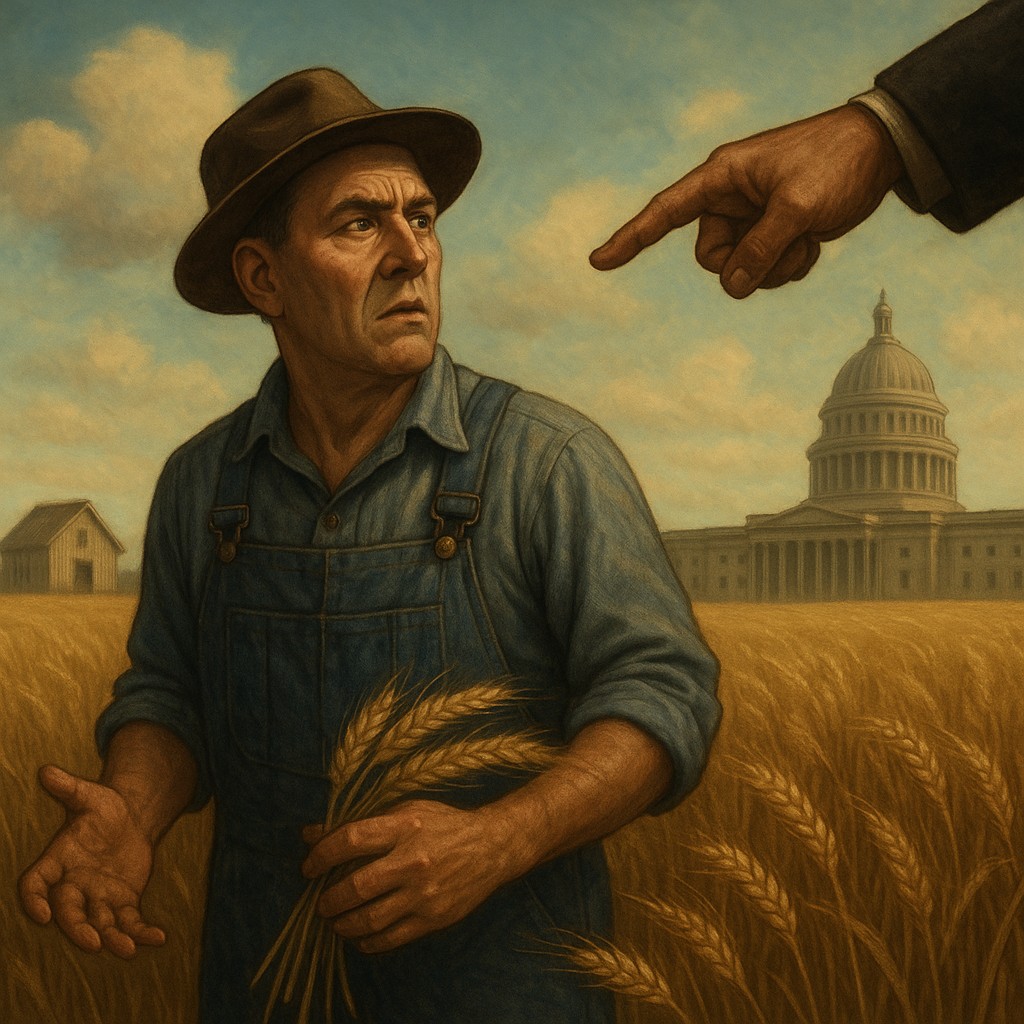
Imagine the shock of a hard-working farmer who, while standing in his own field, is told by the federal government that he cannot grow food for his own animals on his own land. This sounds like the start of a dystopian novel, but it was the gritty reality for Roscoe Filburn, an Ohio dairy farmer in the early 1940s. At the time, the United States was struggling with the leftovers of the Great Depression and the heavy demands of World War II. To keep prices steady, the government set strict limits on how much wheat a farmer could grow, hoping to keep the supply low and prices high enough for farmers to stay in business.
Roscoe Filburn followed the rules for the wheat he planned to sell, but he grew an extra twelve acres specifically to feed his cows and make flour for his family. He argued that since this extra grain never left his farm, never sat in a truck, and never crossed a state line, the federal government had no right to tell him what to do with it. This "mind your own business" defense went all the way to the Supreme Court, resulting in one of the most important and surprising legal decisions in American history. It changed the definition of "interstate commerce," which is the trade of goods between states, from a simple exchange into a massive web where almost everything we do is considered part of the national economy.
The Butterfly Effect of the Local Farm
To understand why the Supreme Court cared about a few extra bags of wheat in Ohio, we have to look at the idea of the "aggregate effect." The court ruled that if every farmer in the country decided to grow their own "extra" wheat for personal use, the combined impact would ruin the national market. If you grow your own wheat, you aren't buying it from someone else. When millions of people stop buying a product because they are making it themselves, the demand for that product drops. This causes prices to crash across the entire country.
This logic suggests that even an act of self-sufficiency is an economic choice that ripples outward. By choosing not to buy from the market, Roscoe Filburn was actually changing the market. The Supreme Court decided that the power to oversee trade between states included the power to regulate anything that "substantially affects" that trade. This shift moved the focus away from the physical movement of goods across borders and toward the hidden economic results of how individuals behave.
Mapping the Lines of Federal Authority
Before this landmark case, the legal world generally saw commerce as something you could see, like a train carrying coal from Pennsylvania to New York. If the coal stayed in Pennsylvania, it was a local matter for that state to handle. The 'Wickard v. Filburn' decision broke this boundary by introducing a more connected view of the world. It established that the federal government's reach is not limited by geography, but by economic impact. This created a new framework for what the government can and cannot control.
This framework is often called the "Aggregation Principle." It asks a simple question: if everyone did what this person is doing, would it change the national economy? If the answer is yes, the federal government usually has the green light to step in. This is why laws about the environment, working conditions, and even home-grown medicinal plants often use the Commerce Clause, the section of the Constitution allowing the regulation of trade, as their legal foundation. The table below shows how the legal perspective shifted after this historic turning point.
| Feature of Regulation |
Pre-Wickard Era (Before 1942) |
Post-Wickard Era (After 1942) |
| Primary Focus |
Physical movement across state lines |
Economic impact on national markets |
| Local Activity |
Generally exempt from federal law |
Subject to federal law if it adds up to a big change |
| Personal Use |
Seen as outside the world of trade |
Seen as a factor that changes demand |
| Government Role |
Limited to policing trade and transit |
Manager of the whole national economy |
| Test for Power |
"Is the item crossing a border?" |
"Does this activity affect supply and demand?" |
The Difference Between Personal Choice and Economic Impact
It is important to clarify that this ruling does not give the government a "blank check" to control every part of your private life. There is a difference between an economic activity and a purely personal or moral choice. over the decades, the Supreme Court has occasionally pushed back when the government tries to use the Commerce Clause to regulate things that do not have a clear connection to money or markets. For example, the court ruled that the federal government could not use this power to regulate guns in school zones or violence against women, because those were seen as criminal or social issues rather than economic ones.
The 'Wickard' precedent specifically looks at the "commercial" nature of an act, even if it happens in private. If you are making, growing, or using something that exists within a national market, you are technically part of that market. However, your choice of hobbies, who you marry, or what you believe remains protected because those actions do not disrupt the national supply and demand of a product. The legal battle is almost always over where to draw the line between a "private act" and an "economic act."
Modern Echoes in the Digital and Green Age
Today, we see the ghost of Roscoe Filburn in many modern debates. Consider the rules for the internet or data privacy. While your personal browsing history feels private, the combined data of millions of users is a multi-billion dollar industry. Because your data affects a national and international market, the federal government uses the lessons from 'Wickard v. Filburn' to justify national standards for digital trade. The same logic applies to environmental rules. A single homeowner burning leaves in their backyard might not seem like a federal issue, but the total effect of millions of people affecting air quality can hurt the national economy through healthcare costs and farm productivity.
The move to renewable energy also follows this pattern. If millions of people install solar panels and stop buying electricity from the national power grid, they are doing exactly what Filburn did with his wheat. They are pulling out of a market, which changes the price and availability of electricity for everyone else. Governments use their power to manage these transitions, making sure that a shift in individual behavior does not crash the entire system. This shows that modern regulations are not just about "control," but about keeping the environment stable in a world where everyone is connected.
Correcting the Myth of Limitless Government
A common mistake is thinking that 'Wickard v. Filburn' destroyed the 10th Amendment, which saves certain powers for the states. While it definitely expanded the government's reach, it did not give it the power to do whatever it wants. The legal system still requires a "rational basis" for these rules. The government has to prove there is a logical link between the local activity and the national economy. If the connection is too strange or too distant, the courts can still strike the law down. It is a balancing act, not a total takeover.
Another myth is that this case only matters to farmers. In reality, this case is the reason why federal minimum wage laws apply to local businesses. It is also why federal civil rights laws could be used to end segregation at local lunch counters and hotels. By proving that local businesses affect the national flow of people and money, the government was able to enforce a baseline of fairness and safety across the entire country. Without this case, the United States would likely be a patchwork of wildly different laws, making it nearly impossible to run a national business or move freely between states without facing legal chaos.
As you look around your home today, from the food in your pantry to the energy powering your screen, remember that you are part of a giant, breathing economic machine. Your smallest choices, when multiplied by millions, have the power to shift markets and change history. Understanding the legal journey of a simple wheat farmer allows you to see the invisible threads that connect your private life to national law. This interconnectedness is what helps maintain the stability and progress of our society. Every regulation is not just a rule, but a piece of a much larger puzzle that keeps our modern world moving forward.