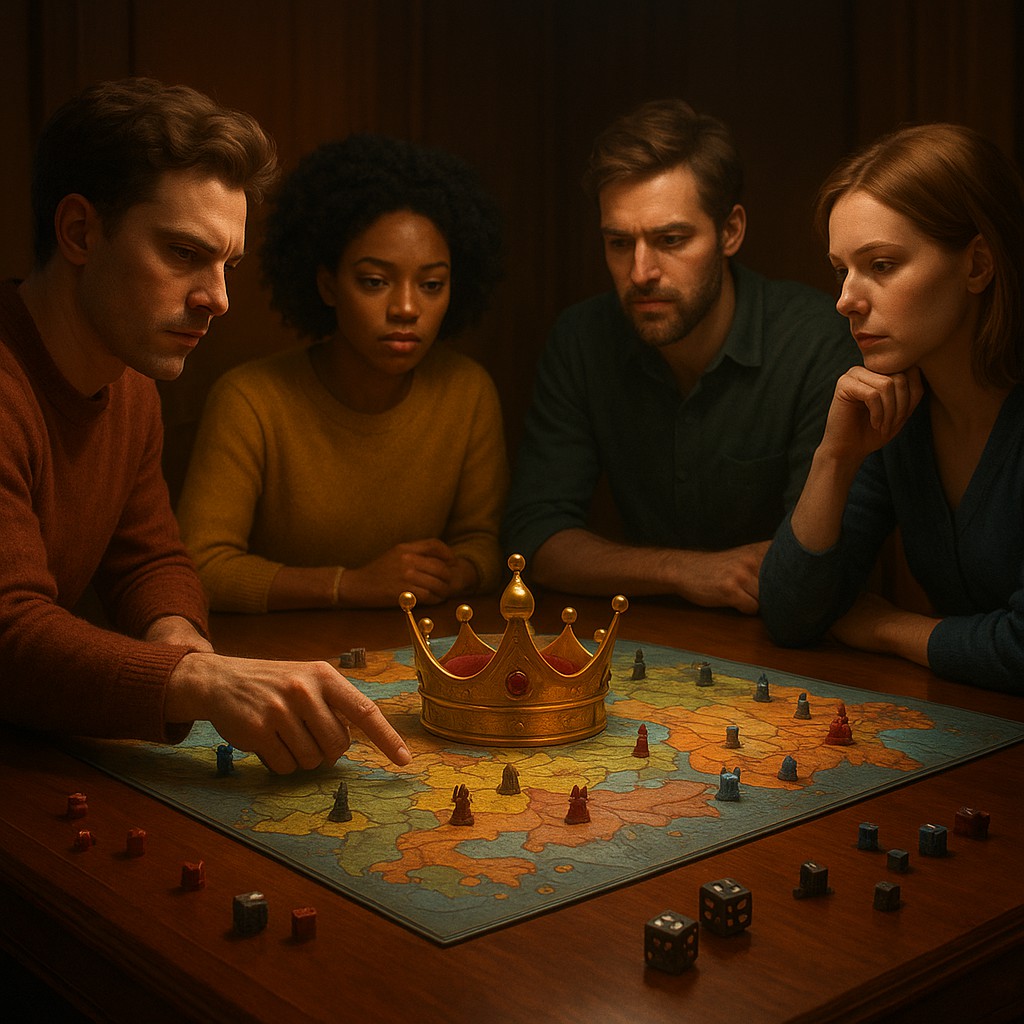
Imagine you are sitting around a mahogany table with three close friends, deep into the tenth round of a complex strategy game. You have spent the last three hours building an empire, managing resources, and carefully planning your path to glory. However, a run of bad luck with the dice and a poorly timed invasion from the north have left your economy in ruins and your armies scattered. As you look at the board, the cold truth sets in: you cannot win. There is no sequence of moves, no hidden card, and no stroke of luck that will put the crown on your head. For all intents and purposes, you are a ghost in the machine.
Yet, the game is not over. It is your turn, and while you cannot save yourself, your next move will decide which of your remaining opponents wins. If you trade your last bit of gold to Sarah, she will have enough to build the Wonders of the World and win instantly. If you use your final soldiers to attack Sarah’s border, you clear a path for Mark to waltz into the capital and seize the throne. You have lost the ability to win, but you have gained something perhaps even more powerful: the power to choose the victor. This is known as kingmaking - a moment where the competitive logic of a game collapses and is replaced by something much more human, emotional, and politically complex.
The Moment the Crown Passes Through Your Hands
Kingmaking is often called the "spoiler effect" of the gaming world. It happens in any contest with more than two sides where a player who has no mathematical chance of winning can still change the outcome for everyone else. In a two-player game like Chess, this never happens. If you are losing, you either lose or you resign; there is no third party to benefit from your defeat. But in a game with three, four, or five players, power is rarely balanced. When one person falls behind, their presence on the board becomes a wildcard that the leaders must handle with extreme caution.
The psychological shift that happens during kingmaking is fascinating because it breaks the "social contract" of gaming. We generally play games assuming that everyone is acting in their own self-interest to win. When a player can no longer win, that self-interest vanishes. The resulting void is often filled by spite, gratitude, or random whim. Suddenly, the game is no longer about managing resources; it is about who was the nicest to the person currently losing. This shift from objective strategy to social maneuvering is why kingmaking is one of the most debated topics in both game design and political theory.
The Kingmaker as a Geopolitical Reality
While we most often see this happen over a deck of cards or a colorful board, kingmaking is a fundamental part of how the real world works. In international relations, small "buffer" states - minor countries located between larger rivals - or small political parties often find themselves in the role of the kingmaker. Consider a national election where two major parties are neck-and-neck, but neither has a majority. A tiny third party, representing perhaps only five percent of the vote, suddenly holds the fate of the nation in its hands. They cannot lead the government themselves, but they decide which giant gets to take charge. This disproportionate influence of the "weak" is a paradox that keeps political scientists up at night.
In the corporate world, this dynamic appears during hostile takeovers or battles for control of a company. A minority shareholder might own a tiny sliver of a business, but if two massive investment firms are locked in a 49-to-49 percent stalemate, that small player becomes the most important person in the room. This highlights a crucial lesson about power: it is not always about the total resources you control, but where those resources sit in relation to the tipping point. A kingmaker’s power comes entirely from the friction between the leaders, proving that in a divided system, the person in the middle (or at the bottom) can often dictate terms to the top.
Designing the Sting Out of the Game
For many players, kingmaking is a frustrating "bug" that ruins the spirit of competition. Game designers spend countless hours trying to build systems that prevent it. One common solution is hidden scoring. In many modern "Euro-style" board games, you do not actually know who is winning until the very last second when everyone reveals their points. By hiding the lead, designers keep players motivated to play for their own best score rather than switching to a strategy fueled by spite. If you think you might still have a chance, you will keep playing for yourself, which ironically keeps the game fair for everyone.
Another technique is "shortening the tail." This involves mechanics that ensure the game ends quickly once a clear leader emerges, or "catch-up" mechanics that keep everyone close enough to win until the very end. However, some designers argue that kingmaking is not a bug at all, but a vital part of social strategy. In games like Diplomacy or Dune, the whole point is to manage your relationships so that when someone falls behind, they still want to see you succeed. In these cases, kingmaking is the ultimate penalty for being a "jerk" during the game. If you played ruthlessly and stepped on everyone's toes to get ahead, you shouldn't be surprised when the person you crushed uses their last breath to hand the win to your rival.
| Strategy Type |
Objective |
Role of Kingmaking |
Common Example |
| Pure Symmetric |
Individual Victory |
Non-existent; usually 2-player or elimination. |
Chess, Go, Tennis |
| Hidden Progress |
Maximizing Score |
Minimized; players rarely know they've lost. |
Ticket to Ride, Terraforming Mars |
| High Diplomacy |
Negotiated Power |
Central; alliances and "kingmaking" are the point. |
Diplomacy, Risk, Game of Thrones |
| Engine Building |
Resource Optimization |
Accidental; usually caused by board interference. |
Catan, Splendor |
The Ethics of the Spite Move
When you find yourself as a kingmaker, you face a strange ethical dilemma. Do you try to play "optimally," even though doing so no longer helps you? Some players believe in the "purest" approach, where they continue to make the moves that would have been best for them if they still had a chance to win. This is often seen as the most honorable path, as it keeps your personal bias out of the final result. However, this is easier said than done. It is hard to care about the price of wheat in a game of Catan when your empire is a smoking crater and the player to your left has been mocking your trades for an hour.
This brings us to the "Social Contract of Competition." When we sit down to play, we agree to follow the rules, but we also agree to a set of unwritten emotional rules. Kingmaking tests these boundaries because it allows for the "Spite Move" - a decision made specifically to punish a player who wronged you earlier. While this feels satisfying in the moment, it can cause long-term tension in a friend group. On the other hand, some groups embrace "Kingmaker's Gratitude," where the losing player rewards an ally who helped them earlier. Neither approach is "wrong" according to the rulebook, but they turn the game from a test of skill into a test of character and memory.
Why the Underdog Always Matters
The existence of kingmaking reminds us that no one in a system is truly powerless unless the system is designed to ignore them entirely. In any environment where people interact, the "loser" still takes up space, holds resources, and makes choices. By understanding kingmaking, we become better at navigating the social complexities of life. It teaches us that how we treat people on our way up matters immensely. Those same people might eventually decide whether we actually reach the top or get tripped just inches from the finish line.
The next time you are at a gaming table, or perhaps in a meeting where you feel your influence slipping, remember the power of the kingmaker. You may not be wearing the crown today, but your actions still ripple across the board. The mark of a truly great strategist is not just knowing how to win, but knowing how to behave when winning is no longer an option. Whether you choose to be a graceful loser or a vengeful spoiler, you are a reminder that in a complex world, the final decision often rests in the most unexpected hands. Use that influence wisely; even without a path to victory, you still hold the keys to the kingdom.