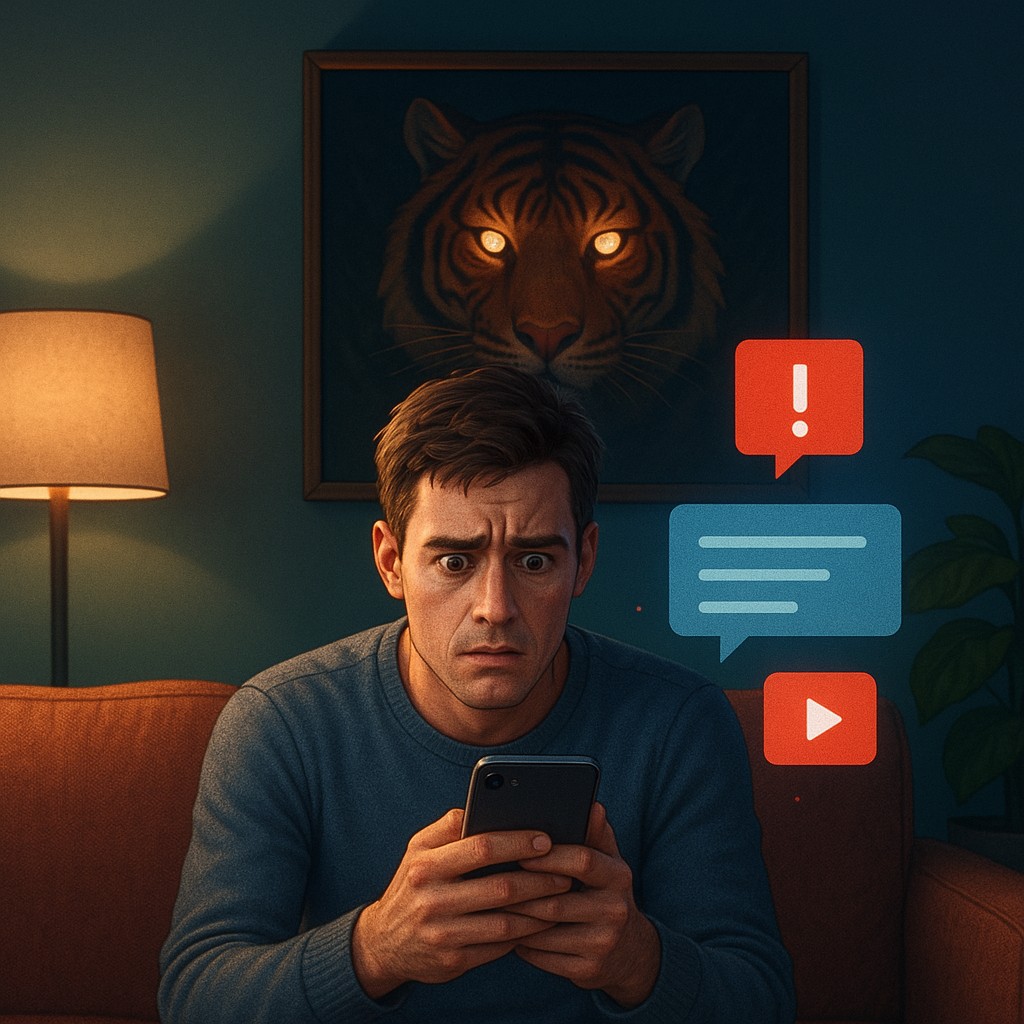
Imagine for a moment that you are a hunter-gatherer wandering through a lush savanna ten thousand years ago. Suddenly, the bushes rustle, and a pair of glowing eyes peers through the leaves. Your brain is a master of survival. It doesn't stop to analyze the scientific name of the shrub or the predator's diet. Instead, it floods your body with cortisol and adrenaline, forcing your heart to race and preparing your muscles to either fight for your life or run as fast as you can.
This is the "fight or flight" response. It is a brilliant evolutionary tool that kept your ancestors from becoming a snack. This reaction is fast, efficient, and meant to be over quickly. It is supposed to end once the danger has passed and you are safely back at the campfire.
Now, fast-forward to today. You are sitting on a comfortable sofa, sipping a lukewarm coffee, and scrolling through your phone. There are no sabre-toothed tigers in your living room, yet your heart is racing. Your palms are damp, and your neck muscles are as tight as guitar strings. As you read a bitter political argument or watch a breaking news alert about a contested election, your ancient brain is firing off the exact same chemical alarms it used on the savanna.
The problem is that the "tiger" on your screen never actually attacks, and it never actually leaves. You are stuck in a state of high alert, soaking in stress hormones while sitting perfectly still. This phenomenon, which mental health professionals increasingly call Post-Election Stress, is changing the way we understand our relationship with the digital world.
The Biological Prank of the Digital Age
To understand why a simple headline can make you feel like you just finished a boxing match, we have to look at how the brain handles social conflict. Our brains evolved in small tribal groups where social standing and peace within the group were matters of life and death. If the tribe was in trouble, your survival was at risk. Today, the "tribe" has grown to include millions of strangers on the internet, but the brain hasn't received the update. When you see intense political division or social unrest on your screen, your amygdala - the brain's emotional smoke detector - treats it as a direct threat to your safety.
When the amygdala sounds the alarm, the hypothalamus tells the glands to release cortisol. In small doses, cortisol is helpful; it helps you wake up in the morning and focus on urgent tasks. However, the modern news cycle is a non-stop flood of "breaking" news designed to keep you clicking. Unlike the tiger in the bushes, the news cycle never ends. This leads to chronic cortisol exposure, which acts like a slow leak in your body's plumbing. Over time, this chemical saturation leads to "allostatic load." This is a technical term for the physical wear and tear that builds up when you are under constant stress. It is why you feel physically exhausted even if you have spent the entire day sitting in an office chair.
Designing a Personal Information Diet
Just as we learned that eating too much sugar causes physical illness, we are now discovering that consuming endless, high-intensity information leads to mental exhaustion. This has led to the rise of "informational hygiene," a concept that treats news consumption as a matter of public and personal health. The goal is not to become ignorant or stop caring about the world. Instead, it is about moving from a "reactive" state, where your phone controls your mood, to an "intentional" state, where you choose when and how to engage with the world's problems.
Think of your attention as a limited resource, much like a monthly budget. Every time you check a notification out of habit, you are spending a portion of that budget. Most of us are currently "overdrawn," spending more emotional energy on the news than our nervous systems can afford to pay back. By creating boundaries, you are essentially setting up a savings account for your sanity. This means shifting from "push" information, where alerts are forced in front of you, to "pull" information, where you look for updates only when you have the mental energy to handle them.
Comparing High-Stress vs. High-Hygiene Habits
To see how these changes look in daily life, consider the following table. It compares common habits that lead to Post-Election Stress with the practices recommended by mental health experts.
| Feature |
Reactive Consumption (High Stress) |
Intentional Hygiene (Low Stress) |
| Delivery Method |
Instant push notifications and "breaking" alerts. |
Scheduled "check-in" times (e.g., 8:00 AM and 6:00 PM). |
| Physical Setting |
Scrolling in bed, during meals, or while traveling. |
Designated "news zones" away from where you rest. |
| Media Format |
Short videos and high-conflict social media threads. |
Long articles, newsletters, or weekly summaries. |
| Reaction Pattern |
Immediate emotional response and "doomscrolling." |
Thinking through what you read, then taking time to reflect. |
| End Goal |
Staying "connected" at all costs. |
Staying informed while protecting your mental energy. |
Breaking the Cycle of Doomscrolling
One of the most harmful habits we have developed is "doomscrolling," the act of continuously scrolling through bad news even when it makes us upset. This behavior is actually a confused attempt by the brain to find safety. The logic is: "If I just read one more article, I will finally understand the situation and then I will feel safe." Unfortunately, the internet is a bottomless pit. There is no "end" to the news cycle, so that feeling of safety never arrives. Instead, the brain stays trapped in a loop of searching and stress.
To break this cycle, therapists suggest "compartmentalization." This doesn't mean ignoring politics; it means giving it a specific place in your life so it doesn't bleed into your sleep, your work, and your relationships. For example, you might decide that the first hour of your day and the last hour before sleep are "no-news zones." During these times, your nervous system is most likely to be upset or disrupted. By protecting these windows, you allow your cortisol levels to rise and fall naturally, rather than being spiked by a random post or a divisive headline.
The Power of the Physical World
Another key strategy for managing Post-Election Stress is "anchoring" yourself in the real world. When we spend hours online, our brains can forget that our immediate surroundings are actually safe. This is why many therapists recommend "grounding techniques" after reading heavy news. This could be as simple as going for a walk, gardening, or doing a hobby that uses your hands. These activities send a powerful signal to the brain: "I am here, I am moving, and there is no immediate physical threat."
Additionally, it is helpful to shift your focus from global problems you cannot control to local actions you can. Chronic stress is often made worse by a sense of helplessness. When you read about massive national or international conflicts, you take on the stress of the situation without a way to release that energy. By focusing that energy on local community service, a neighborhood project, or even just helping a friend, you give your brain a "win." This replaces the feeling of being a helpless victim of the news with the feeling of being an active participant in your own life.
Building a Sustainable Civic Mindset
Ultimately, the shift toward informational hygiene is about sustainability. We live in a world that requires us to be involved; there are important issues to vote on, social causes to support, and policies to understand. However, if you burn out your nervous system by November, you won't have the energy to be a productive citizen in December. We often treat our mental health as a luxury to deal with "after the crisis," but the modern world is a series of crises that overlap. Waiting for a quiet moment to take care of yourself is like waiting for the ocean to stop having waves before you learn to swim.
By setting boundaries and managing your media "diet," you are actually becoming a more effective advocate for the things you care about. A person who is well-rested, calm, and clearly informed is much more capable of fighting injustice than someone who is exhausted, cynical, and paralyzed by stress. Informational hygiene isn't about looking away; it is about making sure your eyes are clear enough to see where you are going.
You possess the most complex biological machinery in the known universe, but it requires the right fuel and maintenance to work properly. By taking control of your digital environment, you are not just reducing stress; you are reclaiming your time, your focus, and your joy. The world's problems will still be there when you log back in, but you will find that when you approach them on your own terms, you are no longer a victim of your own anxiety. You are an empowered observer, capable of processing the world without being consumed by it. Take a deep breath, put the phone down for a moment, and remember that your peace is the foundation of your power.