You have likely found yourself stuck in a growing state of frustration, white-knuckling the steering wheel as your car crawls forward at the pace of a snail. You glance at the GPS, which glows with a stubborn red line, and prepare yourself for the sight of a multi-car wreck or a construction crew tearing up the asphalt. Yet, as the minutes tick by and the speedometer finally starts its climb back toward sixty, you notice something baffling: there was no accident, no closed lane, and no police cruiser with flashing lights. The road ahead is perfectly clear, the sun is shining, and you have just been a victim of a ghost that haunts our highways.
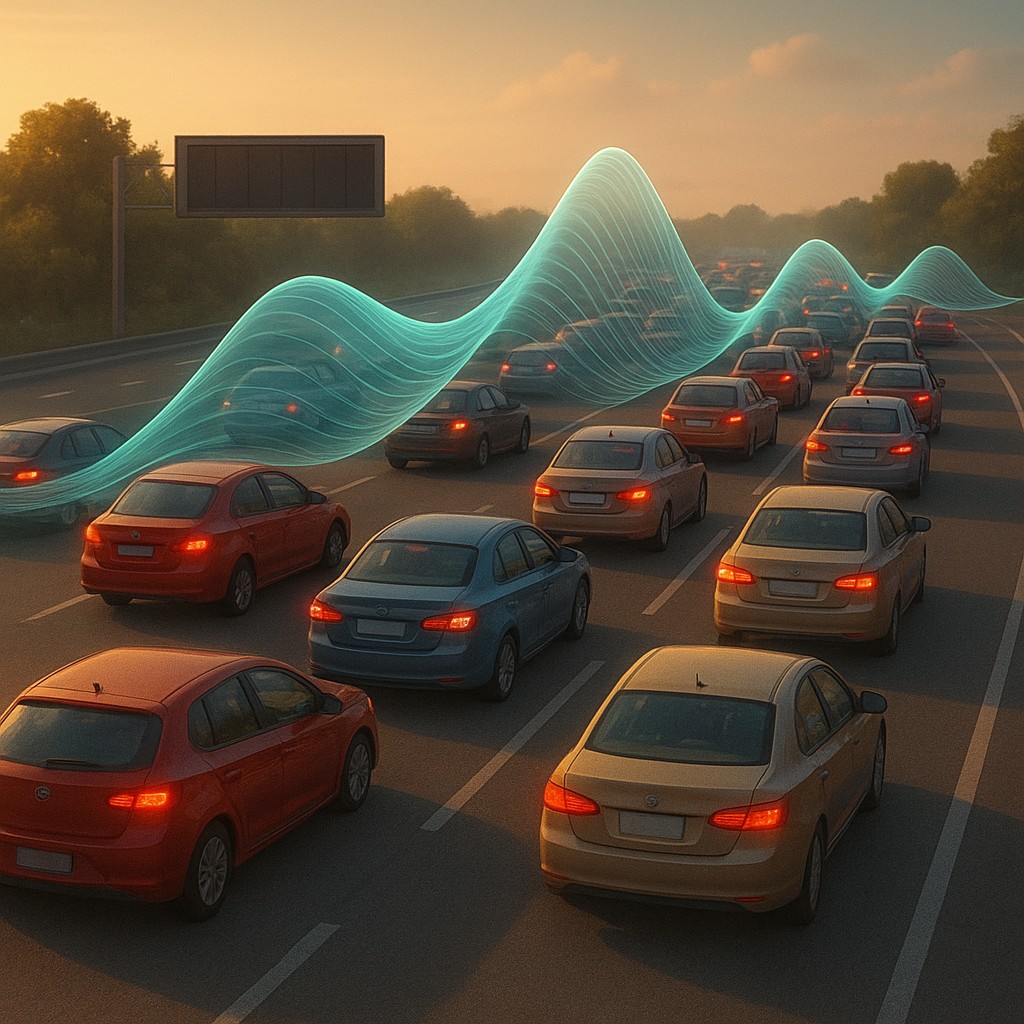
This phenomenon, known to mathematicians and engineers as a "phantom traffic jam," is a fascinating example of how individual human behavior can disrupt a complex system. It is not caused by broken roads or disasters, but by the mathematical way waves move through a medium. In this case, the medium is a long line of cars, and the wave is a pulse of braking energy that travels backward through that line. Understanding how these invisible clogs form is the first step toward keeping your cool during the morning commute. It reveals that traffic works less like a collection of solid objects and more like a moody, flowing liquid.
The Invisible Physics of the Highway Pulse
To understand why traffic suddenly stops for no reason, we have to look at vehicles not as independent machines, but as molecules in a fluid. When you are driving on a highway at seventy miles per hour, you are part of a delicate balance. As long as everyone keeps the exact same speed and distance, the "fluid" flows smoothly. However, human beings are not perfect sensors. We have reaction times, different comfort levels regarding how close we follow others, and a tendency to be distracted by the radio or a passing billboard.
When one driver taps their brakes, perhaps because they saw a bird or realized they were slightly over the speed limit, they create a small ripple. The driver behind them sees the brake lights and, out of a natural instinct to stay safe, taps their own brakes just a millisecond longer or a fraction harder to ensure they don't hit the car in front. This is a "backward traveling wave." While the cars are moving forward, the signal to "slow down" is actually moving backward toward the horizon. By the time this signal reaches the tenth or twentieth car in line, that slight tap has grown into a full-on emergency stop.
This ripple effect happens because of our natural physical delays. It takes about half a second to a second for a person to see a light and move their foot to the pedal. To make up for that lost time, we tend to overreact with more force. If the first car slows down by five miles per hour, the fifth car might slow by fifteen, and the twentieth car comes to a dead stop. This creates a "jamiton," a self-sustaining wave of congestion that can last for hours. It moves slowly backward against the flow of traffic long after the original driver who tapped their brakes has reached their destination and started dinner.
The Mathematical Anatomy of a Jamiton
Researchers have spent decades studying these jams using "cellular automaton models," which are computer simulations that predict how small parts affect a big system. These simulations show that traffic jams are an "emergent property," meaning they are a complex result of very simple rules. In these models, cars follow three basic instructions: speed up if there is space, slow down if a car is close, and occasionally slow down randomly due to human error. Even without a bottleneck like a bridge or a toll booth, those random hiccups eventually bunch up to form a solid mass of stopped cars.
| Feature |
Smooth Flow (Steady) |
Phantom Jam (Choppy) |
| Driver Spacing |
Large, consistent gaps |
Uneven, "rubber-band" gaps |
| Speed Changes |
Low (everyone at 60 mph) |
High (sudden 60 to 0 drops) |
| Information Flow |
Predictable visual cues |
Delayed reaction ripples |
| System Stability |
High; absorbs minor braking |
Low; small taps cause total collapse |
| Fuel Efficiency |
Good due to steady engine speed |
Poor due to constant idling and braking |
As the table shows, the shift from smooth flow to a phantom jam changes how information travels on the road. In a stable system, a driver can see several cars ahead and adjust their speed gradually. In an unstable system, drivers are forced to react only to the bumper immediately in front of them. This creates a loop where the system becomes more and more sensitive to small movements. Eventually, the cars get so close together that there isn't enough room to react and slow down smoothly, effectively "freezing" the liquid flow into a solid block.
Become the Shock Absorber of the Roadway
The most empowering part of understanding phantom jams is realizing that since individual behavior causes them, individual behavior can also solve them. You do not need a degree in engineering to help clear an invisible jam; you simply need to change how you view your role in line. Most drivers feel a subconscious pressure to "close the gap" with the car in front. We feel that by hugging the bumper ahead, we are somehow getting to our destination faster. In reality, this behavior is exactly what feeds the phantom. When you leave no room for error, every tiny tap of the lead car's brakes forces you to react, which then forces the person behind you to do the same.
To break the cycle, you must become a "traffic shock absorber." This means intentionally keeping a large, steady gap between your vehicle and the one in front, even if other drivers occasionally merge into that space. When you see brake lights far ahead, don't immediately slam on your own brakes. Instead, let your car coast, using that large gap to soak up the lead car's slowing. If the car in front slows down and then speeds back up, your gap allows you to keep a constant, average speed without ever touching your brake pedal.
When you do this, you effectively kill the backward-moving wave. The person behind you sees your steady pace and realizes they don't need to brake either. You have turned a "stop-and-go" signal into a "slow-but-steady" signal. While it might feel strange to stay at thirty miles per hour when the car in front of you is briefly doing forty, your consistency prevents the "accordion effect" that leads to mile-long standstills. You are no longer just a driver; you are a stabilizer for the entire highway.
The Psychology of the Highway Ego
Why is it so hard for us to keep these gaps? The answer lies in our psychology and a feeling researchers call "the illusion of the faster lane." On a crowded highway, we are hyper-aware of cars passing us, but we rarely notice the cars we are passing. This creates a feeling of being "left behind," which triggers a competitive urge to close gaps and change lanes frequently. This ego-driven driving is the primary fuel for phantom jams. Every time a driver cuts into a small gap in the next lane, the driver who was cut off must brake to create a safety cushion, sending a fresh ripple of congestion miles back.
Furthermore, we often underestimate the power of "synchronized flow." There is a state between moving freely and a total jam where cars move at the same speed across all lanes. In this state, the highway can actually handle more cars than it can when everyone is darting around trying to find the "fast" lane. When we drive selfishly, we accidentally lower the road's capacity. By relaxing and accepting a steady, slightly slower pace, we actually increase the "throughput" (the total number of cars that can pass through), meaning everyone gets home sooner.
It is also worth noting that while our cars are getting smarter, they still struggle with human irrationality. Adaptive Cruise Control (ACC) systems are designed to keep these gaps automatically. Studies have shown that if even twenty percent of cars on a highway used these systems effectively, phantom jams could be nearly eliminated. However, until we have fully self-driving cars that can "talk" to each other and coordinate speeds, the responsibility stays with us. We must provide the patience and foresight that the mathematics of the road requires.
The Butterfly Effect of the Brake Pedal
The phantom traffic jam perfectly illustrates the "Butterfly Effect" in our social lives. A single moment of hesitation or an aggressive lane change at 8:00 AM can cause a massive wall of traffic at 8:15 AM that affects thousands of people. This adds a sense of responsibility to our daily commute. We aren't just moving ourselves from point A to point B; we are part of a massive, invisible wave of energy that we either help steady or help disrupt.
Physics tells us that energy is never truly lost; it just changes form. In a traffic jam, the energy of your moving car is turned into heat in your brake pads and frustration in your nervous system. By learning to "flow" rather than "stutter," you save that energy. You save fuel, reduce wear and tear on your car, and most importantly, lower the stress of everyone sharing the road with you. The phantom jam is a ghost we create ourselves, born from our reactions and fed by our impatience, but it vanishes the moment we decide to drive with the big picture in mind.
Next time you find yourself slowing down for no clear reason, don't look for a wreck or a hazard. Instead, look in your rearview mirror and realize that you have the power to stop the wave. Take a deep breath, ease off the gas, and create a cushion of space. You might feel like you are letting people "get ahead" of you, but in reality, you are the one keeping the world moving. There is a quiet thrill in knowing that by doing less, you are actually achieving more for everyone. Embrace the role of the stabilizer and enjoy a smoother, smarter way to travel.