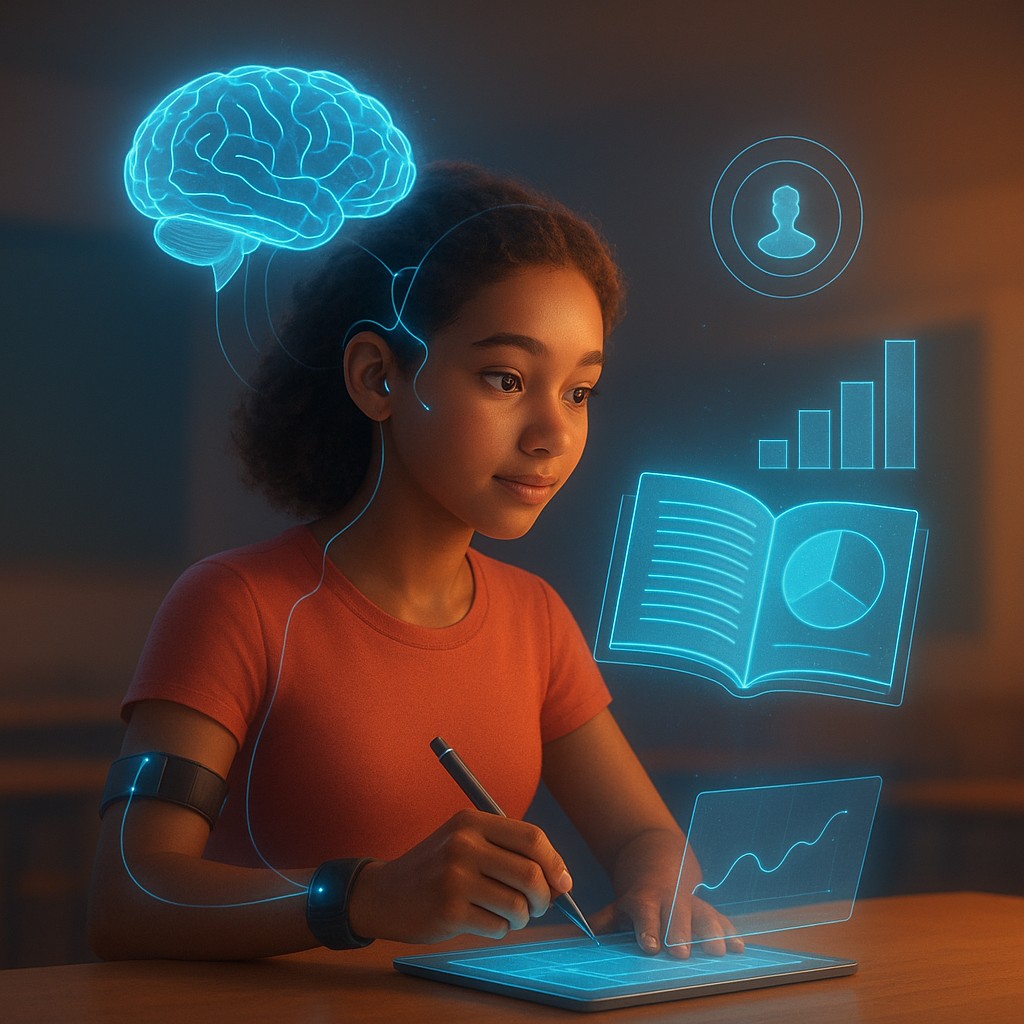
Imagine a classroom where the walls don't exist, the textbooks come to life, and your teacher acts as a silent partner who knows you're about to give up before you even realize it yourself. For decades, the biggest hurdle in education has been the "one size fits all" problem. In this old model, twenty-five students are forced to learn at the exact same speed, regardless of how they feel or how fast they actually work. The student who understands a concept in minutes gets bored and acts out, while the one who needs more time feels a wave of panic as the lesson moves on without them. We have long accepted this as a necessary flaw of public schooling, but a major shift is now moving the focus away from the teacher’s desk and directly toward the student’s own nervous system.
By combining wearable sensors with advanced artificial intelligence, a new method called "Hyper-Personalized Learning" is starting to appear worldwide. This technology does more than just grade a quiz; it tracks how hard your brain is working by reading body signals like your heart rhythm and the electrical changes in your skin. We are moving toward a future where the school curriculum is a living thing that gets harder or easier based on how your body reacts in real time. This is a quest for the "Goldilocks Zone" of learning: a place where the work is never so easy that it’s boring, nor so hard that it’s overwhelming, but just right for helping you grow.
How the Brain Feedback System Works
At the center of this personalized learning is something called a Multi-Agent System (MAS). Think of this as a team of specialized AI "assistant teachers" working together behind the scenes. One assistant tracks your progress through the lesson, another monitors how difficult the material is, and a third, perhaps the most important one, is dedicated to sensing your emotions and physical state. These assistants talk to each other in a fraction of a second to decide if you are ready for a harder math problem or if the software should stop to give you a helpful hint.
The brilliance of this system is how it handles "Cognitive Load." This term refers to the amount of mental energy your working memory uses at any one time. When we learn something new, our brains have a limited amount of "space" to process it. If the information is too simple, we don't use enough of that space and we tune out. If it is too complex, we hit a "bottleneck" that causes stress and stops us from remembering anything. By using a team of AI assistants, the software can change the "instructional scaffolding"-the temporary support given to a student-to make sure the mental workload stays perfectly balanced.
Reading the Body’s Language
How does an AI actually "read" a student’s mind? It looks at the Autonomic Nervous System, specifically through Heart Rate Variability (HRV) and Electrodermal Activity (EDA). HRV does not measure how many times your heart beats per minute. Instead, it measures the tiny changes in the time between those beats. Surprisingly, a healthy and relaxed heart has high variability, meaning the timing between beats changes a lot. When a person is under intense mental stress or anxiety, the heart becomes more like a ticking clock, beating with rigid regularity. By tracking these tiny shifts, a wearable device can tell the AI that a student is becoming frustrated.
Electrodermal Activity, also known as skin conductance, measures tiny changes in how well the skin conducts electricity. This is caused by invisible bursts of sweat from our pores, triggered by the nervous system during times of excitement or hard mental work. When these two signals are combined, they create a biological map of the student’s internal state. If the heart starts beating with clock-like precision and the skin's electricity spikes, the AI knows the student is likely overwhelmed. The system can then simplify the task or send a supportive, encouraging message.
| Biological Signal |
Physical Marker |
What it Means for Learning |
AI Response |
| Heart Rate Variability (HRV) |
Changes in time between heartbeats |
High variability means calm; low variability means stress. |
Make the task easier or suggest a break if stress is too high. |
| Skin Conductance (EDA) |
Moisture levels on the skin |
High levels show intense focus or high excitement. |
Increase difficulty if the student is focused; decrease it if they are panicking. |
| Pupil Dilation |
Widening of the black centers of the eyes |
Larger pupils often mean the brain is working very hard. |
Keep the difficulty the same; the student is actively solving the problem. |
| Reaction Time |
Speed of using the software |
Slowing down may mean confusion; speeding up may mean mastery or just random clicking. |
Look for patterns to see if the learner is guessing or thinking deeply. |
Entering the "Flow State" and the End of Big Tests
The ultimate goal of these systems is to help students reach a state of "Flow." First named by psychologist Mihaly Csikszentmihalyi, Flow is that focused state where you are so involved in what you are doing that you lose track of time. It happens when your skills perfectly match the challenge you are facing. In a normal classroom, Flow happens by accident to only a few students. In a hyper-personalized system, Flow is the goal for everyone. By keeping the student right at the edge of their comfort zone, the system ensures they are always working at their best.
This changes the whole point of school from just "finishing" to actually "mastering" a subject. In most schools today, a student might get a 70% on a test, but the class moves on anyway. This leaves the student with a 30% gap in what they know. That gap grows like a crack in a building’s foundation until the student eventually says they "hate" math or science. A personalized system refuses to move on until a student truly understands the topic, but it also refuses to slow down if a student is ready to fly ahead. This could eventually replace high-stakes testing, since the "test" is happening every second through constant, invisible check-ins on how the student is performing.
The Ethics of Tracking Body Data
While the benefits for learning are huge, the move toward this technology brings serious privacy concerns that international groups are struggling to solve. Biometric data, or information about our bodies, is some of the most sensitive data a human can produce. It is a record of our internal reactions to the world. If a company or a government has a record of a child’s physical responses from age five to eighteen, that data could be used for more than just teaching. It could be used to predict personality traits, health risks, or even political views later in life.
There is also the risk of "biometric bias." If the AI is trained only on data from one group of people, it might misunderstand the stress signals of a student from a different culture or someone with a brain that works differently, such as a student with ADHD. For example, an ADHD student might show physical signs of "distraction" that are actually just part of how they focus. International guidelines from groups like UNESCO insist these systems must be "human-centered." This means the AI should help the teacher and student, not replace human judgment. We must make sure a "stress signal" is seen as a call for help, not a permanent bad grade on a student’s record.
Building the Future of Human Potential
The bridge between who we are and who we can become is built on the quality of our education. As these AI systems move from laboratories into everyday use, we may soon see a world where learning is a joyful, smooth process designed specifically for our unique bodies. It is a future where "average" becomes a forgotten word, because "average" was only ever a mathematical result of trying to force very different minds into a single mold.
Successfully building this future will require a careful balance between new brain science and strong privacy laws. We are essentially giving a computer a look into the human soul, and that "window" must be protected with extreme care. However, the reward for doing so is that everyone gets a chance to be great. When every student has a tutor that understands both their heart and their mind, there is no limit to what humans can achieve. We aren't just teaching subjects anymore; we are learning how to learn, and in the process, we are starting the next chapter of human history.