When a board game becomes a time machine: why the history of Parchís matters
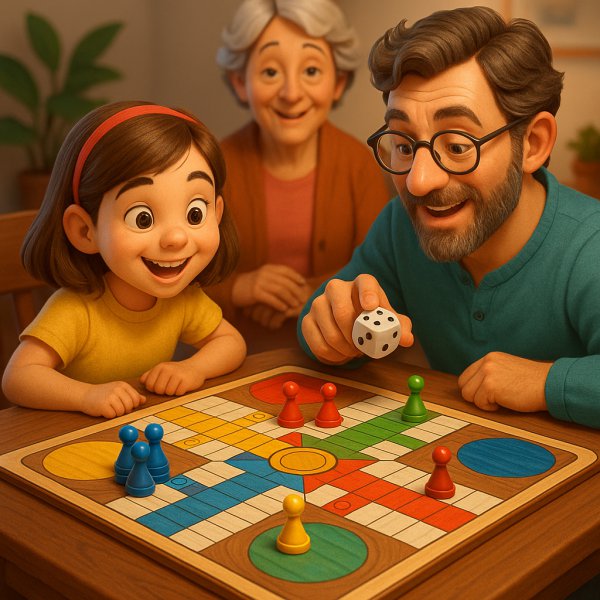
Imagine sitting at a kitchen table, a circular board spread out, bright pawns clustered in corners like small soldiers waiting for orders, laughter from friends pushing a die across the wood, and a single move upending the whole game. That experience is timeless, and Parchís is one of those games that quietly threads families, empires, and migrations together. The history of Parchís is not just about rules and pieces, it is about cultures borrowing, adapting, and reimagining play across centuries.
Parchís belongs to a family of cross-and-circle games that traveled from the courts of medieval India to the parlor rooms of Victorian England, and then into towns and tapas bars across Spain and Latin America. Tracking its path reveals how games adapt to new societies, pick up new rules, change names, and become emblematic of local identity. That makes Parchís a small but vivid lens on cultural exchange, colonial history, and human creativity.
This Learning Nib will take you on that journey. We will start at the game's origin story, move through its transformations into Ludo and Parcheesi, zoom into the Spanish Parchís tradition, and consider the rules, tactics, cultural meaning, and modern digital life of the game. Along the way you will find reflection questions that prompt you to connect the history to your life, practical steps to try the game and teach it to others, and a table that clarifies how the main variants differ.
By the end you should understand where Parchís comes from, why it changed, how to play or teach it, and why a simple board game can hold complex stories about people and their pasts. You might even be inspired to organize a Parchís night and connect across generations with nothing more than pawns and a die.
From Indian palaces to portable boards - Pachisi, the ancient ancestor
The ancestor of Parchís is Pachisi, a cross-and-circle race game that has roots in ancient India. Literary and archaeological references suggest that versions of Pachisi were played several centuries before the Common Era, although the most detailed accounts arise in medieval and Mughal-era sources. Pachisi was played on a cloth board, often designed in a symmetrical cross shape, and used cowrie shells or dice to determine moves. The game carried social significance, occupying courtiers, villagers, and kings alike.
One vivid historical scene is from the Mughal court of Emperor Akbar in the 16th century, where a life-sized Pachisi called Chausar was played using people as pieces, and boards were scaled up to dramatic proportions. Akbar himself is depicted in paintings playing the game on a huge board, indicating the game's prestige. Pachisi's rules varied regionally, but its essential mechanics - racing pieces around a board in a cross layout, capturing opponent pieces, and using throws to move - remained recognizable.
As traders, travelers, and colonizers moved between continents, so did games. British colonial officers and missionaries encountered Pachisi in India in the 19th century, took its essential structure back home, and streamlined its rules to create a commercial version suitable for parlors and families. That simplification became Ludo, which kept the race-and-capture feel but standardized components and die mechanics for mass production.
Reflect on this: how does the evolution of an everyday object - like a game - mirror the movement of ideas across cultures in your own life? Consider a recipe, a song, or a custom you use, and think where it traveled from and how you adapted it.
Ludo and Parcheesi - how the British and Americans packaged a centuries-old game
When British soldiers and administrators observed Pachisi in India, they saw a playable idea ripe for commercial adaptation. The Victorian affinity for standardized games and boxed productions led to Ludo, which was patented in England in 1896. Ludo simplified the gameplay to use a die rather than cowrie shells, and it scaled the board down to convenient sizes with bright colors, making it easy to print and sell.
Across the Atlantic, Americans produced Parcheesi in the late 19th and early 20th centuries, which is essentially an American adaptation of Pachisi. Parcheesi often uses two dice, introduces more structured rules for movement and blocking, and creates distinctive features like safe spaces and specific starting rules. Parcheesi became popular in North America, particularly among families and community centers, and remains a classic American parlor game.
In Spain, the imported game took on a local flavor and name - Parchís. The Spanish embraced the game's social aspects, developing local rule variants and cultural practices around play. Parchís became a fixture at family gatherings, street festivals, and bars, and Spaniards cultivated a set of house rules that give Parchís its unique personality distinct from its cousins.
Practical thinking point: If you already know Ludo or Parcheesi, try playing Parchís with someone who learned it in Spain, and notice the differences. How does a slight rule change affect how competitive, social, or fast the game becomes?
How the Parchís board and pieces tell a story of adaptation
Boards reveal lineage. Pachisi's cloth boards could be elaborate with embroidered paths and decorative centers. Ludo and Parcheesi standardized a square board with a cross-shaped track and colored home bases. Parchís typically uses a square board divided into a cross with 68 squares and four colored corners for the players. Each player has four pawns, and the goal is to race them from start to home.
The visual changes trace practical needs - compactness, manufacturability, and symbolic clarity. Using dice simplified randomness; reducing the number of moves and clarifying safe squares simplified rules for family play. The choice of pawns as small plastic or wooden pieces reflects industrial manufacturing, while historically, wealthy players used carved ivory or bone.
Boards also reveal strategic opportunities. Parchís includes safe squares and stacking rules, where pawns of the same color can block paths by forming stacks. Those mechanics shift the game from pure racing to tactical blocking and negotiation, reflecting a cultural appetite for interplay between luck and tactics.
Try this hands-on suggestion: create a simple homemade Parchís board with cardboard, markers, and small tokens. Play a few rounds with house rules you invent, then reflect on which changes made the game more fun or fair. This small experiment helps you perceive how rules shape social dynamics.
Rules, strategies, and what makes Parchís distinct
Parchís is deceptively simple, and that is part of its charm. Basic rules are easy to learn, which is why families pass them down across generations. But beneath the surface there are coordination problems, risk-reward calculations, and social dynamics that make the game rich.
A typical Parchís setup: each player starts with four pawns in their colored nest. Players roll a single six-sided die; a roll of five, or a six depending on the variant, allows a pawn to leave the nest. Pawns move along a fixed track, and landing on an opponent's pawn sends it back to its nest. Some squares are safe, and stacked pawns form blocks that cannot be passed by opponents. Captures often grant bonus moves, enabling dramatic swings.
Strategy involves timing, risk assessment, and negotiation. Do you advance a single pawn quickly to the safety of the home stretch, or do you spread moves to keep options open? Should you build a block to control territory, knowing it invites coalition attacks? The balance between luck and skill keeps the game accessible, while enabling room for cunning play.
A simple tactical tip: value mobility. A pawn that can move is more useful than one trapped behind a block or stuck in the nest. Making conservative moves early in the game can be wiser than a bold sprint that leaves a pawn isolated and vulnerable.
Reflection question: Think of a decision you recently made under uncertainty. How did you balance aggressive moves with caution, similar to Parchís decisions? What would you change now with the advantage of hindsight?
Common myths and misconceptions about Parchís and related games
History breeds myths. One common misconception is that Parchís and Ludo are the same game, interchangeable across countries. In reality, they are cousins - sharing a lineage but featuring rule differences that change the game's flow. Another myth is that Pachisi was only for elites; while royal courts did play grand versions, Pachisi existed at many social levels, and folk variants were widespread.
People sometimes assume that modern Parchís is identical to ancient Pachisi. That is not true. The move from cloth boards and cowrie shells to boxed dice and plastic pawns involved many rule changes that shaped modern play. A further myth is that Parchís is purely luck-based. While luck is important, the strategic layer - blocking, positioning, cooperative targeting - gives skillful players an edge over time.
Why these myths matter: over-simplifying a game's past can strip away the cultural context that made it meaningful. Understanding change and adaptation enriches how you play, teach, and share the game.
How Parchís connects to math, probability, and social learning
Parchís is not only a cultural artifact, it is a teaching tool. Behind the die rolls lies basic probability, behind the movement decisions sit optimization problems, and behind the interactions is social learning. Calculating the odds of landing on an opposing pawn, deciding when to risk leaving the nest, and managing cooperative targeting are excellent ways to practice probabilistic reasoning, expected value thinking, and negotiation.
For children and adults alike, playing Parchís can build attention, forward planning, and social skills like turn-taking and graceful acceptance of luck. In classrooms, teachers can use Parchís to introduce probability: ask students to calculate the chance of rolling a particular number, or to model expected moves after a few turns. For older students, the game can be a base for simple simulations, like running multiple trials to estimate average game length.
Practical classroom activity: have students simulate 100 games, tracking the number of turns until someone wins. Use the data to compute mean and variance, then discuss how rule tweaks - like using two dice instead of one - affect averages.
The modern life of Parchís - tournaments, apps, and cultural revival
In recent decades Parchís has experienced a digital transformation. Mobile apps, online portals, and social game platforms host thousands of games daily, keeping the tradition alive but changing social dynamics. Online play often removes the face-to-face negotiation, but it adds new elements like ranking, timed moves, and global matchmaking. Some players lament the loss of the social banter that makes Parchís so charming; others celebrate the accessibility.
In Spain and Latin America, Parchís clubs, tournaments, and televised matches have fostered a competitive scene. Professional players develop advanced strategies, employing probability reasoning and psychological play. The communities that form around Parchís continue to adapt the game - adding house rules, regional quirks, and themed boards - showing the game's resilience.
Cultural note: watching older generations play Parchís is like seeing a language with unique dialects. Each household has its idioms - a special rule, a cheeky chant when someone captures a pawn, a penalty for certain moves. These idiosyncrasies reflect family histories and shared laughter.
Quick comparison table: Pachisi, Ludo, Parcheesi, and Parchís
| Variant |
Origin / Era |
Typical Board Shape |
Dice / Random Mechanic |
Notable Rule Differences |
| Pachisi (India) |
Ancient to medieval India |
Cross on cloth, often ornate |
Cowrie shells, regional methods |
Large-scale versions, variable rules, high social range |
| Ludo (England) |
1896 patent, British adaptation |
Square with cross, simplified art |
Single six-sided die |
Standardized rules, family-friendly packaging |
| Parcheesi (USA) |
Late 19th - early 20th century |
Square cross board |
Often two dice |
Stacking rules, safe spaces, specific movement bonuses |
| Parchís (Spain) |
20th century Spanish variant |
Square cross board, 68 squares common |
Single six-sided die (variants exist) |
Stacking blocks, captures grant extra moves, rich house rules |
This table clarifies lineage and core differences. Use it as a quick cheat sheet when comparing rulebooks or teaching new players.
How to host a memorable Parchís night - practical steps to try this week
If you want to bring history to life, host a Parchís night. Here is a simple plan you can try in under two hours.
- Gather materials: any cross-and-circle board or printable Parchís board, four sets of pawns, one die, snacks, and a timer for moves if you want faster play.
- Teach basics: explain the nest, the starting rules, movement, captures, and safe squares. Demonstrate a sample turn so everyone sees a capture and a block.
- Start with house rules: decide whether a roll of five or a roll of six releases a pawn, whether stacked pawns block forever, and how captures give bonus moves. Agreeing on rules avoids disputes later.
- Play a warm-up round: let people ask questions mid-game. Encourage playful banter and storytelling about past games.
- Try a challenge round: give prizes for clever play, best comeback, or most dramatic capture. Use a small notebook to record surprising tactics to revisit later.
After the evening, reflect on which rule variants made play more engaging, and consider rotating rules in future nights to keep the format fresh.
Questions to pause on - prompts for reflection or classroom discussion
- Which rule change in Parchís would most affect game balance - the number of dice, the existence of safe squares, or capture bonuses - and why?
- Think of a family tradition you inherited that has adapted over time. How is that adaptation similar to Parchís traveling across cultures?
- How might playing Parchís help someone practice resilience in the face of bad luck? Can you identify a personal situation where you used similar coping tactics?
These prompts invite you to connect the historical arc of the game to personal and educational contexts, deepening both understanding and practical value.
Wrapping up with a playful nudge to keep exploring
Parchís is more than a pastime. Its history is a mirror of human mobility, adaptation, and the way simple rules can create complex social life. From cowrie shells and royal courts to plastic pawns and smartphone apps, the game has traveled, changed, and come home again in new forms. By learning about Parchís you gain a sharper eye for cultural borrowing, an appreciation for how games teach probability and strategy, and a delightful activity to share with friends and family.
So roll that die. Invite someone who remembers different house rules. Build a board, swap stories, and notice how small rule tweaks change everything. In doing so, you join a lineage of players stretching back centuries, and you carry forward a tradition that is as social and strategic as it is surprisingly wise about the human condition.
If you want, I can provide a printable Parchís board, a simple rule sheet for different regional variants, or a step-by-step guide for teaching kids. Which would you like to try first?