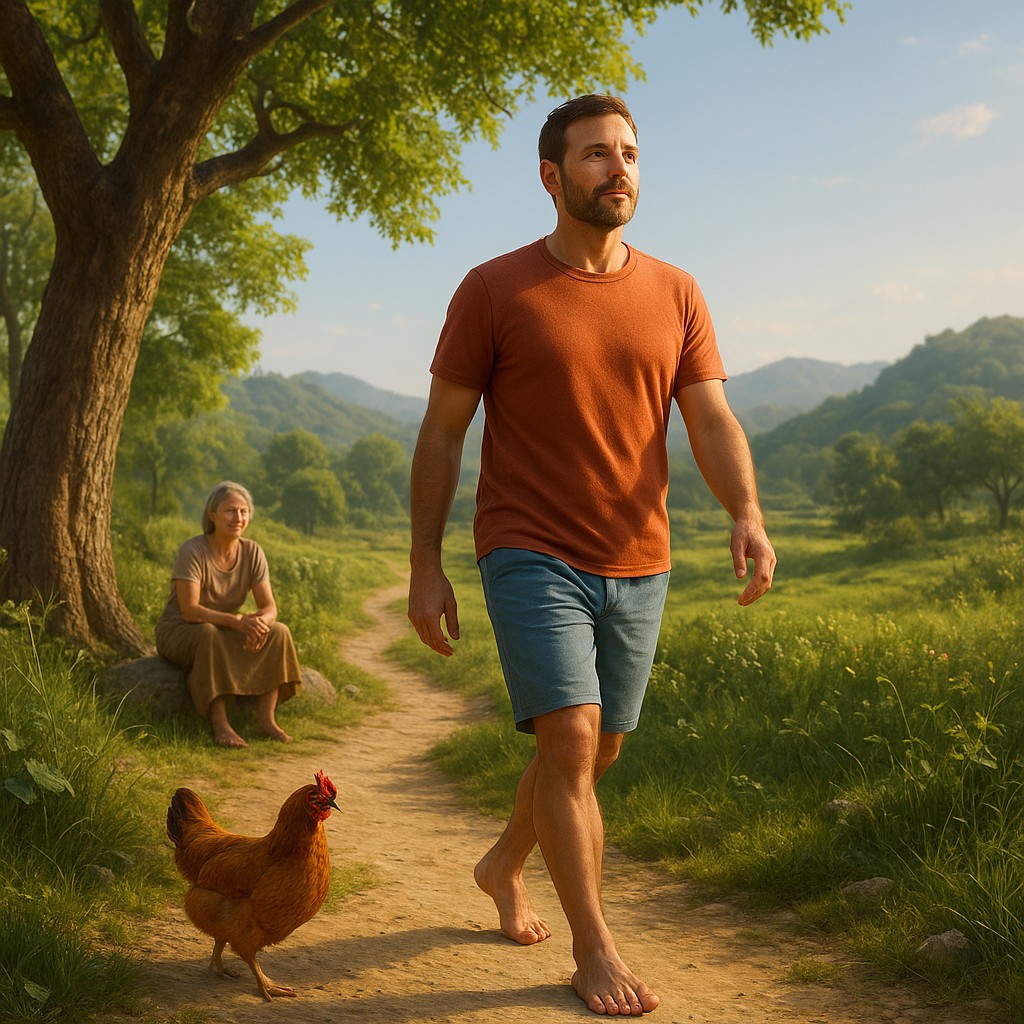
The modern world has sold us on the idea that health is a commodity. We think it requires a monthly membership or an hour of punishing sweat in a dimly lit room. We treat exercise like another chore on the to-do list, squeezed between a morning meeting and a trip to the store, and then spend the other twenty-three hours of the day in a state of physical hibernation. This creates a strange paradox: we might run five miles on a treadmill, yet feel exhausted just walking to the mailbox. By splitting our lives into "workout time" and "rest time," we have forgotten that our bodies were built for constant, gentle, and purposeful movement.
The secret to a long and vibrant life may not be found in the latest high-intensity interval training (HIIT) class. Instead, it lies in how people live in "Blue Zones." These are specific parts of the world, like Sardinia in Italy or Okinawa in Japan, where people regularly live to be over one hundred years old while keeping their minds and bodies remarkably sharp. When researchers looked at these populations, they didn't find people lifting heavy weights or training for marathons. They found communities where movement is so deeply woven into every day that it is almost unavoidable. These people don't exercise because it's "good for them"; they move because their world demands it.
The Myth of the Desk-Bound Athlete
For many of us, daily life follows a predictable, sedentary rhythm. We sit in a car to get to work, sit at a desk for eight hours, sit in the car to go home, and sit on the sofa to relax. To make up for this, we might spend forty-five minutes at the gym pushing ourselves to the point of collapse. While that gym session is better than nothing, it doesn't actually erase the metabolic damage caused by nearly twenty hours of total stillness. Scientists have named this "Active Couch Potato" syndrome. It describes people who meet standard exercise goals but still face major health risks because they spend the rest of their day being so inactive.
When we sit for hours on end, our bodies enter a "power-save" mode. Lipoprotein lipase, an enzyme that helps break down fats in the blood, drops significantly. Our insulin sensitivity goes down, and our circulation slows. An hour of intense exercise can boost these levels for a short time, but it cannot keep them up all day. The Blue Zone approach works because it never lets the metabolic engine turn off. By walking to the market, kneading bread by hand, or tending a hillside garden, these people keep their enzymes active and their blood sugar stable from sunrise to sunset.
Environment Over Willpower
One of the most important lessons from studying centenarians is that they do not rely on willpower to stay fit. In our society, we often blame ourselves for being "lazy" if we skip the gym. However, human biology is naturally wired to save energy whenever it can. If your environment allows you to be still, your brain will likely choose that path. In the Blue Zones, tradition and geography redesign the environment to move the human body. There are no elevators in ancient Sardinian villages built on steep hills, and there are no leaf blowers in the gardens of Okinawa.
To copy this in a modern setting, we need to look at our surroundings through the lens of "friction." Usually, we try to make life as easy as possible by using remote controls, delivery apps, and automatic gadgets. To achieve natural movement, we need to intentionally bring a little healthy friction back into our lives. This might mean parking at the far end of the lot, using a standing desk, or taking the stairs instead of the lift. When movement is a side effect of your lifestyle rather than a scheduled task, it becomes something you can sustain for decades, not just for the length of a New Year's resolution.
Comparing Gym Culture to Natural Movement
It is helpful to see how these two approaches affect the body and mind differently. While both have their place, understanding their unique traits can help us find a better balance.
| Feature |
Modern Gym Culture |
Blue Zone Natural Movement |
| Duration |
Short, intense bursts (30-60 mins) |
Constant, low-intensity (all day) |
| Motivation |
Discipline, goals, and mirrors |
Necessity, chores, and social life |
| Impact on Joints |
High impact, repetitive stress |
Low impact, varied ranges of motion |
| Metabolic State |
Rollercoaster (spike and crash) |
Steady and consistent activation |
| Social Aspect |
Often solitary or competitive |
Collaborative and community-based |
| Long-term Cost |
Financial (membership and gear) |
Free (integrated into daily tasks) |
While the gym is great for building specific strength or fixing an injury with a professional, it often lacks the variety found in natural movement. In a gym, we move in straight lines, often using machines that dictate our path. In a garden or on a walk over uneven ground, the body must constantly adjust for balance, use tiny stabilizer muscles, and rotate through complex angles. This "functional" variety is what keeps joints lubricated and the nervous system sharp well into old age.
The Metabolic Fire of Micro-Activities
The magic of natural movement lies in what researchers call "Non-Exercise Activity Thermogenesis," or NEAT. This is the energy we use for everything that isn't sleeping, eating, or sports. It includes walking, typing, fidgeting, and even just standing. For most people, NEAT accounts for a much larger part of daily calorie burning than a workout does. If you increase your NEAT by simply moving more throughout the day, you can burn hundreds of extra calories without ever feeling like you exercised.
More importantly, these small bursts of activity act as signals to the body. Every time you stand up to stretch or walk across the office to talk to a colleague, you are "waking up" your cells. A recent study in Nature Medicine suggests that even one-minute bursts of vigorous activity, like climbing stairs or carrying heavy groceries, can significantly lower the risk of death. These "exercise snacks" are much easier to manage than a full gym session and fit right into a busy workday. they prevent the stiffness and brain fog that come with sitting still for too long.
Restoring the Joy of the Human Machine
We often forget that movement is a basic human joy. Children don't run because they want to burn calories; they run because it feels good to move. Somewhere on the way to adulthood, we started seeing movement as a punishment for what we ate or a price we pay for health. By shifting our focus to natural movement, we can win back that sense of play. Gardening becomes a way to connect with the earth, walking becomes a way to explore the neighborhood, and physical labor becomes a form of "moving meditation."
This change requires a shift in perspective. It means valuing the "slow way" of doing things. It might mean walking to the local coffee shop instead of driving, even if it takes fifteen minutes longer. It might mean standing up during a long phone call or doing some light stretching while watching the news. These small choices add up over time, building a foundation of health that is tough and lasting. You aren't just building a body; you are building a life that supports that body.
The Limits of Natural Movement
While the Blue Zone philosophy can change your life, it does have its limits. Natural movement is a fantastic baseline for health, but it isn't a cure-all. If you have a specific injury, like a torn ligament or chronic back pain, simply "moving naturally" might make the problem worse if your technique is poor. In these cases, targeted physical therapy exercises are essential. These exercises are like precision tools to fix a broken part, while natural movement is the general maintenance that keeps the whole machine running.
Additionally, for people with specific athletic goals, like running a marathon or increasing bone density, structured weight training or cardio is still very helpful. The goal of natural movement isn't to ban the gym entirely, but to make sure the gym isn't the only time you move. Think of natural movement as the main course of your physical diet, with structured exercise serving as a powerful supplement to fill in the gaps.
As you look at your schedule for the coming week, try to see beyond the sixty-minute blocks of "exercise." Look for hidden chances to engage with the world physically. Whether you choose a hand tool over a power tool, take a walk after dinner with a friend, or simply stand up every time you send an email, every movement counts. You were designed to stay in motion. By redesigning your world to nudge you toward activity, you take the pressure off your willpower and put the power back into your lifestyle. Embrace the ease of the slow, steady movement that has sustained humanity for thousands of years, and you might just find yourself walking toward a much longer, brighter future.