Imagine you are a salmon, a sleek athlete of the river, swimming with purpose toward the mountain streams where you were born. Your journey is already a gauntlet of hungry bears, plunging waterfalls, and exhausting distances. But now you face a modern predator: the humming, spinning blades of a hydroelectric turbine. Historically, the way to keep you out of these industrial intake pipes was simple and brutal. Engineers would stretch thick, heavy nets across the water. While they stopped the fish, these nets often became death traps. The mesh would scrape off sensitive scales, tangle fins, or trap smaller creatures against the rope by the sheer force of the current. It was a clumsy, physical fix for a delicate biological problem.
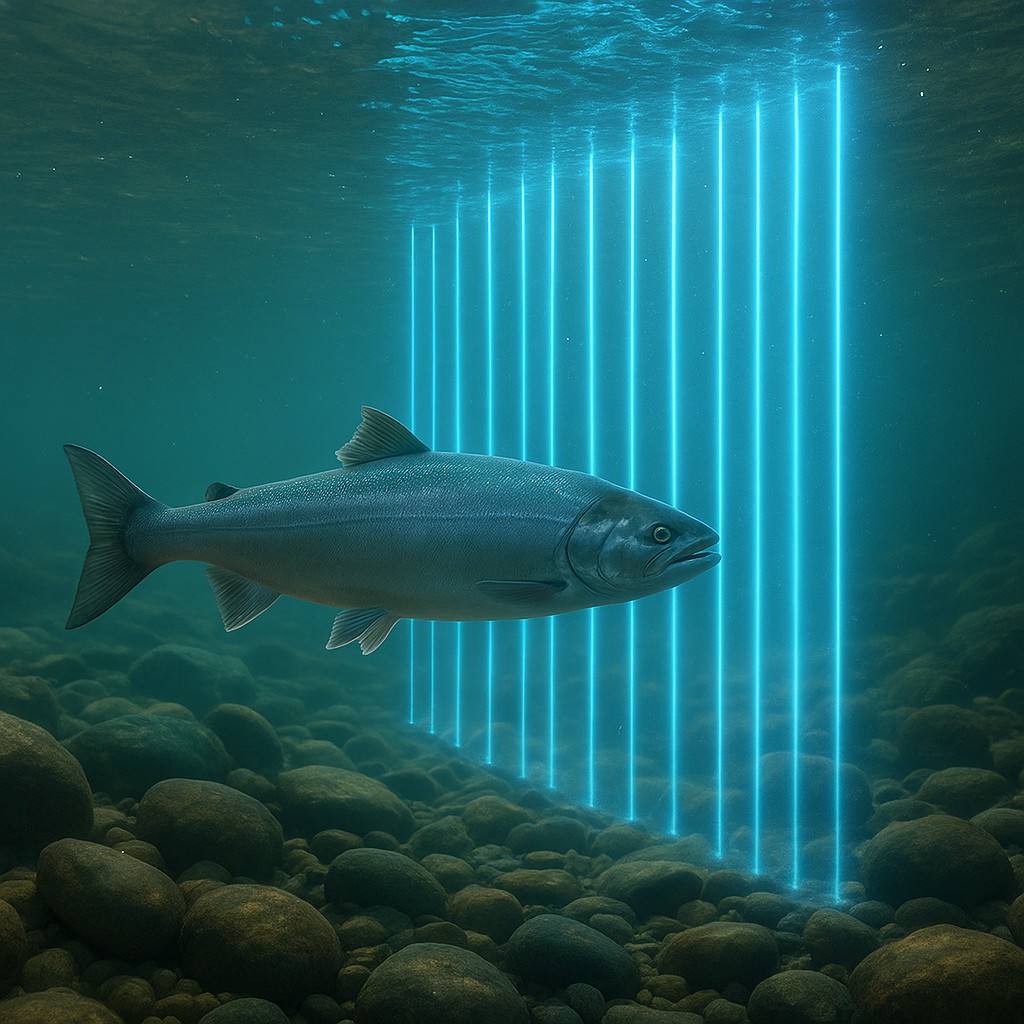
Today, engineers and conservationists are ditching the heavy mesh for something far more elegant. They are using "optical herding," a technique that replaces steel and nylon with shimmering curtains of laser light. By shining specific colors and flashing patterns into the water, scientists are building "glimmering fences" that fish see as solid, impassable walls. This technology turns a fish's greatest survival skill, its lightning-fast vision, into a tool for its own protection. Instead of being dragged into a mesh trap, the fish sees a wall of light, instinctively turns away, and pivots into a safe side channel. It continues its journey without ever being touched by a human hand.
The Evolutionary Cheat Code for Underwater Navigation
To understand why a fish would fear a beam of light, we have to look at how they see their world. Water is a medium that swallows color and blurs detail. For a fish, sight is the primary way to spot predators and navigate the complex underwater landscape. Most species have evolved eyes that are incredibly sensitive to movement and contrast. In the wild, a sudden change in light usually means a predator is lunging. When a laser beam slices through the water, it creates a high-contrast boundary that does not exist in nature. To the fish, this isn't just a pretty light; it is a signal of a physical edge or a potential threat.
The brilliance of optical herding lies in its ability to hijack the fish's "startle response." Known as the C-start, this is a fast reflex where the fish’s body curls into a "C" shape and then snaps away from a stimulus. By placing lasers at specific angles across a channel, we aren't just showing the fish a light; we are creating a psychological barrier. The fish perceives the laser line as a solid boundary, much like you might see a glass door. While you could technically walk through a glass door if you tried, your brain tells you there is a solid object in your path. For a school of fish, this collective vision creates a "virtual wall" that steers the entire group away from danger.
Tuning the Spectrum for Different Species
Not all light is created equal in the deep. Water acts as a giant filter, soaking up different colors at different depths. For instance, red light disappears almost immediately as you go deeper, while blue and green light travel the furthest. This means that a light-herding system must be tuned to the environment and the specific "customers" it is trying to redirect. If you are guiding salmon near the surface, a certain frequency of green light might look like a solid neon sign to them. However, if you are dealing with eels living near the bottom, you might need a completely different approach.
| Factor |
Influence on Optical Herding |
Practical Outcome |
| Water Turbidity |
Silt and dirt particles scatter light beams. |
Lower efficiency; requires more powerful lasers. |
| Species Vision |
Different fish see different color ranges. |
Laser color must match what the fish's eyes can see. |
| Ambient Light |
Natural sunlight can wash out artificial signals. |
Systems often use pulses or strobes to stay visible. |
| Flow Velocity |
How fast the water moves toward the turbine. |
Fish need enough time to react before being swept past. |
Interestingly, some fish are "phototactic," meaning they are naturally drawn toward light, while others are "photophobic," meaning they flee from it. This gives engineers two different strategies. They can use "repulsion lasers" to block the entrance to a dangerous turbine, or "attraction lights" to lure the fish toward a safe, artificial stream or fish ladder. By combining these two methods, conservationists create a "push-pull" system. It directs fish through industrial areas with the precision of a light-based traffic controller.
Overcoming the Challenges of Liquid Space
While the concept of a laser fence sounds like science fiction, putting it into practice requires a deep understanding of how water moves and how light behaves. One of the biggest hurdles is turbidity, or the cloudiness of the water. If a river is full of silt after a heavy rain, a laser beam that was once sharp and scary becomes a dull, scattered glow. This glow might actually attract curious fish rather than repelling them, which is the opposite of the goal. Engineers have to design "smart" systems that can adjust their brightness based on real-time sensors, ensuring the "fence" remains visible even when the river gets muddy.
Another fascinating hurdle is "habituation." Fish are surprisingly clever. If a light stays perfectly still and never changes, some species might eventually realize it doesn't actually bite. To prevent the fish from getting used to the barrier, many systems use flashing patterns or moving beams. By varying how fast the light flashes, the system keeps the fish on their toes, or rather, their fins. These flickering patterns mimic the visual "jitter" of a living predator or a shifting physical obstacle, ensuring that the fish's flight response stays sharp.
Beyond Dams: The Future of Light-Based Conservation
The potential for optical herding stretches far beyond power dams. In the commercial fishing industry, "bycatch" is a global crisis. Every year, millions of tons of unintended sea life are caught in nets meant for other fish. Experiments with LED-lit nets have shown that adding green lights to certain parts of a net can help sea turtles or young salmon find escape holes. By using light to "show them the exit," we can make industrial fishing more selective and far less destructive to the rest of the ocean.
As we move toward a future where we must balance our need for energy with our responsibility to the planet, optical herding is a sign of human ingenuity. It shifts our approach from ruling over nature with brute force to communicating with nature through its own biological language. We are learning to speak "fish" using the medium of light. This approach does more than just save lives; it preserves the dignity of the wild, allowing the silver travelers of our rivers to navigate our world without being broken by it.
The next time you look at a shimmering river, imagine the invisible architecture built beneath the surface. We are creating a world where light serves as a guardian, a silent shepherd guiding aquatic life toward safety. It is a reminder that the best solutions often come not from building bigger walls, but from understanding how life sees the world. By looking through the eyes of a fish, we have discovered a way to light the path toward living together in harmony.