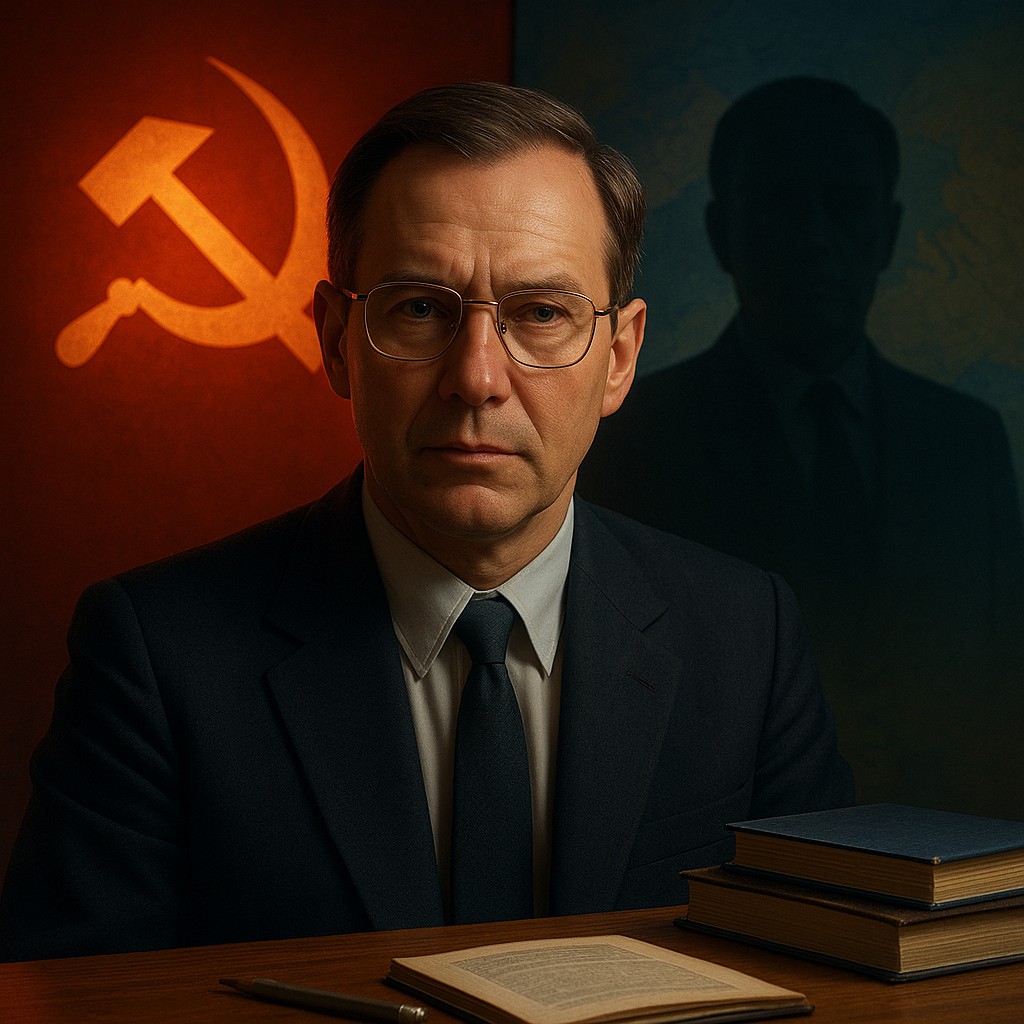
The Cold War is usually told as a clash between abstract systems: capitalism versus communism, NATO versus the Warsaw Pact, missile against missile. But history often turns on people, not ideas. Sometimes it turns on someone who, on paper, looks like the least likely hero: a disciplined KGB officer with a cautious smile, a sharp memory, and a private decision to betray the organization that raised him.
Oleg Gordievsky’s story matters because it shows how intelligence work can shape events without firing a shot. He did not "defeat" the Soviet Union by himself. The USSR fell for many reasons: economic stagnation, political decay, rising nationalism, and reforms that spun out of control. Still, Gordievsky’s secret work with Britain helped the West see Soviet fears more clearly, avoid catastrophic misunderstandings, and apply pressure at moments when the Soviet system was already creaking.
If you are imagining a spy movie where everyone wears trench coats and speaks in code, this is different. Gordievsky’s life is messy, morally complicated, and far more interesting. It is a clear case of how information, trust, paranoia, and courage collide.
From loyal insider to quiet dissenter in a system built on suspicion
Oleg Gordievsky was born in 1938 into a family tied to the Soviet security services. That is not trivia; it shaped his early path. In the USSR, family background could open doors or shut them, and links to the security organs often meant access, status, and a sense of belonging to the state’s inner circle. He studied at the elite Moscow State Institute of International Relations (MGIMO), a pipeline for diplomats and intelligence officers.
He joined the KGB and served abroad, with postings in Denmark and later the United Kingdom. Those assignments were not vacations. For Soviet intelligence officers, overseas service mixed privilege with intense surveillance. You were watched, tested, and judged, not only by enemies but by your own side, because the KGB always assumed betrayal was possible.
So what changed him? Gordievsky described it as a slow moral and political disillusionment rather than a sudden conversion. Events like the crushing of the Prague Spring in 1968 hit many Soviet intellectuals and officials hard. Seeing Western societies up close mattered too, not because the West was perfect, but because it undermined Soviet claims that life outside socialism was uniformly miserable. In short, he compared reality to doctrine and saw a gap.
The art of becoming a “walk-in” and why MI6 took the risk
A common myth says spies are always recruited with seduction, blackmail, or money. Those methods exist, but Gordievsky’s case is closer to a "walk-in": someone who, for moral or political reasons, chooses to cooperate. That is rare and extremely valuable, but also extremely risky for the service that accepts them.
If you are MI6 and a KGB officer offers to work with you, you do not pop champagne. You worry it is a trap, a dangle, or a provocation meant to expose your methods and officers. Intelligence services are professionally paranoid because sometimes paranoia is just realism with better shoes.
MI6 treated Gordievsky with the caution you would use when accepting a priceless painting from a stranger in a raincoat. They had to test him over time, protect him from discovery, and get enough evidence to justify the risk. Over several years, Gordievsky became one of Britain’s most important sources inside Soviet intelligence, offering not just names and operations but a sense of how Soviet leaders thought: what they feared, misunderstood, and prioritized.
His access mattered because of where he rose. Gordievsky became the KGB’s resident-designate in London, effectively positioned to run Soviet intelligence in the UK. That is like becoming the head chef while sending secret recipes to a rival restaurant.
What he actually provided: not just secrets, but a map of Soviet fear
Spy work is not only about stealing blueprints or decoding messages. Gordievsky supplied operational intelligence, but his deeper value was strategic: he helped the West understand the Soviet mindset during a very dangerous phase of the Cold War.
One central theme was Soviet threat perception. In the early 1980s, Soviet leaders genuinely feared a surprise nuclear attack from NATO. That fear was not entirely rational, but it was real. The USSR had a history of devastating invasions and a political culture that treated external hostility as constant. Add aging leadership, poor information flows, and bureaucracies that rewarded alarmism, and you get a system ready to misread signals.
Gordievsky reported on how Soviet leaders interpreted Western actions, including military exercises. That mattered because deterrence depends on signaling, and signaling only works when both sides understand each other. If one side thinks the other is "just exercising" and the other thinks "this is cover for an attack," a misunderstanding can light a fuse.
He also helped identify Soviet agents and methods in the West. That kind of information can disrupt operations, protect sources, and tighten security. More subtly, his reporting helped policymakers apply pressure without pushing the USSR into panic. The Cold War had plenty of force, but avoiding miscalculation was a soft skill that kept the world from stumbling into catastrophe.
A quick table of Gordievsky’s impact, simplified but useful
| Area of impact |
What Gordievsky contributed |
Why it mattered |
| Soviet threat perceptions |
Reports on how Soviet leaders interpreted NATO moves |
Reduced risk of escalation caused by misunderstanding |
| KGB operations in the UK and Europe |
Information about targets, tradecraft, and personnel |
Helped counterintelligence disrupt Soviet efforts |
| Leadership and internal politics |
Insight into factional dynamics and thinking in Moscow |
Improved Western decision-making and diplomacy |
| Strategic communication |
Guidance on what messages would be read as strength vs. provocation |
Helped balance deterrence with stability |
This table compresses a complicated history, but it shows a key point: intelligence is not only about secrets, it is about context. Gordievsky was valuable because he gave the West a clearer model of the Soviet mind at a time when mistakes could be fatal.
The 1983 danger zone: Able Archer, paranoia, and the value of inside information
If you want one year that shows why Gordievsky mattered, look at 1983. Tensions were high: the Soviet invasion of Afghanistan still dragged on, NATO was deploying new missiles in Europe, and rhetoric on both sides was sharp. The Soviet Union had just shot down Korean Air Lines Flight 007 after it strayed into Soviet airspace, killing everyone aboard, which ratcheted up distrust and anger.
That year NATO ran a command-post exercise called Able Archer 83. From NATO’s view, it was a drill. From the Soviet view, with limited reliable information and leaders who expected deception, it could look like preparation for a real first strike. Soviet forces reportedly increased their readiness.
That is where a source like Gordievsky mattered. His information about Soviet alarm helped Western leaders see that "normal" actions could be read as existential threats. That understanding made it easier to dial down tensions. Gordievsky did not single-handedly stop a nuclear war, but his reporting added clarity at a moment when clarity was scarce and priceless.
It is a mistake to think the USSR was always the reckless side. The truth is more unsettling: both sides feared the other might do something crazy, and both built systems that could turn fear into action. Gordievsky’s intelligence helped reduce the chance that fear would become fate.
The long influence: helping the West engage Gorbachev with sharper eyes
When Mikhail Gorbachev rose in 1985, the Soviet Union did not suddenly become friendly, but it did change. Gorbachev pursued reforms like perestroika (restructuring) and glasnost (openness), partly to rescue the system from its own failures. The West could treat this as a trick or as an opening, while still keeping deterrence.
Gordievsky’s reporting helped Western leaders judge that shift more finely. That did not mean trusting Moscow blindly. It meant spotting when Soviet leaders genuinely sought de-escalation and economic relief, and when they were posturing. That kind of judgment shaped summit planning and arms-control talks.
Some accounts say Gordievsky influenced British Prime Minister Margaret Thatcher and others in how they saw Gorbachev. Thatcher famously called Gorbachev someone "we can do business with." Whether Gordievsky was decisive in that view is debated. What is fair to say is that his intelligence added to a more informed Western approach at a critical moment when the Soviet Union was starting to loosen its grip.
Do not over-credit one source: the Soviet collapse was a huge structural event. But intelligence can act like a lever: it does not create the weight, it helps move it.
The recall to Moscow and a Hollywood-grade escape that was painfully real
The most famous chapter of Gordievsky’s life is his escape from the Soviet Union in 1985. The KGB began to suspect him and recalled him to Moscow. In that culture, a recall under suspicion is not a nuisance, it is a possible prelude to interrogation, imprisonment, or worse. Once back, he was watched, pressured, and reportedly drugged during questioning, though details vary.
British intelligence had an emergency exfiltration plan ready, a last resort if he signaled immediate danger. The plan carried enormous risk. It involved getting him to a rendezvous and smuggling him out hidden in a car, crossing into Finland past Soviet border controls. It worked, which sounds like fiction, except the cost of failure would have been grim.
Espionage is not mostly glamorous. It is long stretches of stress, isolation, and the constant fear of discovery, punctuated by moments when everything depends on calm nerves and luck. Gordievsky’s escape required discipline and nerve from him and boldness from the officers who ran the operation.
After he reached the UK, Gordievsky lived under protection. The Soviet Union later convicted him of treason and sentenced him to death in absentia. That sentence was symbolic in that the USSR could not reach him easily, but it showed how seriously they viewed the betrayal.
Moral knots: traitor, patriot, or something messier?
It is tempting to sort people into neat boxes: hero or villain, traitor or patriot. Gordievsky resists those labels, and that is important.
From the Soviet state’s point of view, he was a traitor. He swore loyalty, held a sensitive post, and passed secrets to an adversary. From the British point of view, he was a valuable ally who helped protect lives and reduce risk. Gordievsky said he felt he was betraying a repressive system, not "his people," and that he was helping prevent a catastrophic war.
A more useful way to think about it is to separate three questions that often get mixed together:
- Legality: He broke Soviet laws and oaths.
- Morality: He believed he was acting against oppression and dangerous paranoia.
- Consequences: His intelligence likely improved Western decisions and counterintelligence.
Reasonable people can argue the moral balance. Espionage is inherently undemocratic: crucial choices can hinge on secret information held by a few. At the same time, Cold War governments ran intelligence services because ignorance was often more dangerous than knowledge.
How his secret work connects to the Soviet collapse without turning into fairy tale history
Saying Gordievsky "helped hasten the collapse of the Soviet Union" is true only with nuance. He did not cause economic decline, national tensions, or the heavy arms burden. What he did do was influence the international setting where the Soviet system failed.
Here are the main ways a high-level source can help speed systemic change:
- Reducing Western misreadings: Better understanding can prevent overreactions that might unite hardliners in Moscow.
- Improving Western confidence: Reliable insight lets the West negotiate from strength without panic.
- Constraining Soviet operations abroad: Exposing methods and networks can limit influence and intelligence work.
- Shaping diplomatic engagement: Accurate reads of reformist signals can enable deals that increase internal pressure for openness.
That last point is subtle. Arms-control agreements and lower tensions did not "defeat" the USSR, but they changed incentives and the public story. A leadership that depends on fear to justify harsh control loses credibility when facts and reduced tensions undercut that fear. When a system relies on fear, cutting fear can be destabilizing.
One more caution: don't imagine the USSR fell because the West simply out-spied it. Intelligence helped, but the Soviet Union collapsed mainly because of internal failures in governance and economics. Think of Gordievsky as someone who nudged the wheel when the vehicle already had serious engine trouble.
Remembering Gordievsky without mythologizing him
A useful image is to picture Gordievsky as a translator, not just a spy. He translated Soviet anxieties to the West and helped turn Western signals into something policymakers could act on. In a conflict where misunderstanding could kill millions, that sort of translation was powerful.
He also shows that even rigid systems leave room for individual choices. The KGB tried to build officers who would not deviate, and one of their own decided the system was wrong. That choice cost him dearly: danger, exile, and a life defined by security concerns.
At the same time, resisting myth-making keeps the story honest. Gordievsky was not a trench-coat wizard. He was a skilled professional who made a drastic moral choice, worked under terrifying pressure, and became valuable because he combined access with judgment.
Closing: the quiet power of clarity in a noisy world
Gordievsky’s story is about the power of clear thinking inside a fog of propaganda, fear, and bureaucracy. Whether you admire him, question him, or feel conflicted, you can learn from how one person’s information, courage, and timing shaped decisions at the highest levels. The Cold War did not end because of a single spy, but it did end partly because enough people, in enough places, made reality harder to ignore.
If you take one lesson away, let it be this: history is not moved only by armies and speeches, it is moved by insight. The world gets safer when leaders understand each other’s fears, and when citizens learn to spot myths that flatter their side. Studying Gordievsky is not spy trivia, it is practice in the serious art of seeing clearly.