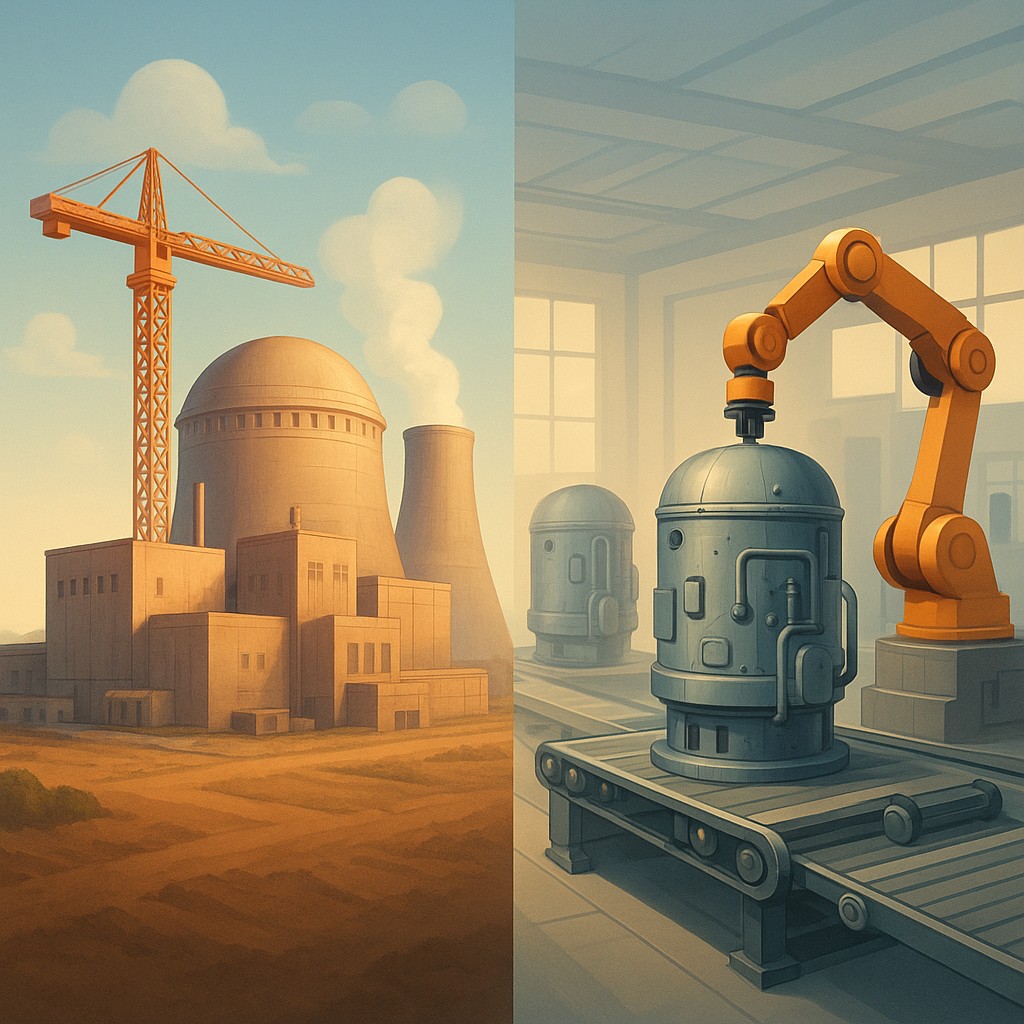
For decades, the story of nuclear energy was "bigger is better." To justify the massive costs of regulation and site preparation, engineers designed gargantuan cathedrals of concrete and steel. Each one was a custom-built architectural feat meant to power an entire metropolis. These projects are so complex that they resemble artisanal watchmaking on a planetary scale. When you build something that large in a muddy field, exposed to the elements and requiring thousands of specialized workers to stay on-site for a decade, the budget tends to explode. It is a bit like trying to build a Boeing 747 in your backyard using a local crew who has never seen a jet engine.
There is a quiet revolution happening in the energy sector that flips this script entirely. Instead of building one giant, unique power plant every twenty years, the industry is moving toward Small Modular Reactors (SMRs). The logic here is radically different: if you cannot make the project cheaper by making it bigger, make it cheaper by making it many times over. By shrinking the reactor to a fraction of its traditional size and moving the work from the construction site to the factory floor, nuclear energy is finally trying to use the same economic magic that makes smartphones and cars affordable. It is the transition from a "civil engineering project" to a "consumer product."
The Cathedral Versus the Assembly Line
Imagine the difference between building a custom mansion and ordering a high-quality prefabricated home. The mansion requires a dedicated architect, unique permits for every custom window, and a year of workers battling rain and logistics. The prefab home, however, is built in a climate-controlled factory where every measurement is laser-precise and every worker performs the same task hundreds of times. This is the "learning curve" in action. In manufacturing, the more units you produce, the more efficient you become. Traditional nuclear power never benefited from this because every plant was a prototype. SMRs aim to break this cycle by treating the nuclear core as a repeatable piece of hardware.
When a reactor is small enough to fit on the back of a truck or a railcar, the entire economic landscape shifts. The "modular" part of the name means that a utility company does not have to bet its entire future on a single 30-billion-dollar project. They can start small, installing one or two units to meet current needs, and then "click" more modules into place as demand grows. This step-by-step approach reduces the terrifying financial risk that has kept private investors away from nuclear for years. It turns a massive, high-stakes gamble into a manageable infrastructure upgrade.
Borrowing the DNA of Ships and Planes
One of the cleverest shortcuts in the SMR playbook is the refusal to reinvent the wheel. For a long time, nuclear designers insisted on custom-made everything, from specialized pumps to one-of-a-kind valves that cost as much as a luxury apartment. Modern SMR designers are looking at the aerospace and shipbuilding industries and asking, "Can we just use that?" By adopting standardized parts already used in massive container ships or advanced aircraft, reactor developers can tap into existing, high-volume supply chains. This drastically reduces the cost of parts and, more importantly, ensures those parts are already tested and certified for high-performance environments.
This cross-industry borrowing extends to the actual construction techniques. The maritime industry, specifically the people who build nuclear submarines and aircraft carriers, has been building "small" reactors in tight spaces for years. SMR companies are hiring experts from these fields to apply modular block construction, where giant sections of the plant are finished in a factory and simply welded together on-site. This approach minimizes the time spent in the "muddy field" phase of construction, which is where most delays and cost overruns happen. It is less like building a house and more like assembling a very large, very powerful Lego set.
The Financial Logic of Shrinking the Core
To understand why small is the new big, we have to look at the "overnight cost" of energy projects. In finance, the longer a project takes to build, the more expensive it becomes due to interest rates on the massive loans required. A traditional reactor that takes twelve years to build is a financial black hole. An SMR that can be manufactured and installed in three or four years is a much more attractive prospect for a bank. This speed allows the owner to start making money much sooner, using that cash flow to pay for the next module.
| Feature |
Traditional Large-Scale Nuclear |
Small Modular Reactors (SMRs) |
| Construction Site |
Built on-site from scratch |
Factory-manufactured in series |
| Power Output |
1,000+ Megawatts |
50 to 300 Megawatts |
| Cooling Systems |
Active (Requires pumps and power) |
Passive (Relies on gravity and heat flow) |
| Financial Risk |
Massive upfront cost, slow returns |
Scalable, step-by-step investment |
| Supply Chain |
Custom, specialized nuclear parts |
Standardized aero and ship components |
The table above highlights the fundamental shift in strategy. By producing less power per unit, SMRs actually gain a massive safety advantage. Because the core is smaller, it generates less "decay heat" (leftover heat) after it is turned off. This allows many SMR designs to use passive safety systems. Instead of needing giant electric pumps and backup diesel generators to keep the core cool during an emergency, these reactors rely on basic physics. Natural water circulation or airflow can cool the system indefinitely without human intervention. You do not need to worry about a pump failing if you do not need a pump in the first place.
The Fuel Bottleneck and the HALEU Hurdle
If SMRs are so efficient, why aren’t they popping up in every industrial park already? The answer lies in the gas tank. Most traditional reactors run on uranium enriched to about 5% of the isotope U-235. However, to make a reactor small and still have it last a long time between refueling, you need a "denser" fuel. Many SMR designs require High-Assay Low-Enriched Uranium, or HALEU, which is enriched to between 5% and 20%. This is the "Goldilocks" level: high enough to be incredibly efficient, but low enough that it cannot be easily used for weapons.
The problem is that the world currently lacks a reliable, diverse supply chain for HALEU. For a long time, the primary commercial supplier was Russia, which is now a geopolitical impossibility for many Western nations. Building new enrichment plants is a massive, slow, and expensive task that requires strict international oversight. This creates a "chicken and egg" problem: fuel providers are hesitant to build multi-billion dollar plants until they see a fleet of SMRs ready to buy the fuel, while utility companies are hesitant to buy SMRs until they are sure the fuel supply is secure. It is a high-stakes standoff that requires government help and international cooperation to solve.
Solving the Modern Energy Puzzle
The transition to SMRs represents a pivot in how we see nuclear energy. It is no longer just a monumental achievement of physics; it is a vital tool to cut carbon emissions. Because SMRs are small and produce both electricity and heat, they can be placed in locations where a massive traditional plant would be overkill. They could replace coal boilers at existing power plants, using the old grid connections and keeping local jobs alive. They could power remote mines, provide heat for industrial chemical plants, or run massive desalination systems to create fresh water. Their versatility is their greatest strength.
By embracing the lessons of the assembly line and using standard parts from the shipping world, the nuclear industry is finally learning to get out of its own way. The goal is no longer to build a unique masterpiece, but to build a reliable, boring, and remarkably efficient machine. When technology becomes "boring" and predictable, that is usually when it starts to change the world. As we look toward a future that demands massive amounts of carbon-free energy, these modular units might be the building blocks we need to keep the lights on without heating the planet.