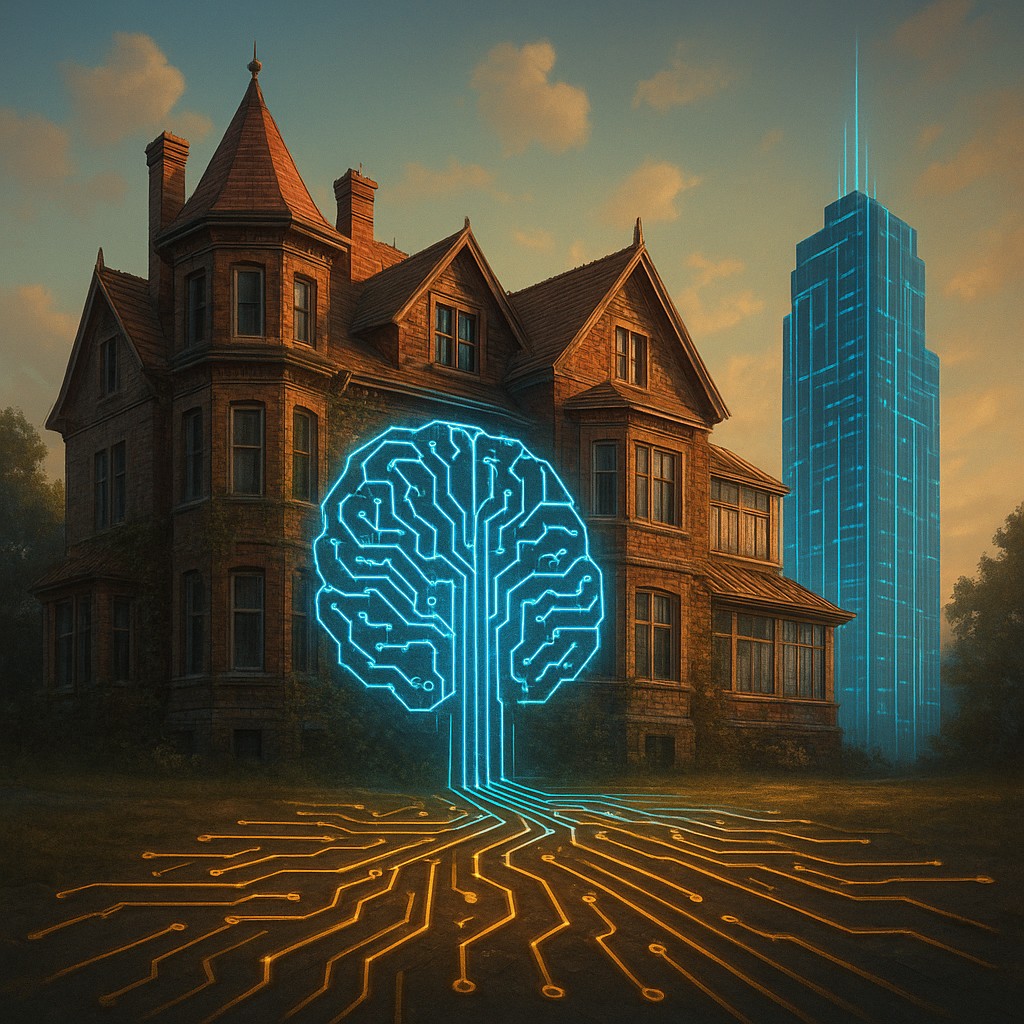
Imagine an old, sprawling mansion that has been in a family for generations. Over seventy years, different owners have added a sunroom here, a bathroom there, and a tangled mess of electrical wiring that somehow runs through the kitchen sink. You want to install a modern smart-home system, but opening any wall might cause the whole house to collapse. This is exactly what the global financial and government sectors look like today. They are held together by millions of lines of code written in the 1960s and 70s. We call the struggle of keeping these fragile systems running "technical debt." For decades, it was a debt we could only pay interest on, never fully settle.
The problem is that while the rest of the world has moved on to sleek, modern programming, the "legacy" code running our banks and power grids uses languages like COBOL. Most people who know how to write in COBOL are now retired, leaving a massive gap in expertise. Until recently, rewriting these systems was considered a "suicide mission" for engineers. The logic is so dense and poorly documented that any small change could spark a global outage. However, a breakthrough in artificial intelligence called neural transduction is changing the math. It offers a way to translate these ancient digital ruins into modern, high-grade code without losing any of the original meaning.
Neural Transduction: The Engine Under the Hood
To understand how we are finally clearing out decades of digital clutter, we have to look at how neural transduction actually works. In the past, if you wanted to switch from one computer language to another, you used a "transpiler." This was a rigid tool that worked like a cheap pocket dictionary, simply replacing word A with word B. The issue is that programming languages, like human languages, have their own unique rhythms and contexts. A literal translation usually results in "garbage in, garbage out," where the new code is just as messy as the old stuff, just written in a newer format.
Neural transduction takes a different path by treating code as a form of "thought" rather than just a list of instructions. It uses deep learning models to study thousands of examples of how a problem is solved in an old language versus how it is solved elegantly in a modern one. Instead of just swapping words, the AI creates a mathematical map of what the code is trying to do. Once it understands the "intent," it recreates that logic in the new language. It acts less like a dictionary and more like a master translator who reads a classic poem and rewrites it as a modern sonnet, keeping the soul of the work alive for a new audience.
This process is great at spotting "anti-patterns," which are basically the bad coding habits of the past. In the 1970s, computer memory was incredibly expensive, so programmers used confusing shortcuts to save space. Today, memory is cheap, but a programmer's time is expensive. Neural transduction finds these old shortcuts and expands them into clear, organized modern code. It doesn't just move the old junk to a new house; it unpacks the bags, throws away the trash, and organizes the essentials on modern shelves.
Breaking the Cycle of Technical Debt
Technical debt is a trap. It starts when a developer takes a shortcut to meet a deadline, promising to fix it later. They rarely do. Over the years, these "temporary" fixes pile up like layers of dirt, making the whole system slow and terrifying to touch. In the business world, this debt shows up as slow banking apps, buggy payroll systems, and an inability to launch new features because the foundation is too weak to support them. Neural transduction acts as a high-tech pressure washer for this digital grime.
The beauty of this approach is its ability to perform "refactoring." This is the process of cleaning up the internal structure of code without changing how it works for the end user. It is the perfect compromise. A customer won't see a difference in how their bank account functions, but the developers behind the scenes might find that a task which used to take three weeks now takes three minutes. Here is how manual translation compares to this new AI-driven era.
| Feature |
Manual Migration |
Old Transpilers |
Neural Transduction (AI) |
| Speed |
Extremely slow (years) |
Fast (minutes) |
Fast (minutes to hours) |
| Logic Accuracy |
High (checked by hand) |
Low (literal/clunky) |
High (understands meaning) |
| Code Quality |
Depends on the person |
Generally poor/messy |
High (modern standards) |
| Risk of Failure |
High (human error) |
High (logic errors) |
Lower (with supervision) |
| Cost |
Extremely expensive |
Moderate |
Scalable and efficient |
The Human Safety Check
Even with the power of AI, we are not at the point where we can just push a button and walk away. Software engineering is full of "edge cases," those rare, strange scenarios that only happen once in a million times. An AI might understand 99% of a program's goal, but in the world of global finance, that missing 1% could mean billions of dollars disappearing. This is why current projects use a "Human-in-the-Loop" system.
The AI provides a "draft" of the new code and explains why it made certain choices. It might say, "I noticed you were using a sorting method from 1982; I replaced it with a modern version that is 400% faster." An experienced developer then reviews these suggestions, acting as a high-level editor. This partnership is where the magic happens. The AI handles the boring "grunt work" of translating millions of lines of text, while the human focuses on the big picture and business logic.
A common misunderstanding is that the AI is "writing" the software from scratch. It is more accurate to say the AI is "distilling" the software. It isn't making up new rules for how a bank should work. It is simply clarifying the rules that were buried under decades of digital dust. This ensures that the wisdom built into the original code, such as complex tax laws or safety protocols, is preserved even as the language changes.
From Archaeology to Architecture
We are witnessing a major shift in how software is made. For a long time, working on "legacy systems" felt like being a digital archaeologist, digging through the ruins of old mistakes. Neural transduction is turning those archaeologists back into architects. When the weight of technical debt is lifted, developers are free to be creative again. Instead of spending 80% of their budget just trying to keep the lights on, organizations can finally invest in new ideas like better cybersecurity or easier-to-use apps.
Recent trials show that we can bridge the gap between the "Stone Age" of computers and the modern era without starting over. We are finding that the past doesn't have to hold us back; it can be the data that builds our future. By using AI to clear out technical debt, we are essentially giving the world's most important systems a "brain transplant" while the patient is still walking and talking. This was once thought impossible, but it is quickly becoming the new standard for maintaining our digital world.
The next time you use a banking app or pay a utility bill, remember that beneath the colorful icons, there is often a hidden world of ancient logic. We are entering a time where that history can be respected without slowing us down. The ability to translate the past into the future ensures that the foundations of our world stay as strong and efficient as the new technology we build on top of them. The debt is finally being paid, and the digital world is about to feel much lighter.