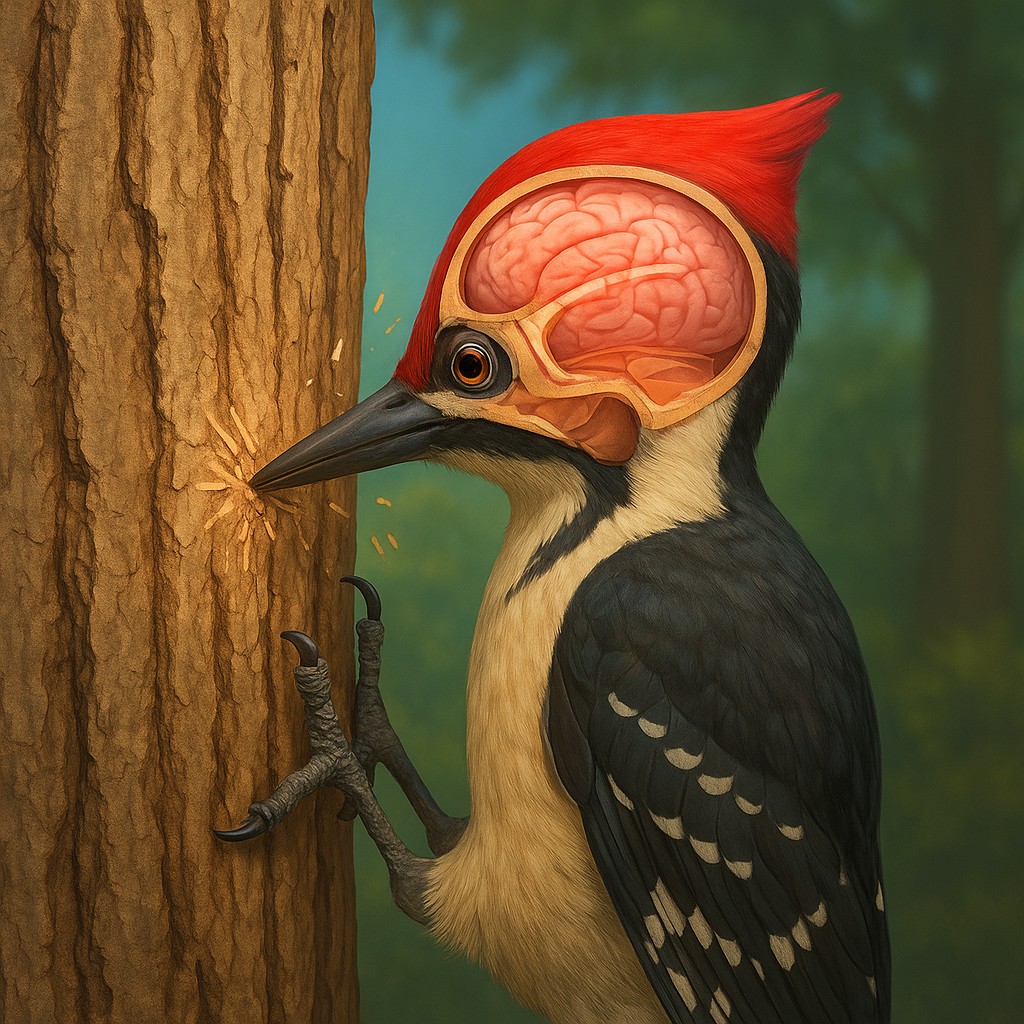
Imagine standing in front of a massive oak tree and trying to drive a nail into the trunk using nothing but your forehead. For a person, this would be a short and disastrous experiment, ending in a severe concussion on the very first try. Yet, for a woodpecker, this violent collision is just a normal Tuesday morning. These birds can peck up to 20 times per second, enduring g-forces of about 1,200g. To put that in perspective, just 100g is usually enough to give a human a life-changing brain injury. For decades, we assumed the secret was a sort of internal bubble wrap, a soft, squishy cushion protecting the brain from the impact.
The reality, however, is much more surprising and mechanically brilliant. It turns out that if a woodpecker’s head actually worked like a sponge or a shock absorber, the bird would be terrible at its job. Soft padding soaks up energy, which is great for safety but terrible for demolition; it would be like trying to hammer a nail with a marshmallow. Instead of relying on "squish," the woodpecker uses a masterclass in structural engineering, tension management, and specialized shapes to redirect the force of its work rather than just softening it.
The Myth of the Internal Airbag
The most common mistake people make about woodpeckers is thinking their skulls are filled with a soft material like the foam in a bicycle helmet. If this were true, the woodpecker would have to work twice as hard to get through the bark. Every time it hit the tree, the padding would soak up the energy, preventing it from moving into the wood. To be an effective living jackhammer, the bird actually needs a very stiff skull. Recent high-speed video analysis has confirmed that their heads act more like hard, heavy mallets than soft pillows.
So, how does a rigid object survive such a violent stop without its contents turning into mush? The answer lies in the physics of fluids and the size of the brain itself. Because the woodpecker has a very small brain, the ratio of its surface area to its weight is much higher than ours. Furthermore, the space between the brain and the skull, which is filled with fluid, is incredibly narrow. This means there is almost no room for the brain to slosh around or rattle inside the bone. In the world of high-impact physics, being small is a superpower.
The Hyoid Bone as a Safety Harness
While small brain size provides a natural defense, the most impressive piece of engineering in the woodpecker’s toolkit is the hyoid bone. In humans, the hyoid is a small, U-shaped bone in the neck that helps us swallow and speak. In the woodpecker, evolution has taken this simple structure and turned it into a wrap-around safety belt. The hyoid bone starts at the jaw, travels back through the throat, wraps entirely around the back of the skull, crosses over the top of the head, and finally anchors inside the bird's right nostril.
This strange, looping structure acts as a tension harness. When the beak hits the wood, the hyoid system creates a path for the vibrations to travel through bone and muscle rather than through the brain. Think of it like a seatbelt in a race car. It does not necessarily make the hit feel soft, but it holds everything in place so securely that the internal parts cannot whip forward or twist violently. By spreading the mechanical stress around the entire skull, the hyoid prevents the force from hitting a single, deadly point.
Redirecting Force with an Uneven Beak
If you look closely at a woodpecker’s beak, you will notice something that looks like a mistake: the top and bottom halves are often different lengths. This asymmetry is a deliberate choice by nature to manage vibration. When the two halves of the beak are uneven, the shock waves from the impact do not travel in a straight line toward the brain. Instead, the vibration is bent away.
Because the lower beak is usually longer and stronger, it takes the brunt of the initial hit. This structure helps guide the "shudder" of the collision away from the delicate skull and down toward the more robust lower body and neck muscles. It is a biological version of a lightning rod, providing a path of least resistance for energy to bypass the sensitive "electronics" of the brain. The following table summarizes how these various parts work together to provide protection without using traditional padding.
| Feature |
Mechanism |
Primary Function |
| Hyoid Bone |
Tension-based "seatbelt" wrap |
Spreads shock around the skull |
| Skull Rigidity |
Dense bone with almost no "give" |
Sends maximum energy into the wood |
| Brain Size |
High surface-area-to-mass ratio |
Prevents internal rattling and sloshing |
| Unequal Beak |
Shape-based force redirection |
Sends vibrations toward the sturdy body |
| Brain Fluid |
Minimal volume and tight fit |
Limits how much the brain can move |
The Trade-offs of Specialization
Every incredible engineering feat comes with a price, and the woodpecker is no exception. This bird has become so specialized for high-impact drilling that it has lost flexibility in other areas of its life. The same rigid skull and bone harness that protect it from wood making its head less flexible for other tasks. For example, a woodpecker cannot easily use its head for the delicate grooming or complex food-handling that other birds do with ease.
This is a classic example of an evolutionary niche. The woodpecker traded general versatility for the ability to reach a food source, such as larvae hidden deep inside wood, that almost no other creature can get to. Its body is a high-performance tool, but like a Formula 1 car, it is built for a very specific job. When it isn't hitting trees, its safety features can actually be a bit of a headache, as the tension required to keep the skull stable requires constant energy and limits the range of motion in its neck and jaw.
Applying Bird Engineering to Human Safety
We can learn a lot from the woodpecker’s "stiffness-first" approach to protection. For a long time, human safety gear, like football helmets or car bumpers, was built with a "padding" philosophy. We tried to make things softer to slow down the hit. While this works for many types of crashes, the woodpecker teaches us that managing the path of the vibration is just as important as cushioning the blow.
Modern engineers are now looking at the woodpecker’s hyoid bone as a model for new types of safety gear. Instead of just adding more foam to a helmet, researchers are testing outer shells that use tension harnesses to mimic the bird's wrap-around bone structure. If we can build a helmet that sends force around the skull rather than trying to absorb it through layers of plastic, we may be able to significantly reduce brain injuries in sports and dangerous jobs. The woodpecker proves that sometimes the best way to handle a hit is not to hide from it, but to build a better bridge for the energy to cross.
The story of the woodpecker is a reminder that the most obvious solution, like adding a cushion, is not always the best one. It challenges us to look deeper at how systems handle stress and to appreciate a design that thrives on impact rather than just surviving it. The next time you hear that rhythmic drumming in the woods, remember that you are listening to a masterclass in physics. Let it inspire you to think about the rigid supports in your own life, those structures that might seem stiff, but are actually the very things keeping you safe when the world hits hard.