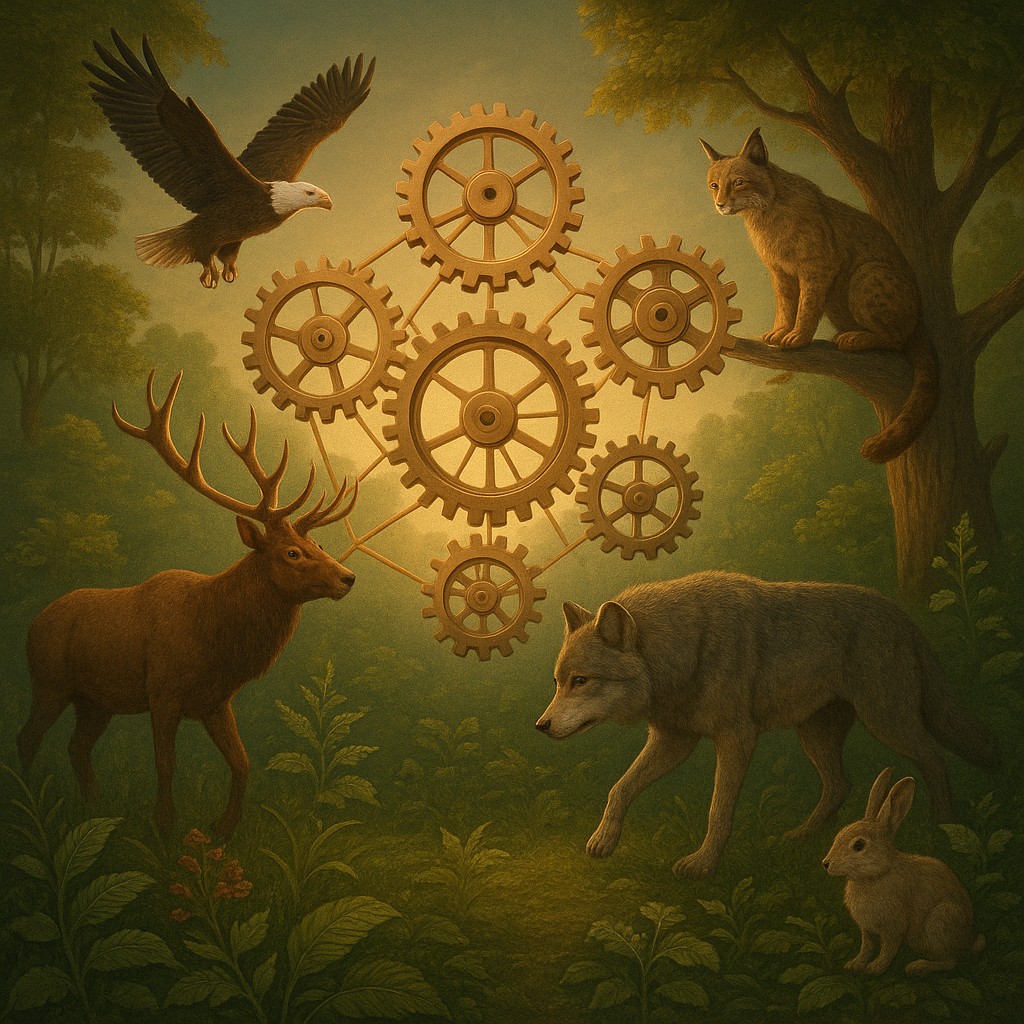
Imagine a clock where every gear, spring, and tiny screw is linked. If you remove even one small wheel, the hands might stop moving or start spinning wildly out of control. Nature works much like that clock, but instead of metal parts, it is built from living connections called food webs. For a long time, we pictured these webs as simple ladders where the big animals at the top did nothing more than eat the smaller ones below. We assumed that if you removed a top predator, the only real change would be a few more happy, healthy deer or rabbits running around. However, nature is far more dramatic and interconnected than we ever realized.
When a top predator disappears or returns to its home, it triggers a phenomenon known as a trophic cascade. The word "trophic" refers to nutrition or eating, and a "cascade" is like a waterfall of effects that pours down from the top of the food chain to the plants and even the physical landscape. It is the ultimate biological "butterfly effect," where a wolf catching an elk in a forest can actually change the path of a river or the quality of the soil. Understanding these cascades is the key to realizing that we cannot just save one species at a time; we must care for the entire complex, messy, and beautiful system if we want it to survive.
The Secret Language of Ecosystem Energy
To understand how a cascade begins, we have to look at how energy moves through a habitat. In the simplest terms, the sun feeds the grass, the grass feeds the elk, and the elk feed the wolves. This is often called a "top-down" system when the predators are the ones in charge. When predators are present, they act as a sort of biological thermostat, keeping the population of plant-eaters in check. Without that thermostat, the herbivores (the plant-eaters) grow in number until they have eaten every green thing in sight. This leads to a barren landscape where the soil washes away because there are no roots to hold it down, leaving other animals without homes.
Trophic cascades show us that predators are not just "killers," but are actually "engineers." Their presence creates a "landscape of fear," which is a scientific way of saying that prey animals change their behavior when they know they are being watched. If you are an elk and you know a wolf might be lurking in the thick willow bushes by the river, you will spend less time standing in the open eating those delicious willow leaves. Instead, you will move to higher ground where you can see better. This simple decision, driven by the instinct to stay alive, gives riverside plants a chance to breathe, grow, and transform the environment.
The Yellowstone Transformation and the Power of Return
The most famous example of this ripple effect happened in Yellowstone National Park. After wolves were hunted to local extinction in the early 20th century, the park began a slow, quiet decline. Without wolves to keep them moving, the elk grew lazy and overpopulated. They spent their days lounging by the rivers, eating every young willow and aspen shoot they could find. The forests stopped growing back, the riverbanks became unstable, and many other species began to vanish. It was as if someone had hit the "pause" button on the park's natural cycle of growth.
In 1995, everything changed when wolves were brought back to the park. The results were incredible, though they did not happen overnight. As the wolves began to hunt, the elk spread out across the landscape. Because the elk were no longer overgrazing the valley floors, the plants exploded in a surge of green. In just a few years, willow trees grew tall enough to provide shade and nesting spots for birds. Then came the beavers, who used the new willow growth for both food and building material. The dams built by these beavers created ponds that became homes for fish, frogs, and insects. By simply existing, the wolves had indirectly rebuilt a home for dozens of other species.
| Ecosystem Component |
Without Top Predators (The "Broken" State) |
With Top Predators (The "Cascade" State) |
| Herbivores (Elk/Deer) |
High populations; sedentary and over-browsing. |
Controlled populations; mobile and cautious. |
| Vegetation |
Stunted growth; young trees never reach maturity. |
Lush growth; diverse plant life and new forests. |
| Riverbanks/Soil |
High erosion; banks collapse; water is muddy. |
Root systems stabilize soil; clearer, deeper water. |
| Biodiversity |
Low; fewer niches for birds, insects, and rodents. |
High; thriving wetlands, more birds, and scavengers. |
Beyond the Forest and Into the Deep Blue
Trophic cascades are not just a story about wolves and elk; they happen everywhere on Earth, including the deep ocean. One of the most striking examples involves sea otters, sea urchins, and kelp forests. Sea otters are famous for being cute, but they are also fierce predators that love to snack on sea urchins. If you remove the otters, the urchin population explodes. These spiny creatures act like underwater lawnmowers, eating the base of giant kelp until the entire underwater forest is replaced by a barren, rocky desert known as an "urchin barren."
When otters are present, they keep the urchins in hiding, allowing the kelp to grow into massive, towering underwater skyscrapers. These kelp forests are vital because they soak up huge amounts of carbon dioxide from the air, helping to fight climate change. They also provide a nursery for hundreds of species of fish. This demonstrates that a trophic cascade doesn't just affect the animals we see; it affects the chemistry of our atmosphere and the physical structure of the ocean floor. Whether it is a shark in a coral reef or a lion on the savanna, removing the "boss" usually leads to a collapse of the local economy of life.
Navigating the Complexity of Natural Chaos
It is tempting to think that we have nature all figured out and that we can simply "add wolves" or "add otters" to fix any problem. However, the environment is not a simple machine with predictable results; it is a complex, ever-changing system. Scientists often find it difficult to predict exactly how a trophic cascade will turn out because there are thousands of moving parts. A drought, a sudden disease, or even a change in temperature can change how the cascade works in ways we don't expect. This is why conservationists are often cautious despite the success stories.
Sometimes, a cascade can be "dampened" or muffled. If an ecosystem has many different predators that do similar jobs, the loss of one might not be as devastating because others step in to fill the gap. On the other hand, in a system that has been damaged for decades, simply bringing back a predator might not be enough to fix everything if the soil is too far gone or the native seeds have disappeared. Nature is resilient, but it has its limits. This complexity reminds us that our role should be one of humble care. We aren't the directors of the play; we are more like the stagehands trying to make sure the actors have what they need to perform their parts.
Common Myths About Predators and Balance
One of the biggest misconceptions about trophic cascades is that predators are "cruel" or that they will eventually eat all their prey until nothing is left. In reality, predators and prey have danced this dance for millions of years. Predators rarely wipe out their prey because doing so would mean they would starve to death themselves. Instead, they act like pruning shears on a hedge, removing the weak and the sick and preventing the population from outgrowing its food supply. It is a harsh but necessary balance that ensures the health of the entire forest.
Another myth is that trophic cascades only work in one direction. While "top-down" cascades are the most famous, "bottom-up" effects are just as important. If the plants do not have enough nutrients or water, it doesn't matter how many wolves you have; the system will still struggle. The magic happens when both forces are in balance. When we study these cycles, we see that nature doesn't have "good guys" and "bad guys." It only has roles to be filled. By protecting top predators, we aren't just protecting a single animal; we are protecting the invisible threads that hold the entire world together.
The Future of Living Landscapes
Learning about trophic cascades changes the way you look at the world. When you see a thicket of young trees or a clear, bubbling stream, you start to wonder about the hidden forces that made it possible. You begin to see the world not as a collection of separate objects, but as a vibrating web of relationships where every action has a reaction. This perspective is vital for the future of conservation. Our goal should not be to build a nature museum that is frozen in time, but to foster a living, breathing system that is capable of healing itself.
As you think about the environment, remember that your voice and your understanding have power. When we advocate for the protection of large wilderness areas or the return of native species, we are advocating for the return of these beautiful cascades. We are choosing a world that is vibrant, messy, and full of life over one that is quiet and barren. By respecting the complex roles that every creature plays, from the smallest insect to the largest bear, we ensure that the grand clock of nature keeps ticking for generations to come. Your curiosity is the first step in becoming a guardian of that delicate balance.