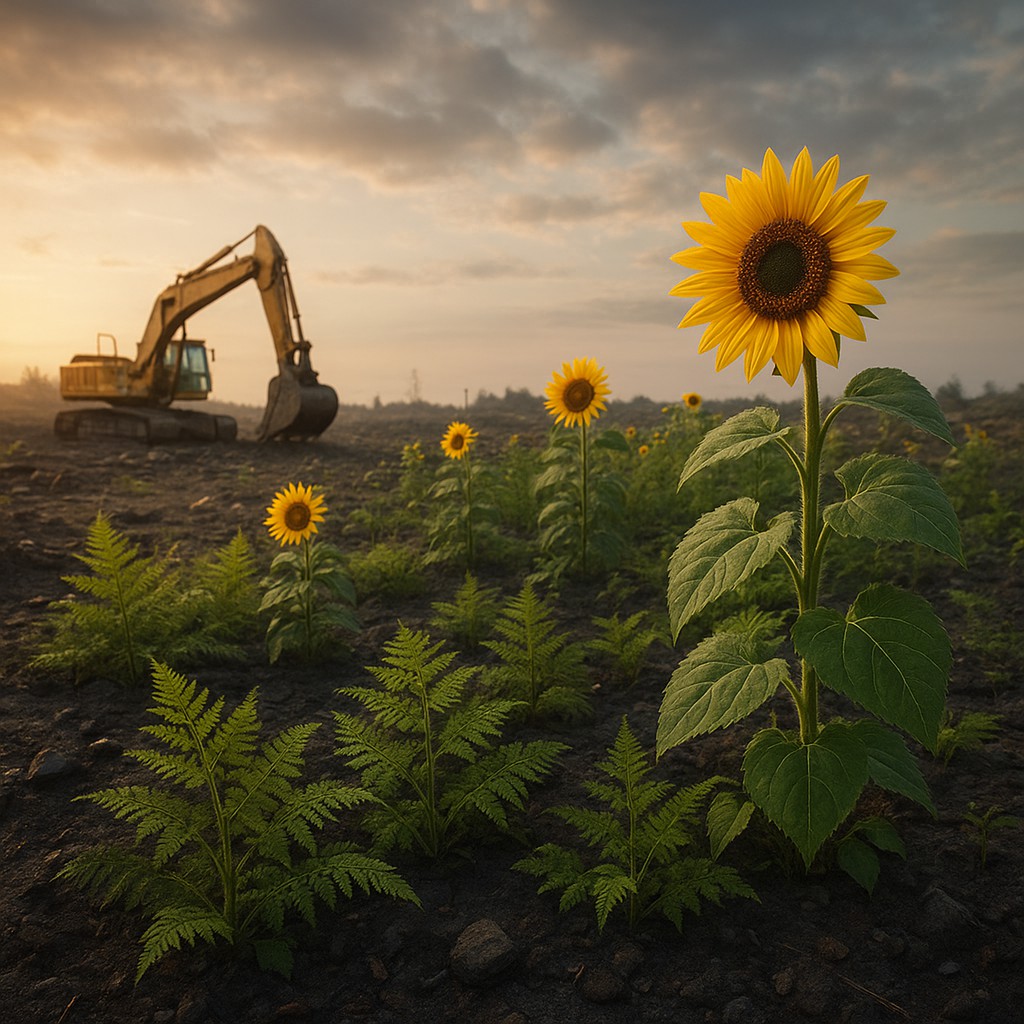
Imagine walking through a post-industrial wasteland. It is the kind of place where the soil is so choked with lead, arsenic, or cadmium that even the toughest weeds struggle to grow. For decades, our only answer to these chemical scars has been the "dig and dump" method. This involves bringing in a fleet of yellow excavators, scooping up tons of earth, and hauling it off to a specialized landfill somewhere else. It is loud, incredibly expensive, and essentially just moves the problem from one patch of dirt to another while leaving a massive hole in the ground. It feels like a brute-force solution to a delicate problem of chemistry, but for a long time, we did not think we had a better choice.
Now, imagine a different scene: a field of quiet ferns and sunflowers doing the same work without the diesel fumes or the million-dollar price tags. These are not ordinary plants. They are the heavy metal fans of the botanical world, evolved to thrive in environments that would kill almost any other living thing. Known as hyperaccumulators, these botanical marvels act like living vacuum cleaners. They draw toxins out of the earth and lock them away in their stems and leaves. This process is called phytoremediation, and it represents a major shift in how we think about environmental cleanup. Instead of fighting nature with heavy machinery, we are partnering with specialists to heal the planet one root at a time.
The Secret Superpowers of Botanical Vacuum Cleaners
To understand how a plant can survive on a diet of poison, we have to look closely at its plumbing. Normally, plants are very picky about what they pull from the soil. They use their roots as a security checkpoint to let in nutrients like nitrogen and phosphorus while keeping out dangerous metals. However, hyperaccumulators have a different strategy. They do not just tolerate heavy metals; they aggressively seek them out. Using specialized transport proteins, these plants pump metals from the soil into their roots and zip them up through the xylem - the plant's internal water pipes - to their upper leaves.
Once the metals reach the leaves, the plant stores them in safe, cellular "storage closets" called vacuoles. By keeping these toxins away from their vital machinery, the plants stay perfectly healthy. Many scientists believe plants evolved this trait as a brilliant defense mechanism. If your leaves are packed with a lethal dose of nickel or zinc, you become an unappealing snack for a grasshopper or a deer. One bite of a hyperaccumulator leaf is like eating a spoonful of metal shavings, poisoning the predator before it can finish its meal. This evolutionary quirk, meant for self-defense, is exactly what makes these plants so valuable for human cleanup efforts.
A Catalog of Green Specialists for Toxic Soils
Not every plant can handle every poison. Just as you wouldn't hire a plumber to fix a laptop, you wouldn't plant a sunflower to fix a site contaminated with nickel. Over the years, researchers have identified hundreds of different hyperaccumulator species, each with its own "favorite" element to devour. This diversity allows environmental engineers to prescribe specific botanical treatments based on the chemical profile of a polluted site.
| Plant Name |
Metal Target |
Notable Characteristic |
| Chinese Brake Fern (Pteris vittata) |
Arsenic |
Can store arsenic at levels 200 times higher than the soil. |
| Alpine Pennycress (Thlaspi caerulescens) |
Zinc and Cadmium |
A tiny weed that can hold up to 3% of its weight in zinc. |
| Sebertia acuminata |
Nickel |
A tree from New Caledonia that bleeds blue-green sap rich in nickel. |
| Sunflowers (Helianthus) |
Lead and Cesium |
Famous for cleaning radioactive soil near the Chernobyl site. |
| Indian Mustard (Brassica juncea) |
Lead and Selenium |
Fast-growing greens that cover large areas quickly. |
The Alpine Pennycress is particularly famous in scientific circles. While it looks like an unremarkable weed you might find in a sidewalk crack, it is a champion at extracting zinc. It can pull hundreds of times more zinc out of the ground than a normal plant, effectively mining the soil. Meanwhile, the Chinese Brake Fern has become the gold standard for removing arsenic. It thrives in contaminated areas, drinking up arsenic that would normally leak into the groundwater and poison local communities. By choosing the right tool for the job, we can customize a cleanup strategy that fits the local climate and the specific footprint of the land.
Trading Speed for Sustainability
The biggest hurdle for the green cleanup movement is the clock. If you use a backhoe and a dump truck, you can clean a site in a week. If you use plants, you are at the mercy of the seasons and natural growth rates. Phytoremediation is a marathon, not a sprint. A single crop of Indian mustard might only remove a small percentage of the total lead in the soil. To reach safety standards, you might need to plant, grow, and harvest these metal-eaters for five, ten, or even fifteen years.
However, the benefits of this slow progress are things machinery simply cannot match. First, there is the cost. Phytoremediation is significantly cheaper than traditional digging, often costing only a fraction of the price. Second, the process protects the soil. Excavation leaves behind a dead, sterile pit. Hyperaccumulators leave behind soil that is rich in organic matter and full of beneficial microbes. By the time the metals are gone, the land is healthy and ready for a park or a farm. This method is also much better for the climate, as it relies on solar energy and plant growth rather than fossil fuels.
Harvesting to Close the Loop
A common question is: "Once the plant is full of poison, where does it go?" If we let the plants die and rot in place, the metals would just sink back into the dirt, and we would be right back where we started. The trick is to treat the plants like a commercial crop. Once the hyperaccumulators are full, they are harvested just like wheat or corn. The plant material is then dried out to reduce its weight, making it much easier to transport than tons of heavy, wet dirt.
In some cases, this toxic harvest is burned in controlled facilities to generate energy, leaving behind a concentrated ash. This ash is essentially high-grade metal ore. This has led to a field called "phytomining." In areas where soil has metal levels that are too low for traditional mining, we can grow hyperaccumulators to concentrate the metal for us. We can then extract nickel or cobalt from the ash, turning a cleanup project into a literal nickel mine. It is the ultimate example of a circular economy, where we turn a pollution hazard into a valuable resource.
Looking Toward a Greener Horizon
While we have made great strides in finding these plants, the future of phytoremediation lies in combining botany with genetics. Researchers are looking for ways to make these plants grow faster or reach deeper into the soil with their roots. Some scientists are experimenting with "bio-augmentation," where they add specific bacteria to the soil to help the plants absorb even more metal. As we refine these techniques, the slow pace of the method may become less of an issue, making it a viable choice even for urgent projects.
It is easy to feel overwhelmed by the damage we have done to the environment, but nature often provides its own elegant solutions. By observing how life adapts to harsh conditions, we have discovered a way to heal the earth using nothing more than sunlight, water, and specialized seeds. The next time you see a fern or a sunflower, remember it might be doing more than just looking pretty; it might be part of a silent army working to scrub our mistakes from the soil and create a cleaner world for everyone.