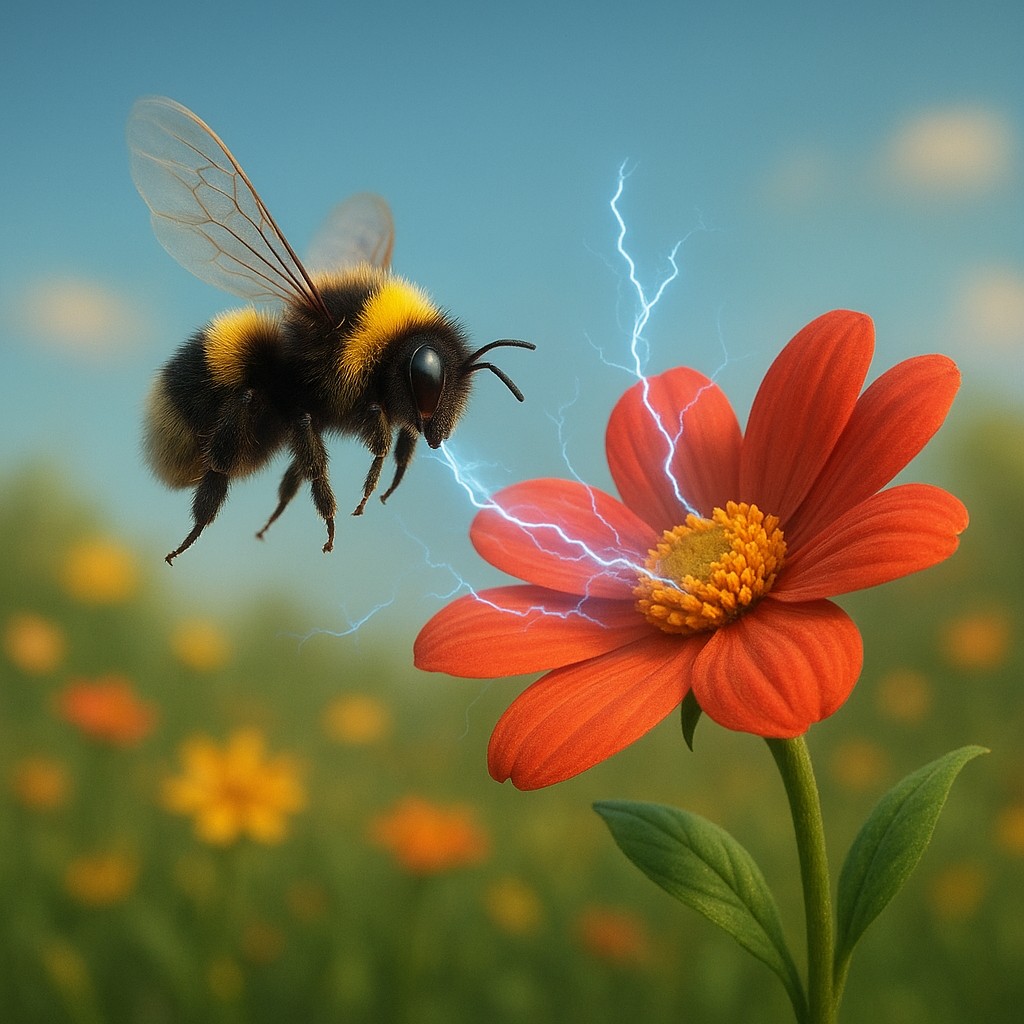
Imagine for a moment that you are a bumblebee. You are a fuzzy, aerodynamic marvel, zig-zagging through a meadow at speeds that would make a human sprinter jealous. As you fly, your rapid wingbeats and the friction of the air against your outer shell create a strange physical side effect. You are essentially a living, buzzing Van de Graaff generator. Every second you spend in the air, you strip electrons from the atmosphere and build up a strong positive static charge. By the time you spot a bright, inviting petal in the grass, you aren't just a hungry insect; you are a localized, high-voltage electrical event looking for a place to land.
Down on the ground, the flower plays the role of the quiet, grounded counterpart. Anchored in the soil, plants are naturally connected to the Earth's negative charge. They sit there, patiently extending their petals like antennas into the sky. This setup creates a massive, invisible tension between the plant and the pollinator. Long before you actually touch the flower, the air between you crackles with an unseen force. This isn't just a random result of movement, but a sophisticated, silent broadcasting system. It allows the flower to whisper its secrets to the bee without making a sound or releasing a single scent molecule.
The Physics of the Pollinator Spark
To understand how this works, we have to look at the world through the lens of static electricity. Every object has an electrical relationship with its environment. Because bees are small and move incredibly fast, the friction they generate is very high for their size. It is the same principle that causes you to get a shock after walking across a carpet in wool socks. The bee builds up a positive charge that can reach several hundred volts. While that sounds like a lot, the actual current is tiny, so the bee isn't in danger of catching fire. Instead, it carries an invisible "halo" of electrical potential wherever it goes.
The flower, rooted in the damp earth, stays at a low, negative charge. In the world of physics, opposites attract, creating a literal pull between the two. When the positively charged bee approaches the negatively charged flower, a small, subtle exchange occurs, similar to a microscopic lightning bolt. This "spark" doesn't just happen at the moment of contact. As the bee nears the flower, the plant’s electrical field begins to shift and warp in response. By the time the bee lands, it has effectively edited the flower's electrical signature, leaving a temporary mark that lingers long after the bee has flown away with its prize.
A Post-it Note Written in Electrons
Why would a plant go through the trouble of having an electrical signature? The answer lies in the brutal efficiency of the natural world. Nectar is expensive for a plant to produce. It takes a lot of energy to brew that sugary cocktail, and once it is gone, the plant needs time to refill the supply. For a bee, time is literally life. Every second spent hovering over a flower that has already been emptied by a previous visitor is a second of wasted energy and increased danger from predators.
The shift in the flower's electric field acts as a "vacancy" sign, or more accurately, a "closed for maintenance" sign. When the first bee lands and takes the nectar, the flower's electrical charge changes for several minutes. When a second bee approaches, it doesn't even have to land to know the cupboard is bare. Its tiny, sensitive hairs can detect the altered field from a distance. The bee senses that the electrical "vibe" of the flower is off, tells its brain to keep moving, and flies on to the next stem. This invisible communication ensures the bee finds food faster and the plant’s remaining pollen is carried to a fresh partner rather than being wasted on a flower that has already finished its work for the hour.
Sensitivity Beyond the Five Senses
Humans often struggle to grasp this concept because we are effectively "electrically blind." We rely on sight, sound, smell, touch, and taste, but bees possess a sixth sense: electroreception. It was once thought that only aquatic animals, like sharks and platypuses, could sense electricity because water is such an excellent conductor. However, recent research has proven that land-dwelling insects are more than capable of sensing fields through the air, provided they have the right equipment.
The bee's equipment consists of thousands of mechanosensory hairs, specifically the small, stiff ones known as "filiform hairs." These hairs are incredibly light and sensitive. When a bee enters an electric field, these hairs experience a force called the "Coulomb force," which causes them to bend or vibrate. This movement triggers nerves at the base of the hair, sending a signal to the brain that says, "Hey, there is a specific electrical pattern here." It is a delicate, tactile way of feeling the shape of the air. This allows the bee to map out its environment in a way we can barely imagine, seeing the world as a complex tapestry of voltages.
| Feature |
Visual Signaling |
Scent Signaling |
Electrical Signaling |
| Medium |
Light waves |
Chemical molecules |
Electric fields |
| Speed |
Instant |
Slow (drifts with wind) |
Almost instant |
| Persistence |
Permanent (color) |
Fades slowly |
Temporary (fades in minutes) |
| Best For.. |
Long-range attraction |
Identifying species |
Real-time status updates |
| Weakness |
Darkness/Camouflage |
Wind/Rain |
High humidity/Rain |
When the Signal Goes Dark
As brilliant as this system is, it is not invincible. The primary enemy of the floral electric field is moisture. This explains why you rarely see bees working frantically during a rainstorm, even if the rain is light. Water is a fantastic conductor of electricity. When it rains, the air becomes humid and the surfaces of the flowers are coated in a layer of water. This effectively grounds the entire system, meaning the "volts" the flower uses to signal the bee are drained away into the wet earth instantly.
In a heavy rain, the electrical "spark" a bee leaves behind is wiped clean. This is known as grounding the signal, and it creates a temporary blackout in the meadow's communication network. This is one reason why bees wait for the sun to come out and the petals to dry before going back to work. They aren't just waiting for the weather to be comfortable; they are waiting for the "internet of flowers" to come back online so they don't have to waste energy guessing which flowers are full.
The Impact of Modern Interference
If the delicate dance between bees and flowers relies on tiny, precise electrical fields, what happens when humans introduce our own massive electrical footprints? This question is currently occupying the minds of many ecologists. We live in a world saturated with electromagnetic noise, from high-voltage power lines to cellular networks and the chemical interference of synthetic fertilizers.
Recent studies have shown that certain fertilizers can actually alter the electrical potential of plants. When a farmer sprays a field, the chemicals can change how a flower holds its charge, potentially "jamming" the signal that bees rely on. If the flower's natural field is masked by chemical or electromagnetic "static," the bee might find it harder to tell the difference between a flower full of nectar and one that is empty. This leads to inefficient foraging, meaning the bee has to work harder for less food, which can hurt the health of the entire hive. Understanding the invisible world of floral electricity is more than a curiosity; it is a vital part of protecting our global food supply and the pollinators that sustain it.
The Invisible Architecture of the Meadow
We often think of nature as a collection of separate parts: a bee over here, a flower over there. But the discovery of floral electric fields reveals that the meadow is actually a single, interconnected system of energy. There is a hidden architecture to the world, a web of invisible lines and silent conversations happening right under our noses. Every time a bee lands on a petal, it is participating in a high-tech data exchange that has been refined over millions of years of evolution.
The next time you walk through a garden or a park, try to visualize the invisible crackle of electricity all around you. Every bloom is a tiny beacon, and every insect is a wandering battery. Recognizing the unseen should give us a profound sense of wonder. We are surrounded by complex, beautiful systems that operate on frequencies we cannot perceive, proving that there is always more to the story than meets the eye. Nature is not just scenery to look at; it is a dynamic, living network that continues to communicate, evolve, and surprise us with its hidden brilliance.