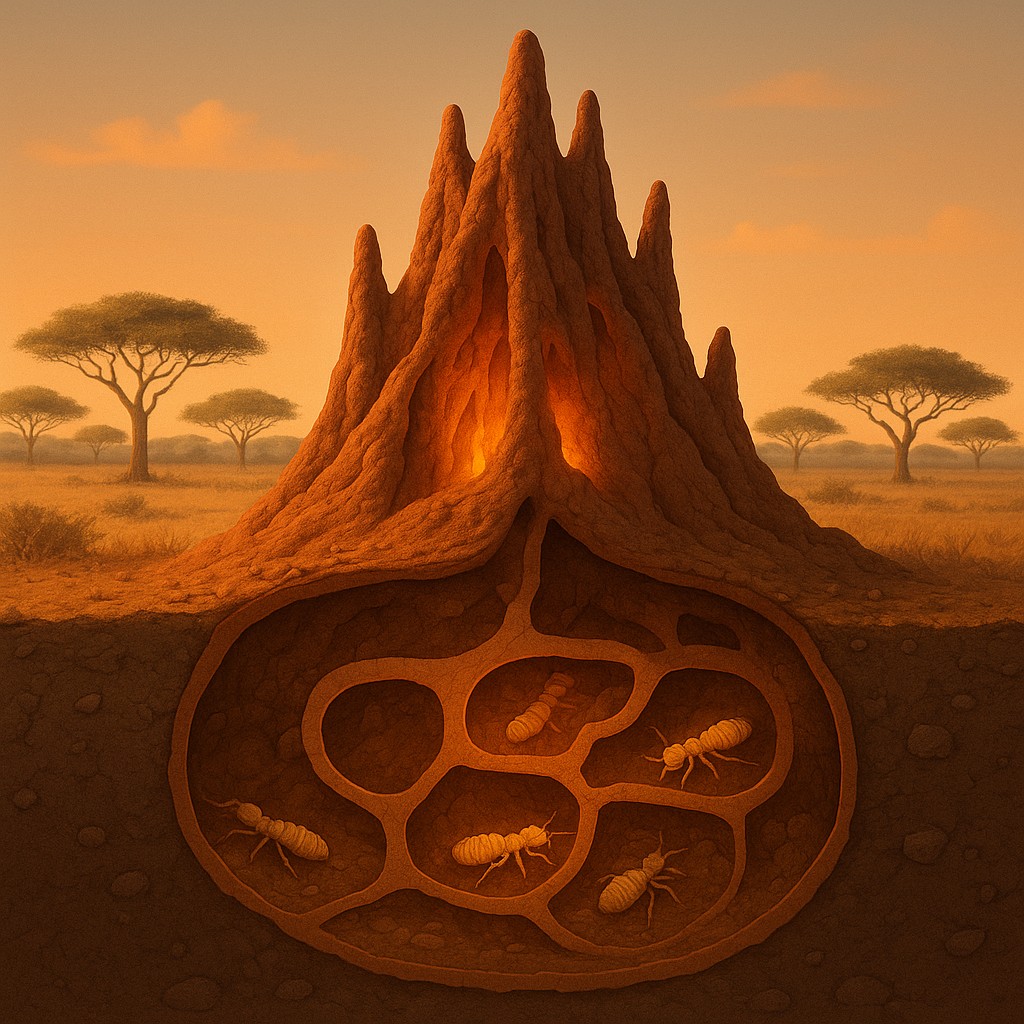
In the scorching savannas of sub-Saharan Africa, where ground temperatures often soar past 40 degrees Celsius (104 Fahrenheit), most animals are desperate for shade or a burrow underground. Yet, rising from the sun-baked earth like jagged, rusty cathedrals are the mounds of Macrotermes bellicosus. These towering structures, sculpted from nothing but saliva and soil, house millions of delicate insects whose survival depends on a biological contradiction. The termites themselves have soft bodies that dry out easily, while the fungus they farm for food needs a perfectly steady temperature to grow. To solve this, these termites have become the world’s most sophisticated thermal engineers without even knowing it, building "smart" homes that run without a single watt of electricity.
For decades, many experts assumed these mounds worked like giant lungs or relied on the wind to push air through their winding tunnels. However, recent research has found a much more elegant system at work, powered by the very sun that threatens the colony. By using a process called the thermosiphon effect, the mound uses "waste" heat from the sun to create a self-regulating ventilation system. This discovery flips our traditional ideas about cooling upside down. Usually, we see heat as a problem to be fought with power-hungry fans and air conditioners. To a termite, heat is not the enemy; it is the fuel that keeps them alive.
The Invisible Engine of Convection
At the heart of termite architecture is the fact that air is a fluid, and like any fluid, its density changes with its temperature. When air heats up, its molecules gain energy and bounce off one another, causing the air to expand and become lighter. In a termite mound, the sun hits the thin, outer walls of the high chimneys. These chimneys act like solar collectors, soaking up radiation and heating the air trapped inside the narrow vertical shafts. As this air warms, it becomes buoyant and begins to float upward, much like a hot-air balloon rising through the sky.
This upward movement is not just a random drift; it starts a powerful chain reaction. As the hot air escapes through the porous tops of the chimneys, it leaves behind a pocket of low pressure at the base of the mound. Nature likes to keep pressure balanced, so this low pressure pulls in fresh air from elsewhere. In the mound, this air is drawn from deep underground tunnels and the shaded base of the structure, where the earth's mass keeps the air much cooler. This "suction" creates a continuous loop where the sun’s energy literally pulls the stale, hot air out of the building while drawing refreshing, cool breezes in.
Scientists call this process a thermosiphon. It is a passive heat exchange system that relies entirely on natural convection (the movement of heat through air) and gravity, rather than mechanical pumps. This logic turns the mound from a static pile of dirt into a living, breathing machine. By using the outside environment as an energy source, the termites have skipped the need for internal power, creating a climate-controlled home that stays stable while the outside world swings between freezing nights and blistering days.
Distinguishing Myth from Reality
When we talk about termite mounds, it is easy to treat the insects like humans. We imagine "architect" termites looking at blueprints or "worker" termites flapping their wings to move the air. It is important to clear up these myths to appreciate how the system really works. The termites do not move the air themselves. While they are master builders, they are not acting like tiny heating and cooling technicians. They do not understand the physics of moving fluids; instead, they respond to local signs like CO2 levels and humidity to change the shape of the mound over many generations.
Another common myth is that the mound stays cool simply because its walls are thick and well-insulated. While thick walls do help slow down temperature swings, insulation alone cannot explain how millions of living insects, who produce their own body heat, avoid cooking themselves alive. To understand the mound, we must see it as a dynamic system of air pressure. The following table compares our standard human approach to cooling with the biological method of the termite mound.
| Feature |
Human HVAC Systems |
Termite Mound Mechanism |
| Energy Source |
Electricity (Power Grid) |
Solar Radiation (The Sun) |
| Moving Parts |
Fans, Compressors, Pumps |
None (Fluid Dynamics) |
| Cooling Agent |
Chemical Refrigerants |
Natural Air and Soil Moisture |
| Maintenance |
High (Needs repairs and parts) |
Low (Constant minor tinkering) |
| Feedback Loop |
Digital Thermostats |
Chemical and Physical Cues |
As the comparison shows, the termite approach is much more sustainable. Humans often design buildings as sealed boxes that fight the environment, using energy to force temperatures down. The termite mound, by contrast, is an open system that works with the environment, using the very heat it wants to escape from to power the escape itself.
Architecture Borrowed from the Savanna
Perhaps the most famous example of these principles in the human world is the Eastgate Centre in Harare, Zimbabwe. Designed by architect Mick Pearce, this large office and shopping complex was one of the first major examples of "biomimicry," or nature-inspired design, in modern building. Harare has a climate similar to the African savanna, with large temperature swings between day and night. Pearce realized that using traditional air conditioning for such a large building would be too expensive and hard on the environment. He looked to local termite mounds for a layout that could regulate its own internal temperature.
The Eastgate Centre uses a system of chimneys and heavy building materials to create a similar thermosiphon effect. During the day, the building’s heavy concrete walls soak up heat. As the sun warms the air in the vertical exhaust vents, the stale air rises and is pushed out through the roof. This draws cool air in from the bottom of the building, which was chilled overnight by the building’s massive structure. The result is a high-rise that uses only about 10 percent of the energy of a typical building its size. It is a functional, money-saving reality that proves nature’s "patents" are worth studying.
Modern architects are now taking this further by looking at "breathable" building skins that mimic the porous walls of termite mounds. Instead of making walls airtight, designers are experimenting with materials that allow small amounts of gas to pass through, just as the mound allows CO2 to escape while keeping moisture inside. This shift moves away from "active" systems that need constant electricity and toward "passive" systems that use the shape of the building to do the hard work.
Waste Heat as a Power Source
The biggest lesson we can learn from the termite mound is a shift in how we look at "waste." In human engineering, heat is often seen as a nuisance or a useless byproduct of our machines and our sunny streets. We spend billions of dollars every year on cooling towers and radiators just to throw this heat away. The termite mound teaches us that heat is not waste; it is a concentrated form of energy that can be put to work.
If we looked at a city through the lens of a thermosiphon, every hot asphalt road and every sun-warmed glass skyscraper could be a potential pump. If we could use that heat to move air through underground tunnels or up solar chimneys, we could theoretically ventilate entire cities for free. This is a "systems-thinking" approach that asks how we can turn a problem into a solution. By understanding how air rises and how the mound functions, we can see that the environment gives us all the tools we need to stay cool. We just have to be clever enough to use the sun to our advantage.
This system also challenges our definition of "intelligence." We often think of intelligence as something that happens inside a brain, but the termite mound suggests a type of collective, structural intelligence. The "mind" of the colony is shown through the soil. The mound is a physical answer to a problem that has been solved over millions of years of evolution. It reminds us that the best solutions are often the ones that blend perfectly with the laws of the universe.
Designing a Harmonious Future
As the climate changes and energy costs go up, the humble termite mound offers a plan for a more resilient future. We can no longer afford to ignore the elegant physics of the natural world. By moving away from energy-hungry mechanical parts and toward passive, structural designs, we can create buildings that are cheaper to run and more comfortable to live in. The thermosiphon effect is a bridge between the efficiency of the savanna and the needs of the twenty-first century.
Understanding these biological machines forces us to rethink our relationship with the sun. Instead of hiding from it behind thick curtains and humming air conditioners, we can design structures that "eat" the sun’s heat and turn it into a cooling breeze. It is a poetic discovery: the very source of the heat provides the power to cool it down. When we stop fighting the laws of physics and start working with them, we find that the most advanced technology on Earth isn't made of silicon and steel, but of mud, instinct, and the simple fact that hot air rises. The next time you see a skyscraper, imagine it behaving not as a tomb, but as a living, breathing mound.