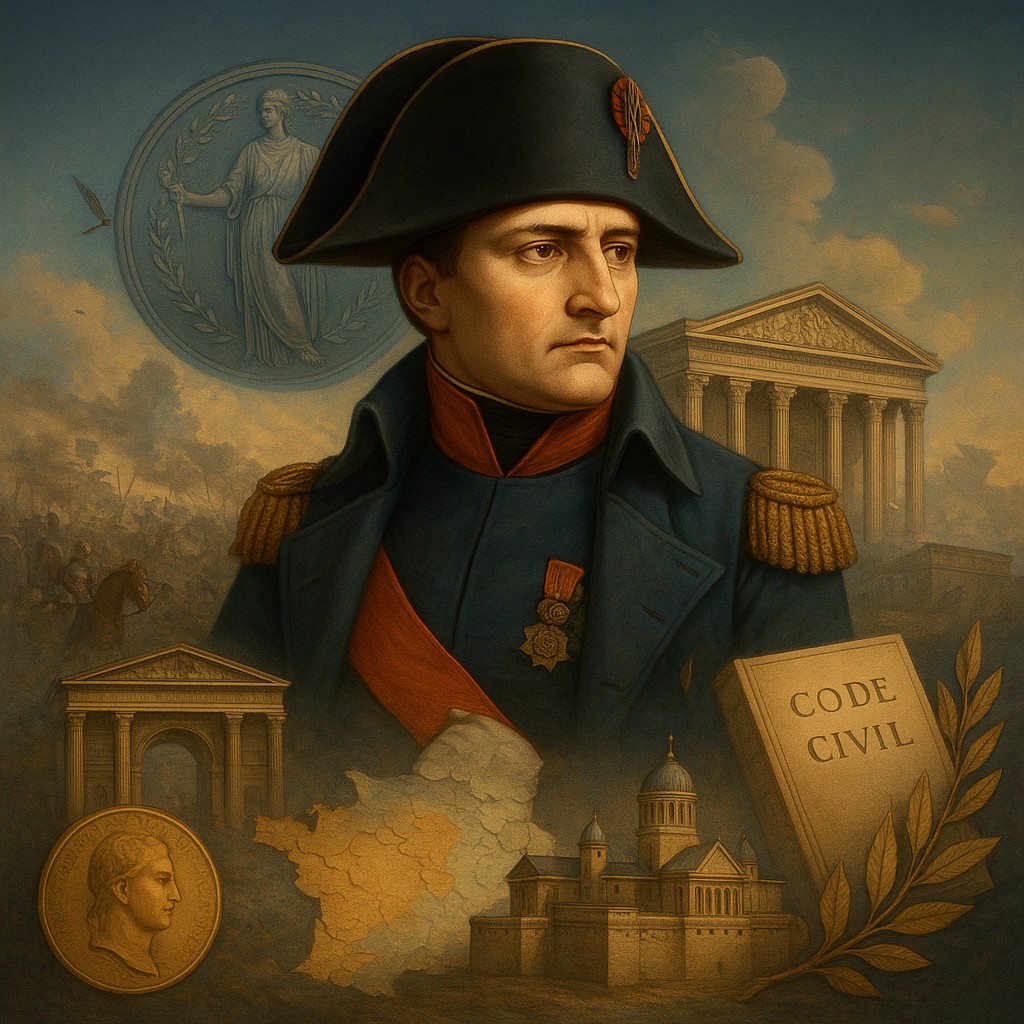
How a Corsican schoolboy became the man who rearranged Europe
Napoleon Bonaparte is one of those historical figures who seems to come with his own weather system - stormy, dramatic, and impossible to ignore. His life reads like a thriller: a provincial outsider rises amid revolution, wins stunning victories, reshapes laws, crowns himself emperor, and then crashes spectacularly. That arc is why he matters: Napoleon did not just win wars, he changed how modern states work, from taxation to courts, from schools to conscription. Understanding him helps explain why Europe, and even parts of the modern world, look and govern themselves the way they do.
Think of Napoleon as an accelerant on trends that already existed in the French Revolution: merit over birth, central authority over feudal fragmentation, legal uniformity over local custom. He was brilliant at turning chaos into order, and ruthless in pursuing efficiency. Yet his story is not simply a tale of competence plus ambition. It is a story of personality, timing, and many small decisions that together produced enormous consequences. Those details make the story fun to study, and useful for anyone curious about leadership, reform, or the unintended results of power.
This learning nib will take you from his boyhood in Corsica, to his artillery training, to the battles that made his name, the political coup that put him in charge, his major reforms and military strategies, and finally his fall and legacy. Along the way we will bust popular myths, highlight the decisions that mattered most, and point out how much of his imprint still survives today. Read on with curiosity, and a little skepticism, because Napoleon’s life is equal parts myth and method.
By the end you should be able to explain not only what Napoleon did, but why he could do it, and what lessons his career offers someone who wants to shape institutions or lead in turbulent times. If that sounds ambitious, remember he began as a child far from the Paris salons, and won a continent. That alone is a useful encouragement.
Small-town origins, a strict household, and a taste for artillery
Napoleon was born on August 15, 1769, in Ajaccio on the island of Corsica, just months after France formally acquired the territory from Genoa. His family belonged to minor nobility, but they were not wealthy power players. Growing up, Napoleon navigated the pride of a noble name, the oddness of his Corsican accent, and the pressure to prove himself in a French world that often looked down on islanders. These early frictions helped form his combative, competitive personality and a deep need to earn respect.
At nine he was sent to French mainland schools where he encountered strict discipline, a new language, and an environment that rewarded military skill. He trained at artillery schools and developed a particular interest in mathematics and logistics, which fit perfectly with the needs of 18th century warfare. Artillery favored precision, planning, and resourcefulness over brute force, and Napoleon’s aptitude made him a natural fit. Those subjects stayed central to his identity - he thought like a man who could map terrain and measure risk.
His family life also shaped him. Napoleon adored his mother, Letizia, and had a complicated relationship with his siblings, who both supported and competed with him throughout his life. Personal grievances like these mattered; Napoleon held grudges, and he rewarded loyalty lavishly while punishing betrayal sternly. Early scarcity taught him to work harder than many of his peers, and that mixture of affection, obligation, and ambition propelled him forward.
A rapid climb through smoke: early military fame and revolutionary opportunity
The French Revolution opened doors that would have been slammed shut in ancien regime France. Napoleon embraced the Revolution’s idea that talent should rise on merit, and he found an institution - the army - that needed clever officers. He first made a name at the Siege of Toulon in 1793, where his artillery work was decisive and resulted in promotion. That success was a practical demonstration of his skills and a public showcase for his daring.
His Italian campaign from 1796 to 1797 turned him from a promising officer into a national star. Facing larger but poorly coordinated forces, he used speed, decisive battles, and clever diplomacy to humiliate Austria and win territory and prestige. Letters home from that period reveal a witty, sometimes ruthless young man who combined military daring with political calculation. He managed supply problems, inspired troops with personal charisma, and struck deals that made victories stick.
An expedition to Egypt in 1798 mixed scientific curiosity with imperial ambition. Napoleon wanted to strike at Britain’s route to India and establish a new base of influence, but the campaign became a strategic sideshow after the British fleet, led by Admiral Nelson, destroyed the French fleet at the Battle of the Nile. Still, Egypt burnished his image as a modernizer - the expedition included scholars and scientists who documented ancient cultures - even if it failed strategically. Crucially, the messy politics in Paris gave him the opening he needed to return and seize power.
The political coup that turned general into ruler
By 1799 France had endured revolution, terror, and a weak government called the Directory. Napoleon returned from Egypt and, with allies who feared instability, orchestrated the coup of 18 Brumaire (November 1799). He presented himself as the savior who could restore order while preserving some revolutionary gains. The result was the Consulate, a new government with Napoleon as First Consul. He had power without immediately taking an imperial crown, which was a shrewd move: it allowed him to consolidate authority while building legitimacy.
During the Consulate he centralized government, reformed administration, and used plebiscites - public votes with limited choice - to claim popular support. In 1804 he took the dramatic step of crowning himself Emperor Napoleon I in a ceremony that combined republican forms with imperial symbolism. He invited the Pope, but famously placed the crown on his own head, an act meant to signal that his authority came from accomplishment rather than divine investiture. The move reflected his complex relationship with legitimacy - he wanted ancient grandeur without losing the modern claim to merit.
His rule combined showmanship with bureaucratic discipline. Napoleon knew how to stage events that created the sense of a national mission while building structures that made government more efficient. Those structures are a major part of his legacy, and they outlast his battlefield victories.
Laws, schools, banks - the practical empire within the state
Napoleon’s most enduring work was not always on the battlefield, but in the halls of administration and law. The Napoleonic Code, compiled and enacted between 1801 and 1804, standardized French law by eliminating many feudal privileges and making civil law clearer and more accessible. It emphasized property rights, secular authority over church law, and legal equality for men, and it later influenced legal systems across Europe and beyond. This codification was an instrument of both justice and control, making the state’s authority consistent across France.
He reformed taxation, created the Bank of France in 1800 to stabilize the currency, and centralized the bureaucracy so local officials answered to Paris-appointed prefects. Education was reorganized with lycees to train civil servants and military officers, tying meritocratic advancement to state institutions. Napoleon also reached a practical accommodation with the Catholic Church via the Concordat of 1801, which restored some church status while keeping the state firmly in charge of appointments and public order.
These reforms were not purely idealistic. They also made France stronger and more governable, which in turn supported military ventures. Yet reforms had human consequences: the code restricted women’s rights compared with revolutionary rhetoric, and centralization reduced local autonomy. Napoleon’s genius was that his reforms made a modern state functional, but they also concentrated power.
Quick reference: Napoleon’s major domestic reforms and impacts
| Reform or institution |
Year enacted |
What it changed |
Lasting impact |
| Napoleonic Code (Civil Code) |
1804 |
Standardized civil law, clarified property and contract rights, limited feudal practices |
Basis for modern civil law in many countries |
| Bank of France |
1800 |
Stabilized currency, managed public debt |
Foundation of modern French financial system |
| Concordat with the Pope |
1801 |
Reconciled the state and Catholic Church, regulated clergy appointments |
Reinforced state control over religion |
| Central prefect system |
1800 |
Reorganized local governance under Paris-appointed officials |
Strengthened national administrative unity |
| Lycees and education reforms |
1802 onward |
Standardized secondary school system to train officials |
Model for state-run education systems |
| Legion of Honor |
1802 |
Rewarded military and civil merit, replaced aristocratic orders |
Continued as France’s main honor system |
Mastering movement: why Napoleon looked unstoppable on the battlefield
Napoleon’s battlefield reputation rested on movement, surprise, and corps-based organization. He never had the largest army consistently, but he perfected a system where independent corps could operate separately and then combine force at decisive points. That allowed rapid marches, flexible responses, and concentration of force exactly where needed. His tactical instincts favored decisive engagements that broke enemy cohesion rather than long trundling campaigns of attrition.
He was also a supreme logistician in many ways. He pushed for reliable supply lines, meticulous planning of marches, and careful use of artillery to shape battlefields. His staff work and use of local intelligence gave him information advantages. Perhaps most important, his charisma and presence on campaign inspired troops to undertake grueling marches and to fight with confidence. Soldiers believed in him, and that belief mattered.
Yet his brilliance had limits. When campaigns stretched beyond logistical reach, or when bad weather and resistance combined, even his method failed. The invasion of Russia exposed the vulnerability of extended supply lines, harsh climate, and overstretched command. Tactical genius could win battles, but strategic overreach and cumulative attrition were harder to engineer around.
Turning points on the map: victories, stalemates, and disasters
Certain campaigns and battles stand out because they changed the political map. Austerlitz in 1805 is often called his tactical masterpiece - a brilliant combination of feint and timing that crushed the Russian-Austrian coalition and secured French dominance on the continent for years. In contrast, Trafalgar that same year was a naval disaster; Admiral Nelson destroyed the Franco-Spanish fleet, ending Napoleon’s hopes of invading Britain and ensuring British naval dominance.
The Peninsular War in Spain and Portugal became a slow, draining guerrilla conflict that bled French resources and prestige. It taught the European powers that Napoleon could be worn down. The 1812 invasion of Russia was the strategic disaster that historians mark as the beginning of the end. Tactical gains were swallowed by distance, cold, disease, and supply failure, and only a fraction of the Grande Armée returned. After heavy defeats culminating in Leipzig in 1813, coalitions closed in and Paris fell in 1814.
He was exiled to Elba, but only briefly. In 1815 he returned for the dramatic Hundred Days, rallied supporters, and faced the allied field armies at Waterloo. Defeated by combined forces and imperfect communication at Waterloo, he was exiled to the remote island of St Helena, where he spent his last years until his death in 1821. Each of these points shows how military and political fortunes can flip with a single campaign or diplomatic realignment.
Myths versus the messy truth: correcting popular stories
Napoleon’s life attracted myth-making almost as soon as he rose to fame. Separating legend from fact helps us see his real capabilities and limits. For example, the idea that Napoleon was extremely short is misleading; his height was about average for a Frenchman of his era, but British caricature and different units of measurement created the "short" image. Another romantic myth is that he burned his ships in Egypt so his troops had no option but to win - the reality is more complex, involving damaged and captured ships and the strategic environment rather than theatrical self-cutting of escape routes.
Other myths cling to his personality and death. Stories about poisoned tea remain speculative; forensic and historical evidence points toward stomach cancer as the most likely cause, though arsenic traces have fueled conspiracy theories. Finally, the dramatic scene of crowning himself is often simplified: yes, he placed the crown on his own head, but the Pope was present, and the act was carefully staged to combine legitimacy with personal assertion.
A short myth-busting list:
- Napoleon short? Not unusually so for his time, the confusion comes from French-English units and propaganda.
- Burned his ships in Egypt? No dramatic one-off burning, more a result of naval defeat and strategic choices.
- Died mysteriously by poison? Most historians accept a natural cause, though debate still exists.
These corrections do not diminish his legend; they humanize him, which is often more interesting.
Endgame: exile, return, and the final fall
After a series of defeats Napoleon abdicated in 1814 and accepted exile to Elba, a small Mediterranean island where he held nominal sovereignty. But Europe had not seen the last of him. He escaped in 1815, returned to France, and reclaimed power for 100 days with astonishing speed. Many soldiers and citizens preferred his rule to the restored Bourbon monarchy, at least for a moment, and he moved with confidence to rebuild an army.
His final campaign ended at Waterloo on June 18, 1815, where a combination of allied forces, tactical missteps, and bad weather denied him victory. After this definitive defeat, he was shipped to the isolated St Helena in the South Atlantic, where he lived under strict British supervision until his death in 1821. Even in decline he remained a figure of fascination - writing memoirs, strategizing, and managing household affairs - and his final years shaped the legend that later generations would amplify.
Why Napoleon remains a useful model to study today
Napoleon’s life offers lessons about leadership, institutional design, and the limits of personal power. He shows how reforms can produce stability and modernity when paired with centralized authority, and how charisma and competence can work together to produce rapid change. He also demonstrates the dangers of overreach - that even the most skilled leaders are constrained by logistics, environment, and political resistance.
Studying him helps clarify a practical truth: systems matter as much as leaders. Napoleon’s reforms outlived his rule because they reorganized institutions - courts, tax systems, schools - that continued functioning without him. For anyone seeking to shape organizations, that insight is crucial: build structures that persist. And for those interested in strategy, his campaigns are an object lesson in turning mobility and information into advantage, while reminding us that no tactic is invulnerable.
Final lift-off: what to keep from Napoleon’s story
Napoleon’s life is both a cautionary tale and an inspiration. He rose from relative obscurity through talent, relentless work, and bold decisions, and he left marks on law, administration, and military practice that last today. At the same time, his story warns about unchecked ambition, the hazards of stretching resources too far, and the human cost of empire. If you take one practical insight from his life, let it be this: lasting change comes from combining clear vision with durable institutions, not only from fleeting glory. Now go look at a public institution you use every day - a courthouse, bank, or school - and you might just spot a little Napoleonic DNA.