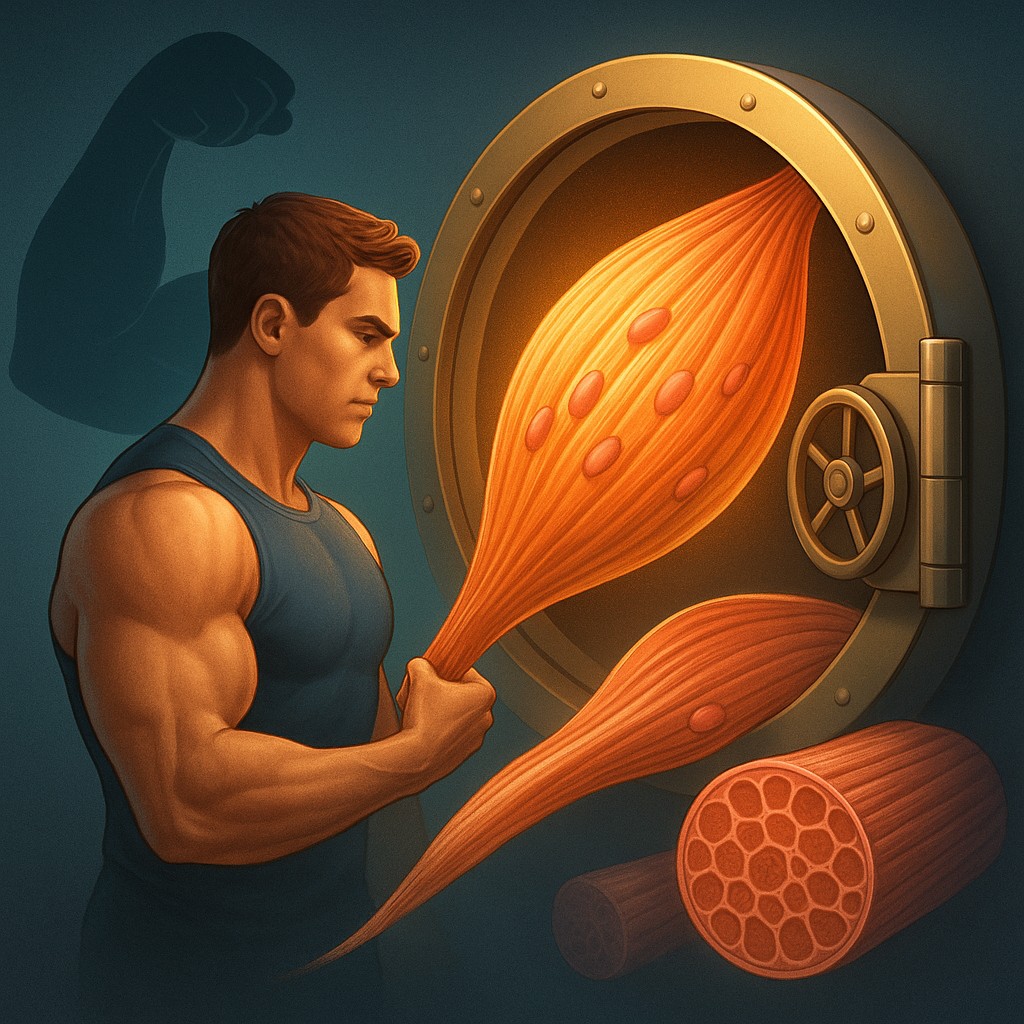
Imagine you have spent three months working hard at the gym. You traded your morning sleep for the steady clank of weights and the slow burn of growing biceps. You finally built a solid physique that fills out a T-shirt, only for a chaotic work project or a cross-country move to derail your routine for six months. When you finally look in the mirror after a long break, your "gains" seem to have evaporated, leaving behind a softer, smaller version of yourself. It feels like all that sweat was a waste, like a sandcastle washed away by the tide of a sedentary life.
However, beneath the surface of that visible shrinkage, your body has actually undergone a permanent structural upgrade. While your muscles might look the same as they did before you ever lifted a weight, their internal architecture is fundamentally different. Your cells have kept the receipts for every heavy set you ever finished. This hidden biological inheritance is why, when you eventually get back to the gym, you will rocket back to your peak performance in a fraction of the time it took the first time around. You aren't starting from scratch; you are simply moving back into a building that already has the foundation poured and the frame built.
The Myth of the Vanishing Muscle
For decades, the common wisdom in sports science was that muscle followed a "use it or lose it" rule. The logic was simple: when you train, your muscle fibers get bigger (hypertrophy), and when you stop, they get smaller (atrophy). Experts assumed that the cellular parts were simply taken apart and recycled, leaving no trace of their former strength. This led to a constant worry among athletes that a two-week vacation would undo months of progress. We viewed muscle as a temporary state, like a battery that slowly leaks power until it is completely drained.
This old model, however, failed to explain the "prodigal son" effect seen in weight rooms everywhere. We have all seen the person who hasn’t stepped foot in a gym for years, yet manages to regain a massive amount of strength and size within just a few weeks of returning. If the muscle were truly gone, this kind of rapid rebound would be biologically impossible. Modern research has revealed that while the protein inside the muscle fiber might shrink, the "command centers" that manage that protein stay exactly where they are. The muscle doesn't disappear; it just enters a state of suspended animation, waiting for the signal to wake back up.
The Cell's Construction Crew
To understand how this memory works, we have to look at the unique makeup of a skeletal muscle cell. Most cells in your body are like small studio apartments with a single occupant: the nucleus. This nucleus acts as the brain of the cell, holding the DNA blueprints and issuing orders to build proteins. But muscle fibers are different. They are enormous, long cylinders that are far too big for a single nucleus to manage. Imagine trying to run a skyscraper-sized construction site with only one foreman located in the basement; nothing would ever get built on the top floors.
To solve this, muscle fibers have many nuclei. They contain hundreds or even thousands of nuclei spread along their length, each managing a small section of the fiber. When you lift heavy weights, you create a demand for more protein than your current nuclei can handle. To meet this demand, your body recruits "satellite cells," which are essentially muscle stem cells waiting nearby. These satellite cells fuse with the muscle fiber and donate their nuclei to the cause. This increases the fiber's "management capacity," allowing it to grow larger and stronger. This process of adding myonuclei (muscle nuclei) is the hardest part of building muscle, requiring consistent, high-intensity effort over long periods.
Why the Blueprints Never Leave
The real breakthrough in our understanding of "muscle memory" came when researchers discovered that these newly acquired nuclei are incredibly tough. Recent studies, including those observing human muscle after months of no training or even being stuck in a cast, show that while the volume of the muscle fiber shrinks significantly, the number of nuclei remains remarkably stable. The factory might stop production and the lights might go out, but the managers don't quit their jobs; they just sit in the darkened office waiting for the next order.
This permanence changes everything we know about fitness. It means that the "struggle" of being a beginner, where progress feels painfully slow, is actually the time when you are creating the most permanent biological wealth. You aren't just building temporary bulk; you are increasing the fundamental cellular density of your tissues. This is why a former athlete can sit on a couch for five years and still have a biological advantage over someone who has never trained. The "infrastructure" for growth is already in place. When that athlete starts training again, their body skips the difficult step of recruiting new satellite cells and goes straight to the easy step of filling the existing "nuclear zones" with protein.
The Limits of Cellular Recall
While the discovery of permanent nuclei is inspiring, it is important to distinguish between "muscle memory" and "total fitness." Your body is a complex system, and not every part of it is as organized as your muscle fibers. Some physical changes are much more temporary. Understanding these differences can help you manage your expectations when returning to a routine after a long break.
| Type of Change |
How it Works |
How Long it Lasts |
Recovery Speed |
| Muscle Size (Hypertrophy) |
Keeping muscle nuclei |
High (Years) |
Very Fast |
| Absolute Strength |
Nerve signals and nuclei |
High |
Fast |
| Cardio Endurance |
Tiny blood vessels and energy cells |
Low (Weeks) |
Moderate |
| Metabolic Efficiency |
Enzyme levels and fuel storage |
Low |
Moderate |
| Motor Skills (Technique) |
Brain and nerve pathways |
Moderate to High |
High (Needs practice) |
As the table shows, your heart and lungs are much less forgiving than your biceps. Cardio traits, such as your "VO2 max" (the max oxygen your body can use) and the density of the tiny blood vessels that deliver oxygen to your cells, begin to drop relatively quickly. This often happens within a few weeks of total inactivity. Similarly, the "skill" of moving, such as the perfect timing for a tennis serve or a complex lift, lives in your nervous system. While these paths aren't erased, they do get "dusty" and require a period of recalibration. You might have the cellular potential to lift a heavy weight, but your brain might temporarily forget the most efficient way to coordinate the movement.
Debunking the "Shrinkage" Panic
One of the most common myths in fitness is that "muscle turns into fat" when you stop exercising. Biologically, this is as impossible as a piece of gold turning into a pile of lead; they are two completely different types of tissue. What actually happens is a two-part shift: the muscle fibers lose water and protein, and because the person is likely burning fewer calories while eating the same amount, fat stores increase. Since the muscle underneath has lost its firmness, the area looks softer, giving the illusion of a transformation.
Another myth is that "muscle memory" is only for elite athletes. In reality, this is a basic human biological process available to everyone. Even a person who does a bodyweight program in their basement for six months and then quits for a year will find it easier to get back to that level than a total beginner. The "ceiling" of your physical potential is raised every time you push yourself to the point of adding new nuclei. This suggests that there is no such thing as a "wasted" workout, even if life eventually forces you to take a break. Every session is an investment in a cellular retirement fund that pays off for the rest of your life.
New Frontiers in Protein Memory
While the theory of permanent nuclei is the foundation, cutting-edge research suggests that muscle memory might be even more sophisticated. Recent studies into the "proteome" - the entire set of proteins a cell produces - indicate that training leaves behind specific protein signatures even after the muscle has shrunk. There is also evidence of "epigenetic" changes, where the DNA inside those nuclei is "tagged" with chemical markers that say "ready for growth."
These tags don't change the DNA itself, but they change how easily the DNA can be read. It is like putting a bookmark in a massive instruction manual. When you start training again, your cells don't have to flip through the whole book to find the instructions for how to build muscle; they just flip straight to the bookmarked page. This multi-layered memory system ensures that the human body is remarkably resilient and prepared for the return of physical challenges. It is a biological safety net designed to help us survive in environments where food and activity levels might change.
The Long-Term View on Consistency
Understanding the permanence of muscle nuclei shifts our focus from "short-term results" to "long-term structural health." If you view fitness as a temporary state, a missed week feels like a disaster. But if you view it as a process of cellular upgrades, you realize that even short bursts of intense effort have lifelong value. This is especially important as we age. Sarcopenia, the loss of muscle mass as we get older, is one of the leading causes of weakness and lost independence in the elderly.
By building a "nuclear reserve" in your youth and middle age, you are essentially preparing your body against the effects of aging. Someone with a high number of muscle nuclei will find it much easier to keep their functional strength in their 70s and 80s than someone starting from scratch. The hard work you do today isn't just for the beach this summer; it is a gift to your future self. The investment stays in the bank, and the interest is paid in physical resilience.
The next time you can't keep up your ideal training schedule, remember that your body isn't resetting to zero. You are not losing your progress; you are simply putting it in storage. The extra nuclei you earned are still there, tucked away within your muscle fibers like tiny, dormant power plants. When life settles down and you find your way back to the gym, those nuclei will be waiting. You’ll find that your muscle memory is far more loyal than your reflection suggests, and your path back to peak performance is shorter and more certain than the first time around. Take heart in the fact that every drop of sweat has been documented and stored in the very fabric of your being.