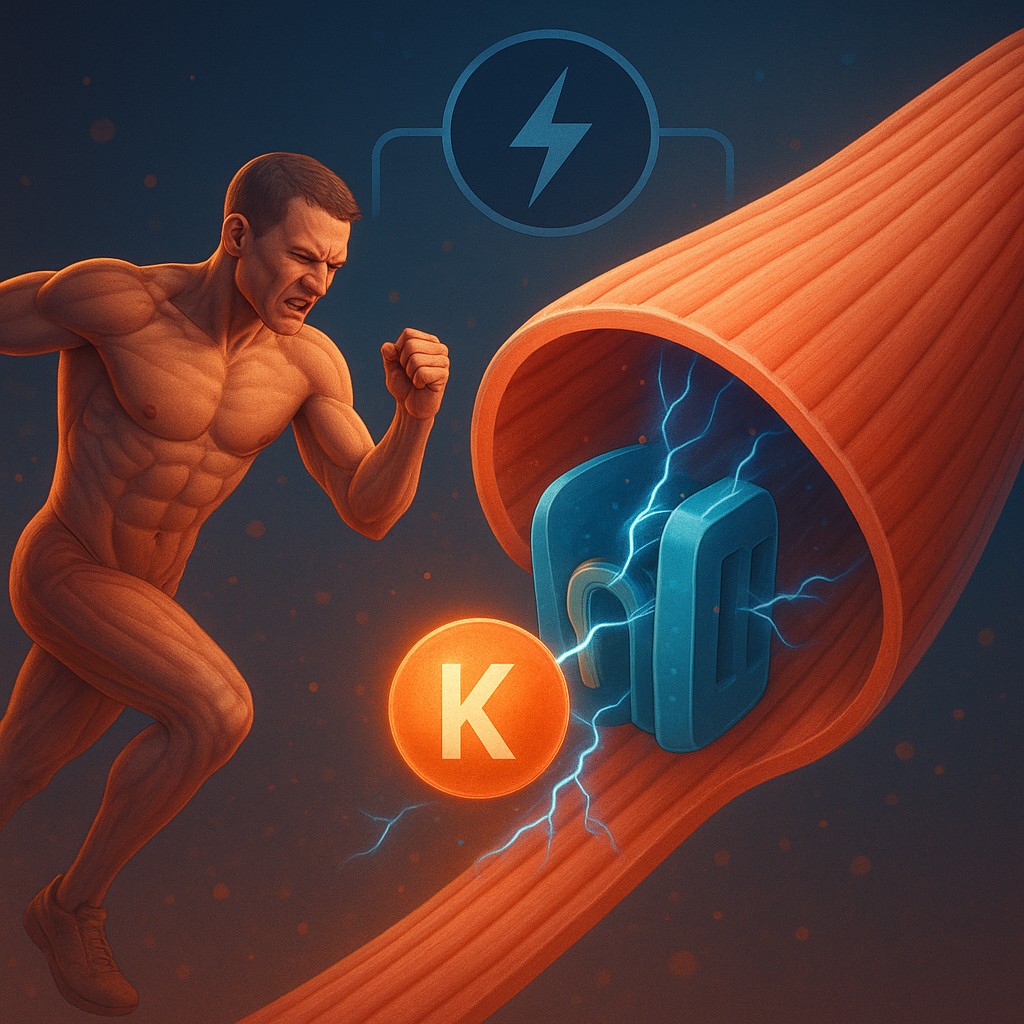
Imagine you are in the final thirty seconds of a high-intensity interval workout. Your lungs are screaming, your heart is drumming against your ribs, and your thighs feel like they have been replaced by molten lead. You push for one last sprint, but your legs simply refuse to respond. It is no longer a matter of willpower or "mind over matter"; your muscles have effectively clocked out and gone on strike. For decades, the primary suspect for this physical mutiny was lactic acid. We were told that as we exercise, our bodies produce this acidic byproduct, which "burns" our fibers and brings our movement to a grinding halt. It was a neat, tidy explanation that combined chemistry with the sensation of pain, but as it turns out, we have been blaming the wrong character in this biological drama.
The truth is far more electrical and much more fascinating. Recent advances in exercise physiology have revealed that the "burn" you feel from lactate is actually a protective signal - a sort of dashboard warning light rather than the engine failure itself. The real reason your muscles stop firing during that final sprint is a breakdown in the cellular electrical grid. To understand why you hit a wall, we have to look past the acidity and focus on the movement of tiny charged particles called ions, specifically potassium. Your muscles are essentially organic batteries, and when they fail, it is because their voltage has dropped too low to trigger a reaction. It is a story of salt, pumps, and the frantic struggle to keep electricity flowing while the demand for power skyrockets.
The Biological Battery and the Electrical Spark
To understand muscle fatigue, we first have to understand how a muscle "knows" when to move. Every single muscle fiber in your body is wrapped in a membrane that acts like an electrical insulator. Inside the cell, the environment is kept at a different electrical charge than the environment outside. This difference in charge, known as the resting membrane potential, is what allows your muscles to be "excitable." When your brain tells your bicep to lift a coffee cup, it sends an electrical impulse down a nerve. When that impulse reaches the muscle, it triggers a sudden, violent shift in the chemical balance of the muscle cell, which causes the muscle to contract.
This shift is governed by two main players: sodium and potassium. Under normal circumstances, your muscle cells are packed with potassium ions, while the space outside the cells is brimming with sodium ions. Think of the muscle cell as a high-pressure reservoir of potassium. When the "go" signal arrives, tiny channels in the cell membrane snap open. Sodium rushes into the cell and potassium leaks out. This rapid exchange creates an action potential - a wave of electricity that travels along the muscle fiber and triggers the mechanical machinery of contraction. Without this swift movement of ions, the muscle remains a hunk of inert protein. It is essentially a biological circuit board that requires a precise salt balance to stay functional.
When the Pumping Stations Can No Longer Keep Up
If every contraction causes potassium to leak out of the cell, you might wonder why we aren't all constantly collapsing after a short walk to the mailbox. The reason is that our cells are equipped with a sophisticated infrastructure called the sodium-potassium pump. These pumps are the unsung heroes of human endurance. Their entire job is to grab the sodium that just rushed in and kick it back out, while simultaneously chasing down the escaped potassium ions and hauling them back inside. This process requires energy in the form of ATP (the body's primary fuel), and it happens incredibly fast. In a resting state, these pumps easily maintain the balance, keeping the "battery" fully charged and ready for the next signal from the brain.
The problem arises when we move from a leisurely stroll to a high-intensity effort. During a sprint or a heavy set of squats, the muscle fibers fire dozens of times per second. Each fire-and-reload cycle results in a fresh wave of potassium leaking out into the space between cells. Eventually, the sheer volume of leaked potassium becomes overwhelming. The sodium-potassium pumps work at maximum capacity, but they simply cannot move the ions back to their home bases fast enough. As potassium builds up on the outside of the cell and runs low on the inside, the electrical gradient begins to vanish. The muscle's "voltage" drops, and suddenly, the brain's signal to contract is met with silence. The cell is no longer electrically responsive.
Comparing the Old Myth and the New Reality
To truly grasp why this shift in understanding matters, it is helpful to look at how we used to view muscle failure compared to our current understanding of ion management. The "Lactic Acid Myth" suggested that our muscles failed because they became too acidic to function, but we now know that lactate is actually a fuel source that your heart and brain love to consume. The real struggle is about maintaining the electrical barrier.
| Feature |
The Lactic Acid Myth |
The Potassium Leakage Reality |
| Primary Culprit |
Lactic acid (lactate) buildup |
Potassium buildup outside the cell |
| Mechanism of Failure |
Acidity "burns" muscle enzymes |
Loss of electrical charge (depolarization) |
| The "Burn" Feeling |
The cause of muscle failure |
A protective warning signal to slow down |
| Role of Rest |
Clearing away metabolic "waste" |
Letting pumps reset the ion balance |
| Key Performance Factor |
Ability to "buffer" or neutralize acid |
Efficiency and number of sodium-potassium pumps |
The table above shows that the focus has shifted from "cleaning up waste" to "restoring a charge." This explains why short bursts of rest are so effective during interval training. You aren't necessarily washing away acid in those thirty seconds of rest; rather, you are giving your sodium-potassium pumps a chance to catch up, pull the escaped potassium back into the cells, and restore the electrical potential required for the next round of work. It is less like cleaning a dirty kitchen and more like recharging a capacitor that has been drained too quickly.
The Protective Burn of Lactic Acid
If potassium leakage is the real reason our muscles stop working, then what is that infamous burning sensation we all know so well? For a long time, we assumed the burn was the sound of the engine failing. Instead, it is more like a governor on a car's engine that prevents you from redlining the vehicle into total destruction. As you exercise intensely, your body produces protons along with lactate. This does increase the acidity in the muscle, which is what triggers the pain receptors. However, this acidity actually serves a fascinating purpose: it helps protect the muscle from the very potassium failure we have been discussing.
Research suggests that an acidic environment actually helps the muscle's electrical system stay functional even when potassium levels are out of whack. The acidity makes the muscle's chloride channels less active, which ironically helps the muscle maintain its electrical "spark" longer than it would in a neutral environment. So, the "burn" is a double-edged sword. It creates the discomfort that encourages you to slow down before you reach total electrical collapse, but it also chemically tweaks your cells to keep them firing just a little bit longer. Rather than the enemy of performance, lactic acid is more like an aggressive coach screaming at you to keep the rhythm while also handing you a subtle chemical shield.
Training the Pumps for Elite Endurance
Knowing that potassium management is the bottleneck for high-intensity performance changes how we think about training. When we talk about "conditioning," we are often talking about the heart and lungs, but at the cellular level, conditioning is largely about the sodium-potassium pumps. Athletes who engage in high-intensity interval training (HIIT) aren't just getting "tougher" or improving their oxygen intake; they are actually stimulating their bodies to build more of these pumps. The more pumps you have in your muscle cell membranes, the faster you can clear out the leaked potassium and the longer you can maintain high-intensity output before the electrical gradient fails.
This is why a seasoned marathoner or a professional cyclist can maintain a pace that would leave a beginner paralyzed with fatigue within minutes. Their cells have become highly efficient ion-management factories. They have more pumps, and those pumps are more sensitive to the movements of potassium. Furthermore, their bodies have become better at sensing the "warning lights" and managing effort so that the ion leak never quite exceeds the pump's capacity. Endurance, in this light, is much less about "grit" and much more about the number of microscopic janitors you have on your cell membranes, frantically whisking potassium back to where it belongs.
Redefining the Limits of Human Potential
Understanding the potassium mechanism offers a refreshing perspective on our physical limits. It transforms the sensation of fatigue from a mysterious, painful "breaking point" into a clear, logical biological process. When your legs give out, you aren't "failing" in a traditional sense. Instead, your body's sophisticated electrical management system has reached a temporary limit to protect itself from damage. It is a sign of a high-performance machine operating at its absolute peak, using every available ion to generate power until the physics of the cell simply demand a reset.
Next time you are pushing yourself to the limit and feel that unmistakable heavy sensation in your limbs, take a moment to appreciate the incredible electrical storm happening inside your cells. You are witnessing a high-speed race between leaking ions and hardworking pumps - a microscopic battle for balance that allows you to move, jump, and run. That burning sensation isn't the sound of your muscles "rotting" from acid; it is the alarm system of an amazingly complex biological computer. Respect the rest, trust the pumps, and know that every time you push to that limit, you are teaching your cells to handle the spark just a little bit better for the next time.