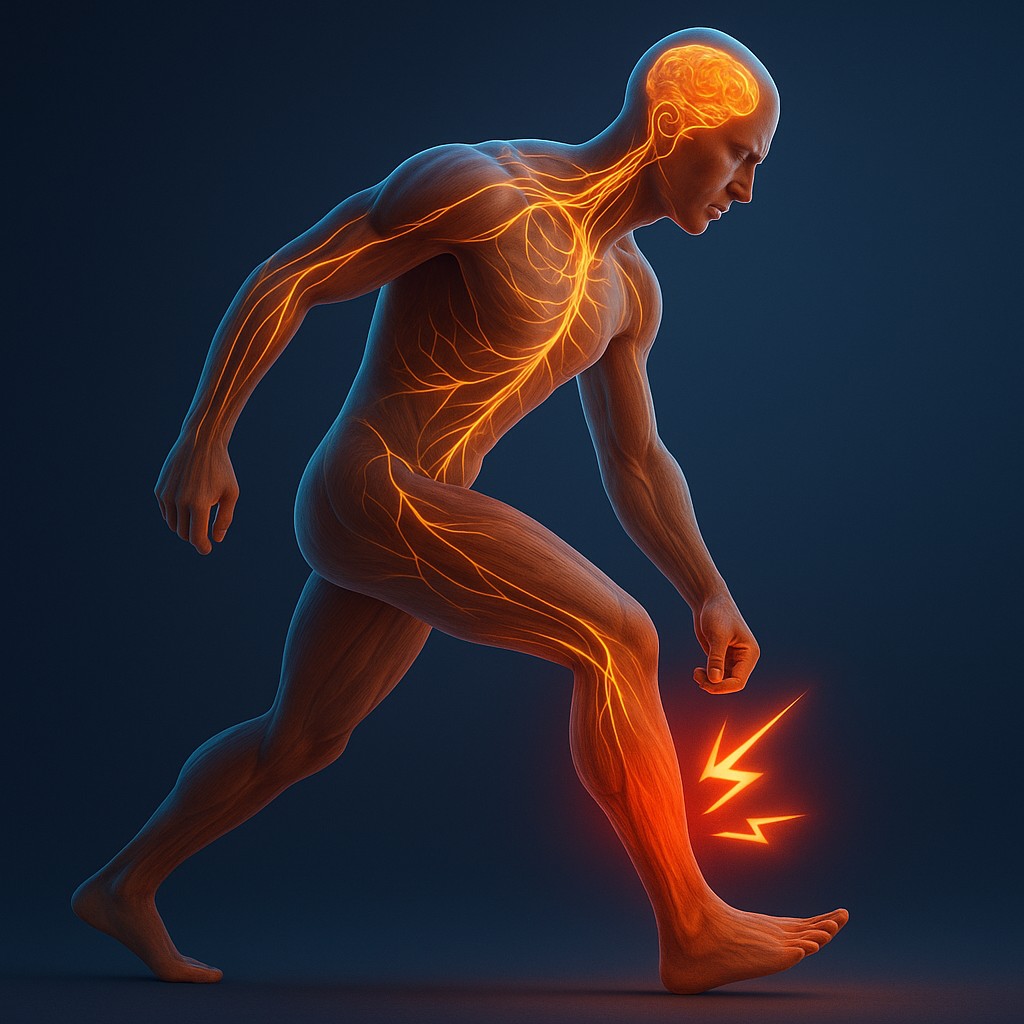
Imagine you are mid-stride during a morning run, or perhaps more relatable, you are deep in a peaceful sleep at 3:00 AM. Suddenly, without warning, your calf muscle decides to turn into a solid, agonizing piece of granite. Your toes curl on their own, and your first instinct is to massage the lump while mentally blaming that extra cup of coffee or the banana you forgot to eat. For decades, the collective wisdom of coaches, parents, and even some doctors has blamed a simple chemical imbalance: you are either dehydrated or low on salt. We have been told to chug sports drinks and eat potassium-rich fruit as if our muscles were simply wilting plants in need of fertilizer.
However, modern neuroscience is starting to reveal a much more chaotic and fascinating story. It turns out that a muscle cramp is rarely a local supply problem involving salt and water. Instead, it is more like an electrical short circuit in the wiring of your nervous system. Your muscle isn't "thirsty," it is being shouted at by a confused spinal cord. By understanding that a cramp is a communication breakdown between your brain, your nerves, and your muscle fibers, we can move past slow-acting remedies and look toward high-speed neurological resets that work in seconds rather than hours.
The Electrical Tug of War Inside Your Limbs
To understand why a muscle suddenly locks up, we first have to look at the delicate balancing act that happens every time you move. Your muscles are governed by two primary sensory organs that act like a sophisticated thermostat. The first is the muscle spindle, which lives deep within the muscle fibers. Its job is to detect how much a muscle is stretching. If a muscle stretches too far or too fast, the spindle sends a frantic signal to the spinal cord, which then commands the muscle to tighten to prevent a tear. This is your "on switch," a protective mechanism designed to keep your limbs from overextending.
Opposing the spindle is the Golgi tendon organ, or GTO. Located where the muscle meets the tendon, the GTO is sensitive to tension. If the muscle contracts too forcefully, the GTO sends a signal that tells the spinal cord to inhibit the muscle, or "turn it off," to prevent the tendon from snapping. In a healthy, rested body, these two sensors dance in perfect harmony. The spindle says "contract" and the GTO says "relax," ensuring that your movements are smooth and controlled. When you are worn out, however, this balance collapses. The GTO becomes quiet and sluggish, while the muscle spindle becomes hyperactive and loud. The result is a flood of "contract" signals with no "relax" signals to counter them, leading to the sustained, involuntary explosion of activity we call a cramp.
Why the Salt and Water Myth Persists
The idea that cramps are caused by electrolyte imbalances or dehydration is one of the most stubborn myths in sports science. It originated largely from studies of industrial workers in the early 20th century who worked in extreme heat. because they sweated and they cramped, the two were linked. While it is true that extreme, total-body electrolyte loss can lead to muscle twitching, it doesn't explain why a runner in mild weather gets a cramp in only one specific calf muscle. If your blood chemistry were truly the culprit, your entire body would likely seize up at once, rather than one small area.
Furthermore, several large studies of marathon runners have shown no real difference in hydration levels or blood salt concentrations between those who cramped and those who didn't. When we reach for a sports drink during a cramp, we are looking for a metabolic solution to a nerve problem. The reason stretching often helps is not because it moves fluids around, but because it physically pulls on the tendon, manually triggering the Golgi tendon organ. By stretching the cramped muscle, you are forcing the "off switch" to wake up and tell the spinal cord to stop the electrical storm.
| Feature |
The Old Myth (Dehydration) |
The New Reality (Neuromuscular) |
| Primary Cause |
Lack of water or salt in the blood |
Nervous system fatigue and reflex failure |
| Why it starts |
Sweating drains electrolytes |
Overworked "on switch" vs quiet "off switch" |
| Common Fix |
Bananas, water, salt tablets |
Stretching, nerve resets, sensory triggers |
| Speed of Relief |
Slow (requires digestion) |
Fast (affects the nervous system directly) |
| Affected Area |
Whole body (potentially) |
Specific, overused muscle groups |
The Neural Reset via the Back Door
Perhaps the most startling evidence against the hydration theory is the "pickle juice phenomenon." For years, athletes have sworn that drinking a small amount of pickle juice or vinegar can stop a cramp in its tracks within 30 to 60 seconds. This timeline is biologically impossible for traditional digestion; there is no way for the salts in that juice to be absorbed by the stomach, enter the blood, and travel to a calf muscle in under a minute. Instead, the relief happens because of a reflex that starts in your mouth and throat.
Intense flavors, specifically those that are very sour or spicy, trigger specialized sensors called TRP channels (Transient Receptor Potential) in the back of the mouth. When these sensors are hit with a blast of vinegar or mustard, they send a high-priority signal to the brain and spinal cord. This sensory "noise" essentially acts as a distraction for the nervous system. It is like a neurological "control-alt-delete" that interrupts the runaway electrical loop causing the cramp. By shocking the system with a strong flavor, you force the spinal cord to calm down the overactive motor nerves, causing the muscle to relax almost instantly.
Dealing with the Nighttime Leg Clamp
While athletic cramps are often driven by exhaustion, many people experience painful cramps in the middle of the night. These nocturnal leg cramps are less about physical effort and more about how the nervous system is positioned during rest. When we sleep with our feet pointed downward, the calf muscle is in a shortened, relaxed state. In this position, the Golgi tendon organ is physically unable to detect tension, meaning the "off switch" is essentially offline. If a stray nerve fires while the muscle is in this vulnerable, shortened state, there is nothing to stop the feedback loop from escalating into a full cramp.
This is why moving around or standing up usually solves a nighttime cramp. By standing, you flatten your foot and stretch the calf, which re-engages the tension sensors and sends the "quiet" signal back to the spine. To prevent these episodes, many specialists suggest focusing on "nerve hygiene" for sleep. Stretching the calves before bed or using loose sheets that don't force the toes to point downward can keep the neuromuscular sensors ready to respond throughout the night.
Training the Nervous System to Stay Calm
If cramps are a failure of the nervous system, then the best way to prevent them is to improve how our nerves and muscles communicate under pressure. This means that "cramp-proofing" your body is less about what you eat and more about how you train. You can improve nerve control through balance exercises, jump training (plyometrics), and targeted strength work. When you train a muscle to handle fatigue without losing its coordination, you are teaching the Golgi tendon organ to stay "awake" even when the muscle is tired. This creates a higher threshold for the electrical misfires that lead to locking up.
It is also worth considering the role of the brain in this process. Anxiety and high stress levels can increase how "excitable" your nervous system is, making your nerves more likely to fire impulsively. While a banana is a healthy snack, a better approach to cramp prevention involves rest, proper movement habits, and a healthy respect for the electrical complexity of the human body. The next time you feel a muscle start to twitch, remember that you aren't just a container of salt water; you are a complex electrical grid that occasionally needs a clever reset.
Understanding the true nature of muscle cramps transforms us from passive victims of a "chemical shortage" into active managers of our own biological hardware. When you stop viewing a cramp as a sign of thirst and start seeing it as a nervous system misfire, you gain a new set of tools to handle the pain. Whether it is a quick stretch to wake up your tension sensors or a shot of vinegar to shock your nerves, you are using the language of the nervous system to regain control. Embrace the weirdness of your body's wiring, and you may find that those granite-hard muscles become nothing more than a momentary flicker on the radar.