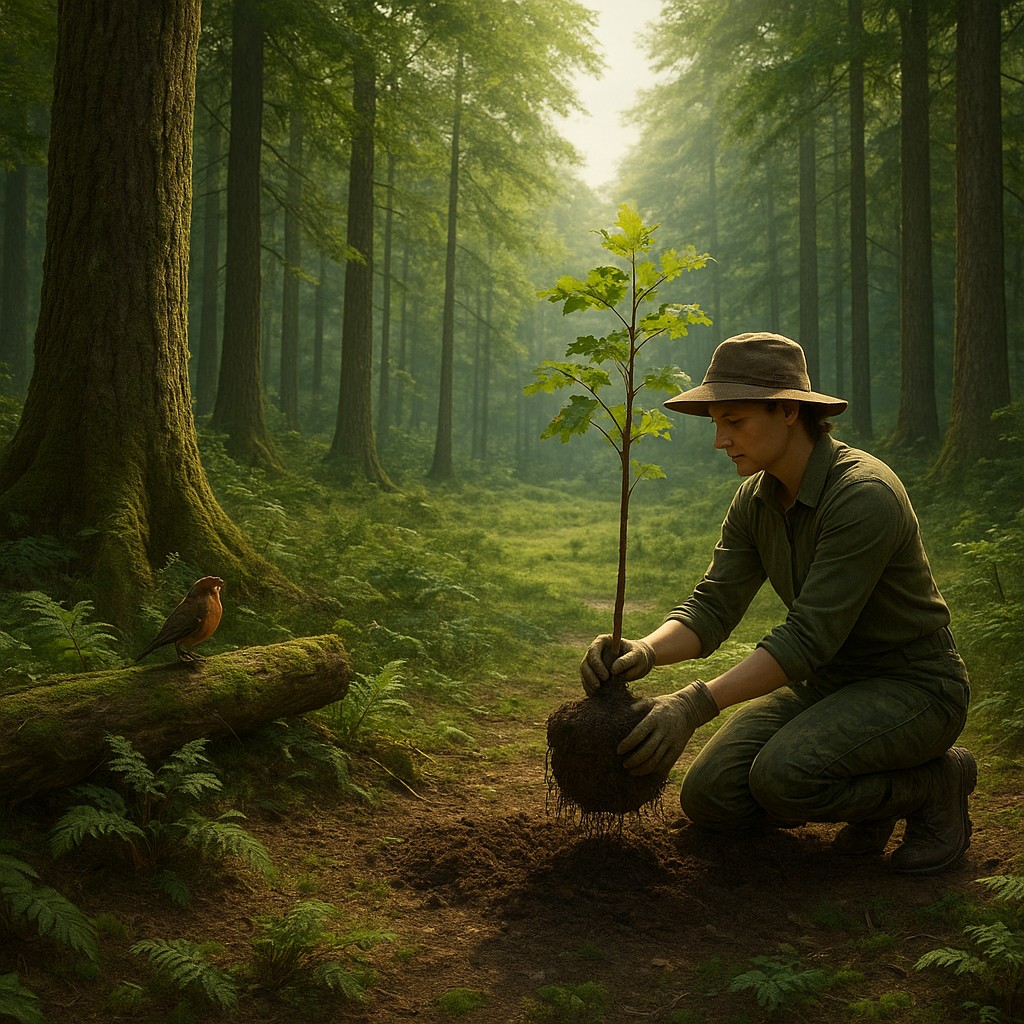
If you stand at the edge of a temperate forest today, you are looking at a community of giants that seem timeless. In reality, they are trapped in a silent, agonizingly slow race. For thousands of years, trees have moved in rhythm with the climate, inching across continents as ice ages retreated and warmth returned. This migration happens through the humble seed, carried by a gust of wind or tucked into the cheek of a forgetful squirrel. However, the geographic "sweet spot" where a sugar maple or a ponderosa pine can thrive is currently sprinting toward the poles at a speed that biology simply cannot match. While a warming atmosphere moves the goalposts by kilometers every year, a heavy-seeded oak might only "migrate" a few hundred meters in an entire generation.
This gap has created a phenomenon scientists call "dispersal lag." It is a state of ecological limbo where trees are stranded in heat they weren't built for, while the hospitable, cooler lands to the north remain empty. If left to their own devices, many of these foundational species face local extinction. They will leave behind "ghost forests" that can no longer support the birds, fungi, and insects that rely on them. To bridge this gap, a bold and controversial group of botanists and foresters has decided to stop waiting for the squirrels. They are becoming the primary agents of transport, physically uprooting seedlings from southern latitudes and planting them in northern frontiers. This is the world of assisted migration, a calculated gamble that redefines what it means to "save" nature in a world where the ground is shifting beneath our feet.
The Mechanics of the Great Green Relocation
To understand why humans are suddenly acting as chauffeurs for the plant kingdom, we have to look at the physical limitations of a tree. Unlike a wolf that can trot fifty miles in a day to find a cooler valley, or a bird that can adjust its flight path in an afternoon, a tree is geographically stubborn. Its only chance to move is the moment a seed leaves the branch. If that seed hits the ground in a patch of earth that is two degrees too hot or ten percent too dry, the family tree stops there. Historically, shifts in global temperature were gradual enough that this "hopscotch" method of movement could keep up. Today, the climate "envelope," the specific set of conditions a species needs to survive, is moving toward the poles and up toward mountain peaks faster than seeds can fly.
Assisted migration serves as a biological shortcut. It is divided into three levels of intervention, each increasing in complexity and risk. The first level involves moving a species within its existing range. This essentially brings "southern" versions of a tree to the northern edge of its current home to boost genetic resilience. The second level, assisted range expansion, moves trees just beyond the border of where they are currently found, nudging them into nearby territory that is just now becoming suitable. The most radical form is species displacement. Here, a tree is moved to an entirely new region far from its historical home because that distant land is predicted to be its only hope for survival in fifty years.
Weighing the Risks of the Ecological Leap
Every time we move a living organism into a territory where it did not evolve, we play a high-stakes game of "What If?" Critics of assisted migration often point to the long history of invasive species as a cautionary tale. When humans brought kudzu to the American South to stop erosion or rabbits to Australia for sport, the results were disastrous because those organisms had no natural checks and balances in their new environments. The fear is that a well-intended introduction today could become the invasive nightmare of tomorrow, outcompeting local plants and turning diverse northern forests into southern monocultures, areas where only one type of tree can grow.
Beyond the trees themselves, there is the "invisible baggage" they carry. Every sapling is its own mobile ecosystem, harboring fungi in its roots, bacteria in its bark, and potentially microscopic diseases that northern trees have never encountered. Introducing a New Mexican pine to an Oregon mountainside might save the pine, but it could accidentally introduce a blight that wipes out local hemlocks. This "Pandora’s Box" element is why the scientific community is locked in a fierce debate. We are forced to choose between the certain loss of doing nothing and the uncertain risk of taking action.
| Strategy Type |
Definition |
Primary Goal |
Risk Level |
| Assisted Population Migration |
Moving seeds within the established range. |
Increasing genetic diversity and heat tolerance. |
Low |
| Assisted Range Expansion |
Moving species just beyond their current border. |
Bypassing dispersal lag into adjacent habitats. |
Moderate |
| Assisted Species Prolocation |
Moving species to far-away, non-native regions. |
Preventing total extinction of a species. |
High |
The End of Static Conservation
For over a century, conservation was based on the idea of the "fortress." We drew lines on maps, called them National Parks, and did our best to keep them frozen in time to protect the specific species living there. Assisted migration shatters this museum-style approach. It suggests that a plot of land is not a static collection of inhabitants, but a dynamic stage where the actors must change for the play to continue. If we insist on keeping "local" trees in a place where the water is disappearing and the heat is rising, we aren't protecting them; we are presiding over their funerals.
This shift requires a new kind of "ecological foresight." Botanists are now using complex computer models to project what the climate of a specific township in Quebec or Minnesota will look like in the year 2080. They then search for a "climate match" in the modern landscapes of Kentucky or Tennessee. It turns forestry into a form of time travel where we plant the forests of the future today. It is a humbling admission that we can no longer protect the wilderness by leaving it alone; instead, we must actively help it migrate to ensure it has a future at all.
Navigating the Ethical Forest
As we take on the role of planetary landscapers, we face deep ethical questions that science alone cannot answer. Who decides which species are "worth" moving? Is a rare, beautiful flowering tree more deserving of a trip north than a plain, scraggly shrub that provides essential food for a specific beetle? There is a danger of human bias entering the process, where we save trees that provide the best timber or the prettiest fall colors while ignoring the complex underbrush that makes a forest function. Our efforts currently focus on "charismatic megaflora," the giants of the woods, but a forest is more than just its tallest members.
Furthermore, there is the question of "ecological integrity." Some argue that by moving species around, we are creating "Franken-forests" that have no historical precedent. This challenges our very definition of what is "natural." If a forest in Canada is made of trees that moved there in the back of a pickup truck, is it still a wild place? Most practitioners argue that a created forest is infinitely better than no forest at all. They see assisted migration not as an attempt to play God, but as a form of "assisted breathing" for an ecosystem that is suffocating under the weight of rapid environmental change.
The realization that trees are migrating via the nursery beds and shovels of scientists is a moving reminder of our current era. It highlights how deeply our actions are connected to the natural world, showing that even the most grounded and ancient organisms are now caught in the wake of human-driven changes. By participating in assisted migration, we aren't just planting trees; we are accepting our responsibility as stewards of a biological heritage that can no longer save itself. As you walk through a forest in the coming decades, look closely at the bark and leaves of the young saplings. You might just be looking at a pioneer that traveled hundreds of miles to keep the canopy alive, a small green passenger on a journey toward a cool, sustainable future.