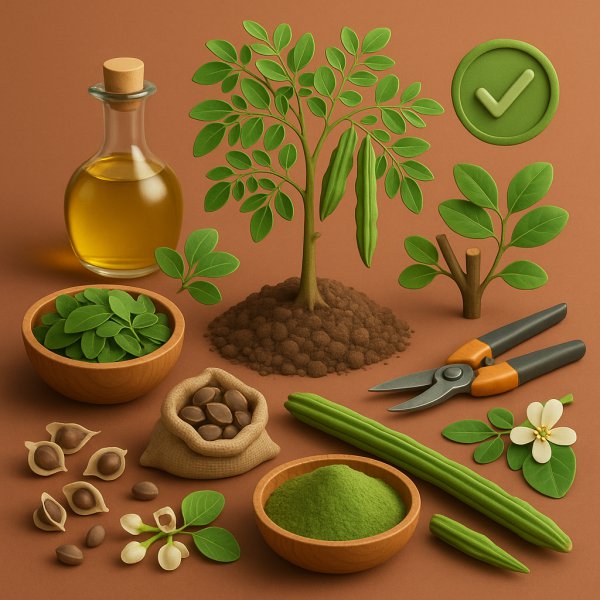
Why the moringa tree feels like a botanical superhero
Imagine a plant that grows from a stick you jab into the ground, that survives heat and drought where other trees wilt, and that offers leaves, pods, seeds, flowers, oil, and even a natural water purifier. That is moringa, often nicknamed the drumstick tree, miracle tree, or tree of life. It is small in stature but enormous in usefulness, turning poor soil into food, turning seeds into clean water, and turning leaves into a nutrient boost that can be dried and stored for months.
People call moringa miraculous for good reasons and for some reasons that are exaggerated. Its leaves are exceptionally nutritious per gram, its seeds produce a stable oil prized in cosmetics and cooking, and communities around the world use it in agroforestry and small-scale businesses. Yet moringa is not a magic cure-all, and sensible understanding helps separate real benefits from hype. This Learning Nib will take you from seed to supper, from chemistry to commerce, so you can appreciate, grow, and use moringa confidently.
By the end you will know how to plant and prune moringa, how and when to harvest each part, what the science actually supports about its health claims, and how to make practical, everyday uses of the tree in the garden, kitchen, and community. Along the way there are quick experiments, safety notes, and reflection questions to help the tree become a meaningful part of your life rather than just another trending superfood.
Meet the moringa family - botany and the species you are most likely to meet
Moringa is a genus of trees in the family Moringaceae, but when people talk about moringa they almost always mean Moringa oleifera. Native to the foothills of the Himalayas, M. oleifera has been spread across tropical and subtropical regions, where it naturalizes easily. It is a fast-growing, deciduous to semi-evergreen tree that can reach 6 to 12 meters when left unpruned, though in cultivation it is often kept shorter for leaf production.
The tree has pale, feathery leaves made up of many small leaflets, long thin pods that are why it is often called the drumstick tree, and clusters of fragrant white flowers. Other species exist, such as Moringa stenopetala and Moringa peregrina, each with localized uses and different tolerances, but M. oleifera is the global workhorse. Its lifecycle and physiology give it resilience - deep taproots for drought survival and nitrogen-friendly behavior in many farming systems - making it excellent for food security projects and dryland agroforestry.
Where moringa thrives and what it tolerates
Moringa prefers warm climates with a pronounced dry season and does best in tropical and subtropical zones. It grows quickly in full sun and tolerates a range of soils, though it prefers well-draining sandy or loam soils with a neutral to slightly acidic pH. Poor soils do not stop moringa from growing, but excessively waterlogged conditions cause root rot and reduced vigor. Temperature tolerance ranges broadly, but young trees can be damaged below about 5 degrees Celsius, while established trees tolerate light, brief chills.
Drought tolerance is one of moringa’s defining characteristics. The tree sheds leaves in prolonged dry periods and resprouts vigorously once moisture returns. Because it grows fast and recovers quickly after pruning or harvesting, moringa is ideal for farmers who need rapid biomass, shade, or edible leaves between longer-term crops. However, in frost-prone or cold regions, moringa is best grown in containers and moved indoors or treated as an annual.
How to establish moringa - step-by-step planting and propagation
Propagating moringa is simple and forgiving, which is why it spreads so easily. The two common methods are direct seeding and vegetative propagation from cuttings. Seeding is easy: plant fresh seeds about 2 centimeters deep, spaced about 3 to 5 meters apart for full-grown trees or closer if you plan coppicing for leaf harvest. Germination occurs in 1 to 2 weeks under warm conditions. Planting from seed yields genetic diversity, which can be good for resilience.
Cuttings, typically hardwood or semi-hardwood pieces 1 to 2 meters long and 3 to 5 centimeters thick, root readily and produce trees that begin yielding earlier than seed-grown trees. Cuttings give you a clone of the parent tree, so desirable traits like disease resistance or pod quality are preserved. Use well-draining soil mixes and provide regular water until rooted. For container growers, a mix of potting soil and sand improves drainage and supports root development.
Caring for your moringa tree - practical tips for thriving growth
Moringa needs sun, light pruning, and occasional feeding to maintain productivity. Young plants benefit from regular watering to establish deep roots, but once established moringa needs much less irrigation than many other crops. Mulching around the base helps conserve moisture and moderates soil temperature. Fertilize lightly with compost or balanced organic fertilizer to encourage leafy growth if soil fertility is low; moringa is not a heavy feeder but appreciates organic matter.
Pruning is part science and part art: frequent light harvests of the top growth encourage a bushier form and higher leaf yields, while removing dead or crossing branches maintains airflow and reduces disease risk. If you want long, straight trunks for poles or timber, prune only to shape a single leader. If your goal is leaf and pod production, create multiple stems by cutting the main shoot at 50 to 100 centimeters above the ground after the tree reaches usable height.
Pests, diseases, and common problems - what to watch for and how to respond
Moringa is relatively pest-resistant but not immune. Common pests include caterpillars, aphids, whiteflies, and spider mites, especially during dry dusty periods. Use integrated pest management: encourage natural predators like ladybugs, spray with water to dislodge soft-bodied insects, and apply neem oil or soap sprays in severe cases. Seed and stem borers can be an issue in some regions, so crop rotation and healthy pruning reduce the problem.
Diseases are often linked to poor drainage or overcrowding. Root rot from waterlogged soils and fungal leaf spots in humid climates are the most frequent diseases. Improve drainage, thin dense plantings for better air circulation, and remove infected material promptly. Because moringa is fast-growing, timely pruning and good hygiene usually keep disease at bay.
Harvesting and using every part - a compact guide for food, medicine, and water
Every part of moringa has a use, but each part needs different timing and handling. Leaves are best harvested when young and tender, usually by pinching or cutting off new growth. Pods are harvested when green and tender for cooking, or left to dry for seed harvest. Seeds are collected from mature dried pods and can be eaten, pressed for oil, or ground for water purification. Flowers are edible and used in teas and fritters, while roots, bark, and seeds have traditional medicinal uses that require caution.
Below is a quick-reference table to summarize what parts do and how they are used.
| Part of moringa |
Typical uses |
Key nutrients or compounds |
Preparation and storage |
Cautions |
| Leaves |
Fresh salads, cooked greens, powders for supplements |
High in vitamin A, C, calcium, iron, protein, antioxidants |
Blanch and dry for powder; store dried in airtight containers |
Generally safe; high doses can affect thyroid medication and blood sugar |
| Pods (drumsticks) |
Curries, soups, steamed vegetables |
Vitamin C, fiber, some protein |
Use fresh or blanch and freeze; pick when tender |
Stringy when old; avoid overripe pods |
| Seeds |
Snacking when roasted, oil production, water purification |
Oil rich in oleic acid, seed proteins for flocculation |
Dry mature pods before shelling; cold-press or roast |
Raw seeds in very large amounts may cause digestive upset |
| Flowers |
Tea, fried fritters, edible garnish |
Flavonoids, nectar for bees |
Pick fresh; use immediately or dry |
Possible pollen allergies in sensitive people |
| Roots and bark |
Traditional remedies |
Pungent compounds similar to horseradish |
Use cautiously; not commonly consumed |
Roots contain potentially toxic compounds at high doses; avoid in pregnancy |
Nutrition and health - separating robust science from hopeful hype
Moringa leaves are nutrient-dense for their weight, containing significant vitamin A precursors, vitamin C, calcium, iron, potassium, and bioavailable protein. This makes them valuable in diets where micronutrient deficiencies are common. Clinical research shows moringa leaf powder can modestly reduce blood sugar and cholesterol in some studies, and its antioxidant compounds have beneficial effects in laboratory and small human trials.
However, claims that moringa cures major diseases or functions as a panacea are not supported by conclusive evidence. While moringa has pharmacologically active compounds, effectiveness varies with part used, dose, and preparation. Root extracts can be toxic and have been traditionally used for strong medicinal effects, so the safest public health approach is to use leaves and seeds with caution and avoid high-dose therapeutic claims without medical supervision. Pregnant and breastfeeding women should consult healthcare providers before using concentrated moringa products.
How moringa seeds can clean water - a simple household method
One of moringa’s most interesting non-food uses is as a natural flocculant to clarify turbid water. Crushed moringa seed powder contains positively charged proteins that bind negatively charged particles and pathogens, helping them settle out. A basic household method looks like this: dry mature seeds, remove hulls, grind the kernels to a fine powder, add a small amount to turbid water, stir vigorously for a minute, then slowly stir for ten minutes and allow it to settle for about an hour, after which the clearer water on top can be decanted.
This method reduces turbidity and some microbes but does not reliably remove viruses or chemical contaminants, so where water safety is critical, combine moringa treatment with boiling or filtration. It is a low-cost, biodegradable option for improving water clarity and reducing bacterial load in many resource-limited settings.
From garden to market - small-business and sustainability opportunities
Moringa’s rapid growth and multiple products make it attractive for small farmers and entrepreneurs. Value-added products include dried leaf powder, teas, culinary powders, oil (ben oil), cosmetic products, and water purification kits. Processing leaf powder requires simple equipment: a dehydrator or solar dryer, grinder, sieves, and airtight packaging. Oil extraction needs more investment for presses. Cooperatives and community drying centers help maintain quality and market volumes.
Sustainability is realistic when production uses local labor, appropriate technology, and market analysis. Quality control matters: aflatoxin from improper drying, variable nutrient labeling, and inconsistent dosages are common pitfalls that reduce market credibility. Think like a seasoned small-business owner: start small, test local demand, and reinvest profits in improved processing and training.
Common myths, and how to think critically about moringa claims
Myth 1: Moringa cures all diseases. Reality: It has beneficial nutrients and some therapeutic properties, but it is not a universal cure. Myth 2: If something is natural, it is always safe. Reality: Roots and concentrated extracts can have harmful effects; dose and context matter. Myth 3: More is better. Reality: Excessive intake of any potent plant compound can produce adverse effects and interfere with medications.
When you see dramatic health claims, ask for specifics: What part of the tree? What dose? Was the evidence from a human clinical trial or just a lab study? The more specific and rigorous the evidence, the more reliable the claim.
Practical ways to taste, use, and preserve moringa at home
Start simple and build familiarity. Fresh leaves are excellent in salads or stirred into soups at the end of cooking. Drying leaves into powder is a high-impact preservation technique that concentrates nutrition and extends shelf life for months. Dry leaves gently at low temperature, avoid direct scorching sun, grind to a fine powder, and store in airtight, opaque containers away from heat.
A few everyday ideas: add a teaspoon of moringa powder to smoothies, sprinkle leaves into omelets, steam pods like green beans, brew flowers into tea, or roast seeds as a snack. For communities, trial a household water treatment combining moringa seed powder with a final boiling step. Remember to introduce small quantities into diets and monitor for tolerance.
Troubleshooting and troubleshooting recipes - practical care tips and experiments
If your moringa grows leggy with long bare trunks, that often means it is not being pruned or is shaded. Cut the main shoot to encourage branching and harvest regularly to promote a bushier habit. Yellowing lower leaves can indicate nutrient deficiency or overwatering; check drainage and add compost. For pest surges, increase beneficial habitat by planting pollinator-friendly flowers and avoid broad-spectrum insecticides.
Try a simple experiment to understand leaf processing: harvest a small batch of leaves, blanch half and dry, dry the other half without blanching, then compare color, aroma, and taste after grinding. Blanching often improves color and reduces bitterness, but drying raw preserves more heat-sensitive nutrients. Observing differences helps you decide which method suits your taste and nutrient goals.
Reflection questions to deepen understanding and personal application
- In what ways could moringa address a specific nutritional or environmental need in your household or community?
- Which part of the moringa tree appeals most to you - leaves for nutrition, seeds for oil and water treatment, or pods for cooking - and why?
- What constraints would you face in growing or processing moringa locally, and what small steps could you take to overcome them?
Spend a few minutes answering these questions and jot down a simple two-week plan to incorporate moringa into a meal or start a seedling. Turning curiosity into concrete steps is how knowledge becomes habit.
A safe and inspiring closing nudge
Moringa is one of those plants that rewards curiosity and sensible experimentation. It offers real nutritional, environmental, and economic value without requiring flashy technology. If you live where it grows, try planting a single seed or cutting this season and harvest a handful of leaves to taste. If you are a gardener in a cooler climate, buy a small tree for a patio pot and treat it as an exotic annual.
Approach moringa with a mix of wonder and critical thinking: celebrate its abilities, respect its limits, and let practical experience teach you the rhythms of planting, pruning, and harvesting. If you give moringa a place in your garden or community thoughtfully, it will likely repay you with shade, food, and a surprisingly deep well of stories to tell.