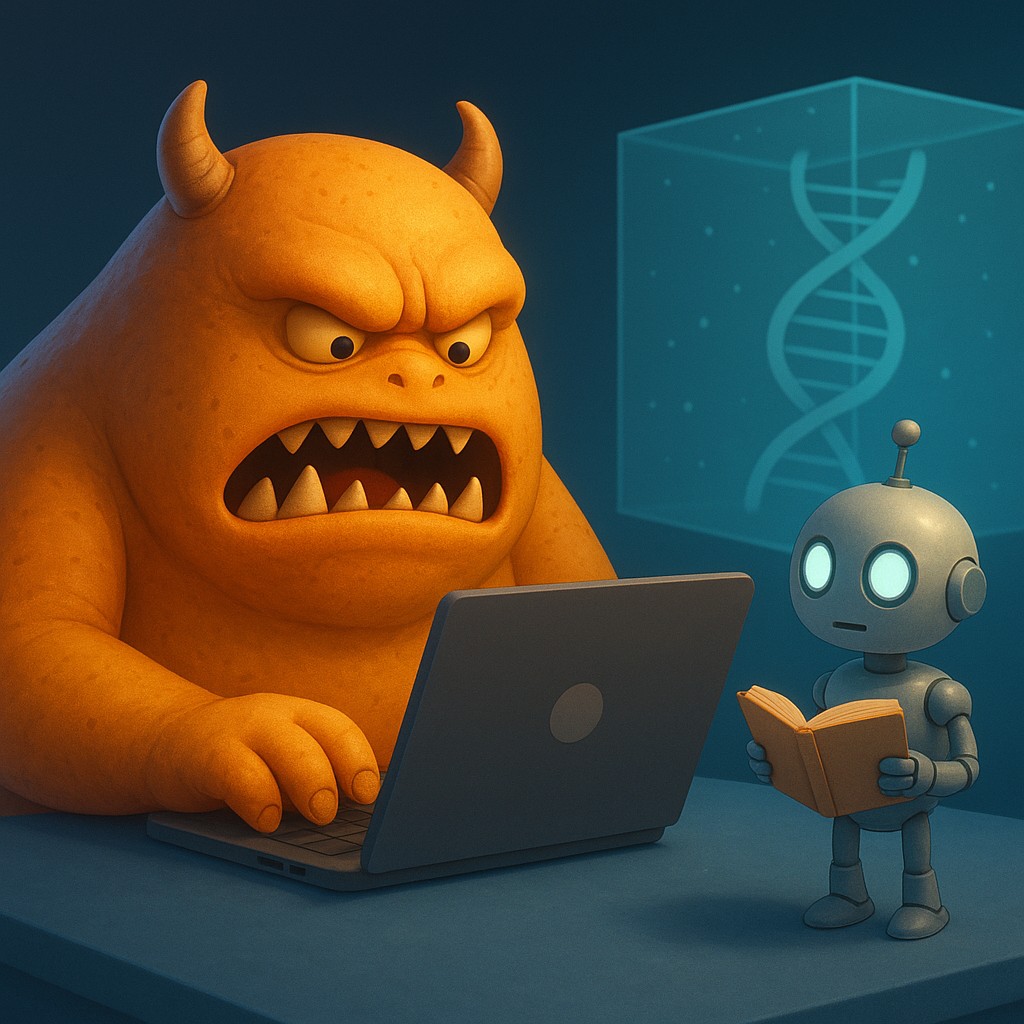
For the past several decades, we have treated the internet like an all-you-can-eat buffet for artificial intelligence. Every blog post about sourdough starters, every heated debate on a message board, and every carefully edited Wikipedia entry has served as fuel for the world’s most powerful Large Language Models. We assumed the food would never run out because humans are naturally talkative, and we leave digital footprints at a staggering pace. However, the world of AI development is facing a quiet realization: we are reaching the bottom of the bowl. The supply of high-quality, human-written text is finite, and the appetite of modern AI is growing faster than our collective ability to write new books and articles.
This digital scarcity has forced researchers to pivot from being "gatherers" to "farmers." Instead of scouring the web for scraps of human leftovers, they are now using the most advanced AI models to grow their own training material. This is known as "synthetic data." While it might sound like a legal loophole or a sci-fi paradox, it is quickly becoming the foundation of next-generation intelligence. By asking a powerhouse model to write a textbook, solve a complex logic puzzle, or explain a mathematical proof, developers create "perfect" examples for smaller, faster models to study. It is a shift away from the messy, repetitive chaos of the open web and toward the structured, logical precision of a digital laboratory.
The Hungry Beast and the Emptying Larder
To understand why we are switching to synthetic data, we have to look at the sheer scale of the appetite involved. Training a cutting-edge model, like those developed by Google, OpenAI, or Meta, requires trillions of words. For perspective, the entire contents of Wikipedia make up only a tiny fraction of a modern model's training set. In the early days, researchers simply scraped the "Common Crawl," a massive archive of nearly everything on the public web. This worked well for a while, giving models a basic grasp of human language, culture, and facts. But the web is also full of noise, toxic comments, repetitive spam, and poorly written instructions that actually make models less reliable.
Current estimates suggest that we might exhaust the entire stock of high-quality, public human text as early as 2026 or 2028. We are entering a phase where simply throwing "more" data at a model no longer works because there is no more data left that is worth reading. If you feed a student nothing but random social media comments, they might learn how to speak, but they won't learn how to solve calculus or write a professional legal brief. The industry is moving from a "quantity" mindset to one of "quality," focusing on data with high informational density, such as structured reasoning, step-by-step logic, and technical documentation.
Distillation and the Art of the Digital Tutor
One of the most effective ways to use synthetic data is through a process known as distillation. Think of this like the relationship between a university professor and a student. The professor (a massive, expensive, and slow AI model) is prompted to explain a complex concept in great detail. The student (a smaller, nimbler, and cheaper AI model) watches that explanation and tries to mimic the logic. Because the professor model has already "digested" the messy internet, it can produce a purified version of that knowledge. The resulting "synthetic" textbook is often more educational than a random collection of human-written web pages because it cuts the fluff and focuses entirely on core principles.
Microsoft researchers recently demonstrated this with a model called phi-1. Instead of feeding it the entire internet, they gave it a relatively small dataset of "textbook quality" data, some of which was written by other AI models. The results were surprising: the tiny model outperformed systems ten times its size in coding and logic tasks. This proved that a small model trained on high-quality, synthetic "brain food" could be smarter than a giant model raised on internet "junk food." This shift allows us to build AI that fits on a phone or laptop while maintaining the reasoning abilities of a massive server farm.
| Feature |
Human-Generated Web Data |
Synthetic Training Data |
| Availability |
Becoming scarce; near exhaustion. |
Theoretically infinite. |
| Cleanliness |
High noise, typos, and formatting errors. |
Highly structured and error-free. |
| Diversity |
Reflects every human bias and quirk. |
Can be narrow or repetitive if not varied. |
| Cost |
High cost to scrape, clean, and filter. |
High computational cost to generate. |
| Logic Density |
Low; buried in conversational fluff. |
High; focused on the "Chain of Thought." |
The Chain of Thought and the Logic Factory
When humans write, we often skip steps. If I explain how to make a sandwich, I might omit the part about opening the bread bag because I assume you already know how. This "hidden knowledge" is a nightmare for training an AI. Synthetic data allows researchers to force the AI to show its work, a technique called "Chain of Thought" (CoT). When a large model generates synthetic data, it is instructed to write out every single logical step it takes to reach a conclusion. This creates a trail of breadcrumbs for the junior model to follow. It isn't just learning the answer; it is learning the architecture of the thought process itself.
This method is particularly powerful in mathematics and computer programming. If you asked a human to write 10,000 unique Python coding exercises with perfect solutions, it would take years and cost a fortune. An advanced AI can generate those same exercises in an afternoon. These synthetic lessons can be tailored to be slightly harder than what the model currently knows, pushing the boundaries of its intelligence in a controlled environment. We are effectively building digital logic factories that churn out perfect examples of reasoning to sharpen the minds of future AI systems.
The Looming Shadow of Model Collapse
However, this feedback loop comes with a significant risk that researchers call "model collapse." Imagine a group of people playing a game of Telephone. The first person whispers a sentence to the second, the second to the third, and so on. By the tenth person, the original message is usually unrecognizable. If an AI is trained primarily on data generated by another AI, rather than "real" reality, it can start to lose touch with the nuances of the world. Small structural errors or biases in the first model get amplified in the second. By the fifth generation, the model might start producing gibberish or inventing facts with absolute confidence.
To avoid this, researchers must be extremely careful to "ground" synthetic data. They cannot simply let an AI talk to itself in a dark room. Most successful synthetic data pipelines involve a "human in the loop" or a verification system. For example, if an AI generates a math problem and an answer, a separate piece of software, such as a calculator or a code executor, checks the math before it is allowed into the training set. This creates a filter that prevents the "echo chamber" effect, ensuring the model learns from the truth rather than from convincing-looking nonsense.
Finding Balance in a Post-Human Data World
We are currently in a transition period where the percentage of synthetic data in training sets is climbing rapidly. In some specific fields, such as privacy-protected medical records or specialized chemical engineering, human data is almost impossible to acquire in bulk. In these cases, synthetic data isn't just a workaround; it is a necessity. It allows researchers to create realistic, anonymous data that follows the patterns of physics or biology without violating anyone's privacy or waiting decades for new experiments.
The future of AI will likely be a hybrid. We will continue to use the unique, creative, and often unpredictable spark of human writing to provide a foundation of "soul" and cultural context. But we will use synthetic data to build the "muscles" of logic, mathematics, and technical precision. This partnership between human creativity and machine logic will allow AI to continue evolving even after the last high-quality book has been scanned. We aren't just teaching machines to read our history; we are teaching them to help us write the textbooks of the future.
As we move forward, the challenge shifts from finding data to curating it. The role of the AI researcher is becoming less like a librarian and more like an editor-in-chief, deciding which synthetic concepts are worth keeping and which are just digital noise. This evolution represents a profound moment in our history: for the first time, we are creating the very tools that will teach our tools how to think. It is a dizzying, recursive journey into the heart of intelligence, proving that even when we run out of words, our curiosity finds a way to generate more.